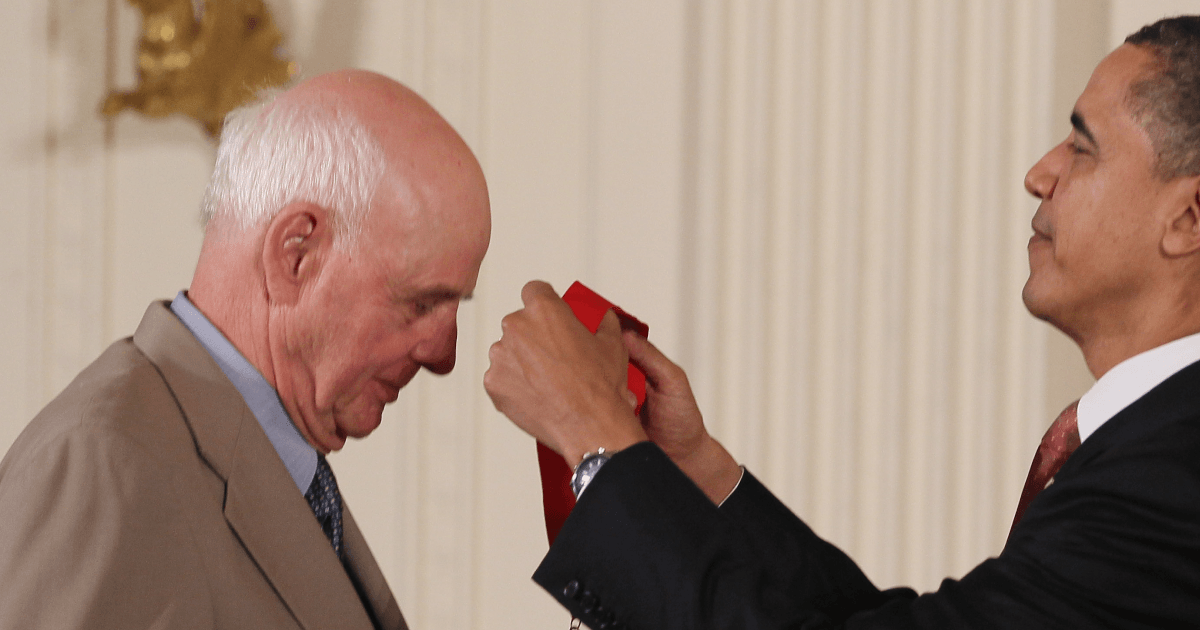

Wendell Berry, the novelist, poet, essayist and farmer, died on August 31, 2026, at his home in Port Royal, Kentucky. He was 92. Berry spent much of his long career defending precisely the things modern life teaches us to leave behind: place, inherited obligations and the local community. Having left Kentucky for an academic career that took him to Stanford and New York, he returned to his home county in the 1960s and spent the rest of his life farming and writing there.
I became acquainted with Berry’s work this year through his book Hannah Coulter. His passing felt like an appropriate occasion to reflect on a theme that book highlighted to me: what exactly do we mean when we talk about freedom and choice? Berry understood that escaping one set of limits does not make us limitless. Very often it merely exchanges limits we have inherited for limits we have chosen – and the latter are not necessarily better.

That question is particularly present in Hannah Coulter. Her children escaped the world of the Coulter farm through higher education, which opened a world much larger and much colder than the one they had previously known. It is hard to say by the end that a single one of her children was better off for having gone to university. In one sense, the story of Hannah Coulter is an isolated event, a mother wondering whether she failed to pass on fully what she herself had been given. In another, she is symptomatic of a generation who felt that an individual’s social advancement was paramount.
She encouraged her children to make new choices, but those choices brought different kinds of limitations. They were free to make the choices of college-educated men and women, but they were increasingly no longer free to be content as farmers. Education had enlarged the number of things they could do, while simultaneously changing the kind of life they could imagine themselves choosing.
Choice – an idea in whose service millions leap to the defence of the indefensible: the slaughter of the unborn, the voluntary suicide of the hopeless, the abandonment of God. There is an irony in making an idol out of choice, namely that any choice we make is itself a new limitation. We sacrifice every other choice we might have made by making this one.
That is why it is silly to worship choice. It would be understandable if the idol were not choice simply, but the correct choice. It makes no sense to treat the ability to go right or left as sacrosanct, if to the right is our destination and to the left a precipice. We do not hold the man who drives off the precipice in high esteem and say, “That man had choice.” We recognise that such a choice is rather its abuse than its fulfilment.
Chesterton puts this very succinctly:
All the will-worshippers, from Nietzsche to Mr Davidson, are really quite empty of volition. They cannot will, they can hardly wish. And if any one wants a proof of this, it can be found quite easily. It can be found in this fact: that they always talk of will as something that expands and breaks out. But it is quite the opposite. Every act of will is an act of self-limitation. To desire action is to desire limitation. In that sense every act is an act of self-sacrifice. When you choose anything, you reject everything else.
It is up to us to make the choices that fence us into the right limits. Marriage limits us. Children limit us. Fidelity to a place, a people and a religion limits us. But those limitations are less like the bars of a cage and more like a picture frame – inside those limits is where beauty resides. The alternative is just another collection of limits – imposed by career, appetite, geography or social pressure.
The more challenging matter that Wendell Berry raises in Hannah Coulter, though, is to what extent we ought to give our children better options than we might have had. The first issue, of course, is determining whether those options really are better. If by better we mean that they lead to a higher socio-economic rung, then they may well be worth considering – but that advancement must be weighed against the new limits that making such a choice will create.
This is where Hannah’s regret becomes much more interesting than a simple lament for the disappearance of the family farm:
We wanted them to have all the education they needed or wanted, and yet hovering over that thought always was the possibility that once they were educated they would go away, which, as it turned out, they did. We owed them that choice, and we gave it to them, and it might be hard to argue that we were wrong. But I wonder now, and I wonder it many a time, if the other choice, the choice of coming home, might not have been made clearer.
Hannah and Nathan simply accepted that further education was good for their children. One path was presented as advancement; the other risked appearing as failure to advance. Even if the children were technically free to come home, surely returning must have seemed like regression. In the end, their farm would pass to someone else, and Hannah’s children were left childless or divorced.
How sadly Berry’s narrative accords with reality. Our character is formed through habits, relationships and environments. University is one of those circumstances when all three are changed at once. A similar danger lies behind all choices that can upend our formation.
JD Vance, reflecting in Communion on losing his own faith after leaving home, describes something remarkably similar:
Many Christian thinkers are troubled by cases like mine. “Why,” they wonder, “do our young people abandon the faith?” […] I’m more persuaded by other explanations, like the inertia of modern life. People leave home and acquire new daily routines, and the habits of old – like reading the Bible and actively participating in a faith community – evaporate. Many young Christians who fall away from the Church do so at this critical juncture between childhood and adulthood.
A young man does not necessarily sit down one afternoon and “choose” to abandon Christianity. He chooses a university, a city, a profession and a group of friends. Each choice, great and small, constitutes his new manner of life. He acquires new habits and loses old ones. Choices beget similar choices.
We must remember that choice, like a good vehicle, exists to get you somewhere. What is paramount is that we have the right end in mind. Ultimately, the mistake most men make is in seeing their lives as ends in themselves – as if every good thing that we ever experience is to find its terminus in us. This is wrong, and it is the very soul of ingratitude.
The simple truth of man is that he is a gift – first given to his parents, subsequently given to himself when he is old enough to be aware of it, and finally to be rendered as gift in turn to others. We are given so as to be given away. Choice is given to man so that he might freely choose self-gift, a fitting sacrifice.
If we want to raise a generation of Catholics who will combat this culture effectively, we must free them to make the right choices. We must be wary who we give their formation to. We ourselves must be ever mindful of whom we surround ourselves with – whose habits we mimic and opinions we value. Likewise, we must recognise that choice exists for our self-gift, not as a good in itself.
Wendell Berry understood that making the “right decision” is not as simple as getting a prestigious degree or career. It is about setting up the limits that will lead to our flourishing – the health and wellbeing of our families and our souls. There is no life without limits. The task is to choose the limits that make us free for the things worth choosing.


.png)