

There’s a scene early in The Mission that I’ve never forgotten: Fr Gabriel climbs above the falls and walks alone into Guaraní territory. Carrying no weapon, he sits down, takes out an oboe and begins to play. The tribesmen emerge from the trees, unsure whether to kill him or listen. It is one of the great images of missionary courage put on film: a priest entering the unknown armed with nothing but an oboe and the conviction that Christ had sent him.
I saw it as a boy, and it made me want to become a Jesuit – not just a priest, specifically a Jesuit. Black robes, discipline, adventure, a readiness to go wherever needed: this was Catholicism at its most heroic. I didn’t become one, for what it’s worth, despite attending a Jesuit school, though the pull of it never quite left.
The Mission isn’t a documentary, and the real history of the Jesuit reductions was messier than Hollywood could tell – but messy isn’t the same as false. Jesuits really did learn local languages, set up schools, map unknown territory, protect indigenous peoples from slave traders and preach the Gospel across continents. By their suppression in 1773, they were running hundreds of schools under a common curriculum, the Ratio Studiorum.
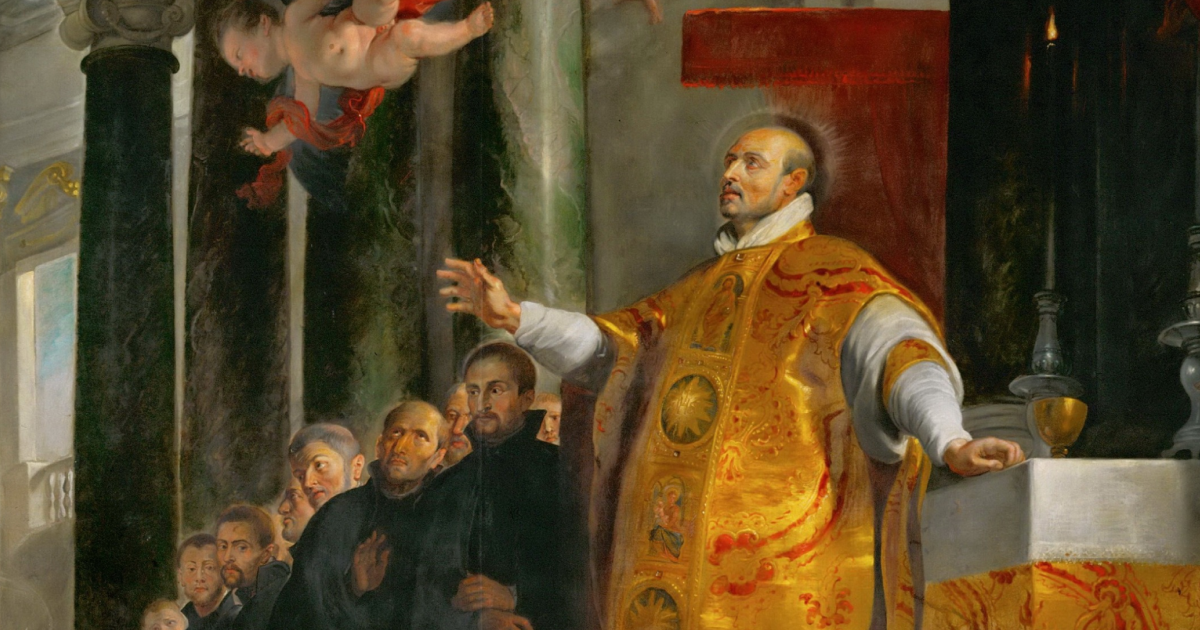
That was the point of Ignatius’s design: a mobile, disciplined body of men who could be sent wherever the Church needed them. He founded the Society in 1540, a former soldier himself, and it kept something of the barracks about it – men serving beneath the standard of Christ, bound by a special vow of obedience to the pope regarding missions.
Say the word “Jesuit” today, though, and the reaction is rather different: an eye-roll, perhaps, or the assumption that whatever follows will sound like something straight out of a progressive newspaper. Jesuits these days often seem more confident discussing climate policy and migration or organising “LGBT+ Masses” – such as the one at Farm Street – than defending anything so unfashionable as Catholic doctrine. Fairly or not, an order once synonymous with missionary zeal now calls to mind sophisticated reasons why the Church should stop insisting on whatever the modern world dislikes.
That is not fair to every Jesuit. The Society still has faithful priests, brave missionaries and serious scholars genuinely formed by the Spiritual Exercises. Nor should its concern with this world be treated as a post-conciliar corruption, because Jesuits have always been “worldly”, in the older and better sense. Ignatius did not bind them to the choral recitation of the Divine Office, leaving them free to preach, teach and tend the sick. The founding formula put the progress of souls in Christian life and doctrine first, but also named reconciliation, care for prisoners and the sick and works of charity for the glory of God and the common good.
Their schools were intended to form not only priests but magistrates, officials and upright citizens. Jesuit concern for education, social assistance and the common good did not begin under Pedro Arrupe; it was there from the beginning. In the reductions portrayed by The Mission, evangelisation, education and protection of the weak were held together and ordered towards God. The trouble was not that Jesuits began caring about justice or the world, but that justice stopped being read through the Faith, while the Faith came to be read through whatever “justice” meant in a given decade.
There is a reason that the word “Jesuitical” has the connotation that it does. As with many things, the turn is usually dated to the years after Vatican II. Pedro Arrupe became superior general in 1965 and set out to refound the Society’s mission for the modern age; by 1975, the 32nd General Congregation had defined it as “the service of faith and the promotion of justice”. There is nothing wrong with the phrase. The Gospel has always had social consequences, and Jesuits who stood with the poor under violent regimes sometimes paid with their lives. The danger lay in what the phrase was allowed to become.
Treat justice as a category of its own, cut loose from theology, and its content will be supplied by whatever happens to be in the air. In the 1970s that often meant Marxist theories of class and liberation; today it is more likely to mean the managerial progressivism found in any large university, charity or NGO. Christianity simply ends up supplying sacred language for what is, at bottom, a secular political agenda.
The election of Pope Francis, the first Jesuit pope, might have been expected to correct some of this. Here at last was a son of Ignatius on the throne of Peter, with an obvious missionary instinct and a real concern for those at the margins. Yet his pontificate also displayed some of the modern Society’s characteristic weaknesses. “Discernment” and “accompaniment” became favourite words, especially after Amoris Laetitia, but too often the opening of a process seemed to replace a clear answer. His teaching on climate change and migration was emphatic, while Catholics attached to the older liturgy discovered through Traditionis Custodes that pastoral flexibility had definite limits. Progressive experiments were to be accompanied patiently; tradition was to be managed and contained.
Francis did not cause the Society’s condition, which had taken shape long before his election; his pontificate was more a culmination than a cause. A Jesuit had finally become pope, and habits already familiar from Jesuit universities and magazines became visible across the Church: confidence in reading the signs of the times, a preference for gesture over definition and the danger that flexibility would be extended mainly in one direction.
The old-school Jesuit learned Chinese astronomy or Guaraní grammar to preach Christ more effectively. His modern successor sometimes appears to study the latest political vocabulary in order to explain why preaching Christ too plainly would be insensitive. “Finding God in all things” quietly turns into affirming all things as they are, and the frontier becomes wherever fashionable opinion is most hostile to Catholic teaching – the Jesuit arriving there not to challenge it, but to be liked by it.
This is why it’s so disappointing, really. The Jesuits were never just another religious order; they were the pope’s own men, put through years of formation and sent on the hardest missions going. Precisely because they were so capable, their failures land harder. A dull parish newsletter can only do so much damage, whereas a brilliant Jesuit with a university chair can reshape how an entire generation thinks about God.
The old Society does not deserve romanticising either. Its history contains vanity, intrigue and compromise alongside genius and martyrdom, and The Mission gives us a cleaned-up version of events. Yet legends survive because something true lies beneath them. Those priests really did cross oceans, enter forests, learn unfamiliar languages and risk death because they believed the peoples they met needed Christ, while also possessing a dignity that slavers and colonial officials refused to recognise. Preaching the Gospel and defending the oppressed were not separate causes; the second grew out of the first.
That is the order which needs recovering. Jesuits do not have to abandon the poor, retreat into the library or turn their backs on the modern world; they need only remember why Ignatius sent them into it.
On the feast of St Ignatius, it is worth remembering that the Society has returned from disaster before. It was thrown out of kingdoms, suppressed by a pope and restored four decades later. Renewal is not impossible, and the remedy is already present in its spiritual inheritance: the Exercises, the meditation on the Two Standards, the choice of poverty with Christ over honour with the world and the total surrender of the Suscipe.
I don’t believe I was wrong to be moved when, as a boy, I watched Fr Gabriel climb that waterfall. The heroism on screen was not invented from nothing. The Society of Jesus really did produce men like that, and can do so again, if it remembers what it actually wants: to convert the world.