

A Sudanese asylum seeker appeared in Belfast Magistrates’ Court on Wednesday charged with attempted murder after an attack on a local man that triggered the worst civil disorder Northern Ireland has seen in several years, drawing condemnation from political leaders and the Irish Catholic Bishops’ Conference, which was meeting in Maynooth as the violence erupted.
Hadi Alodid, 30, was filmed attempting to decapitate Stephen Ogilvie, a disabled man in his forties, with a kitchen knife on the evening of June 8 in the Kinnaird Avenue area of north Belfast. Alodid had stabbed Ogilvie in the eyes, and he remains in hospital with life-threatening injuries. Members of the public confronted the suspect before police arrived; one man fought him off with a hurling stick. When Alodid appeared in court on Wednesday, it emerged that Ogilvie had lost his left eye. Alodid was remanded in custody. The Home Office confirmed he was a Sudanese refugee with a legal residence permit valid until 2028, having arrived via Paris and Dublin in 2023.
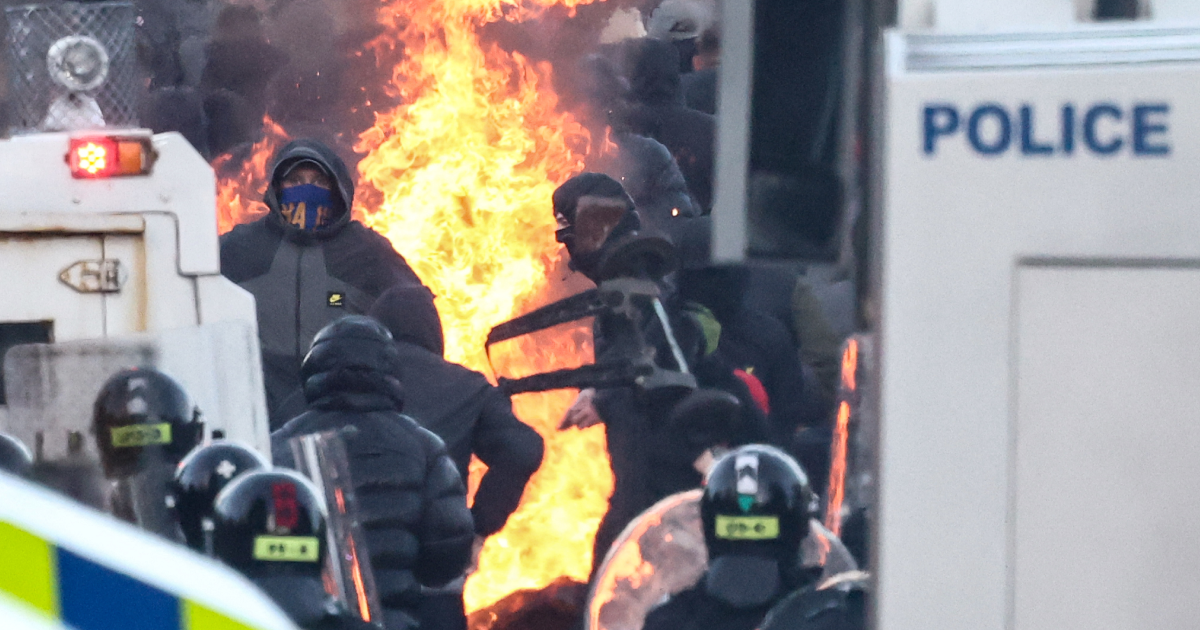
Footage of the attack circulated widely online on June 9, and by that evening disorder had broken out across Belfast and spread to other towns. The Northern Ireland Fire and Rescue Service responded to 62 incidents between 7pm and midnight. At least three houses, a Middle Eastern supermarket, a bus and numerous vehicles were set ablaze. A police car was set on fire in Portadown and a Turkish barber shop was attacked in Ballyclare. Protests spread to Glasgow, Edinburgh and Southampton, where tensions had already been running high following the killing of local student Henry Nowak.
Prime Minister Keir Starmer described the stabbing as “sickening” and said he had “absolutely no tolerance for abhorrent scenes of violence like this on our streets”. First Minister Michelle O’Neill called the riots “outright thuggery”, saying: “Groups of masked men burning families out of their homes is nothing less than disgusting cowardice. This has nothing to do with community.” PSNI Chief Constable Jon Boutcher warned that “people are incited by people who are faceless and know nothing about this brilliant, vibrant place”.
The Irish Catholic Bishops’ Conference addressed the unrest directly in its Maynooth statement. “Bishops expressed concern at the attack on human life and the wider violence and social disorder that has taken place in Belfast and in some other places across Northern Ireland over the last 48 hours,” it read. “Reports that the focus of these violent attacks was family homes and businesses of migrants is all the more disconcerting. The true measure of a just society is one which effectively welcomes newcomers, combats racism and rejects divisive political rhetoric. Bishops call for support for the police and for community leaders throughout the summer months.” Bishop Alan McGuckian SJ of Down and Connor, whose diocese encompasses Belfast, separately condemned the rioting as “utterly wrong” and said the scenes must not be repeated.
The disorder carried an unusual political dimension beyond the familiar loyalist-nationalist divide. Reporting from the Newtownards Road on the night, UnHerd’s Aris Roussinos noted that the attack had taken place in a Catholic, nationalist area of north Belfast, and that the symbolism of the attacker being confronted with a hurling stick was quickly taken up by new Irish Republican factions set against mass migration. The Irish Republican Socialist Party warned against the silencing of “legitimate working-class concerns about immigration” within “communities who, with zero consultation, have never seen such demographic shifts in their lifetime”. Roussinos observed that grumblings against mass migration from working-class Catholics were “entirely absent from their community’s social media and journalistic commentators” – a gap, he suggested, that newer republican factions are moving to fill.
The riots were supported by both Protestant and Catholic groups who increasingly put aside their historical enmity. Earlier in June, Protestant (Church of Ireland) Archbishop John McDowell asserted that “racism” is becoming “the new form of sectarianism” – asserting that a Christian’s attitude to migrants is a “touchstone” of faith.
The riots follow a pattern now recurring annually: Northern Ireland saw prolonged disorder last June following an alleged sexual assault in Ballymena, and was affected by violence after the Southport stabbings in 2024. The 2026 disturbances arrive as the province enters the loyalist marching season, and several unionist politicians have called for a review of arrangements under the Common Travel Area, noting that the suspect had entered Northern Ireland from the Irish Republic.