
When I was a parish priest, the local state primary school would sometimes bring children to visit the church. One of the things I discovered quite quickly was that Christianity was taught alongside other faiths, and this integration involved focusing on various festivals from different religions. For Christianity, the key focus was on Christmas and Easter. Thus, the children could look at the statue of Mary and Jesus and knew who they were. Similarly, they could look at a crucifix and tell me that this was Jesus and that he died on a cross, although the Resurrection did not seem to figure in the story.
But, and it is a big but, because they had learned of the birth and the Passion as separate stories, and although they knew the central character was called Jesus, they did not realise that it was the same person.
I suspect that many in our society keep the events of the Nativity and of Holy Week quite separate in their minds, even if they are aware that it is the same Jesus. Ultimately, however, they cannot be separated. It is a Saviour who has been born for us, the one who is the Word made flesh, who will die and rise to redeem our fallen humanity and open for us the gates of heaven. As we keep the Christmas Octave, the Church sets this remarkable Good News before us.
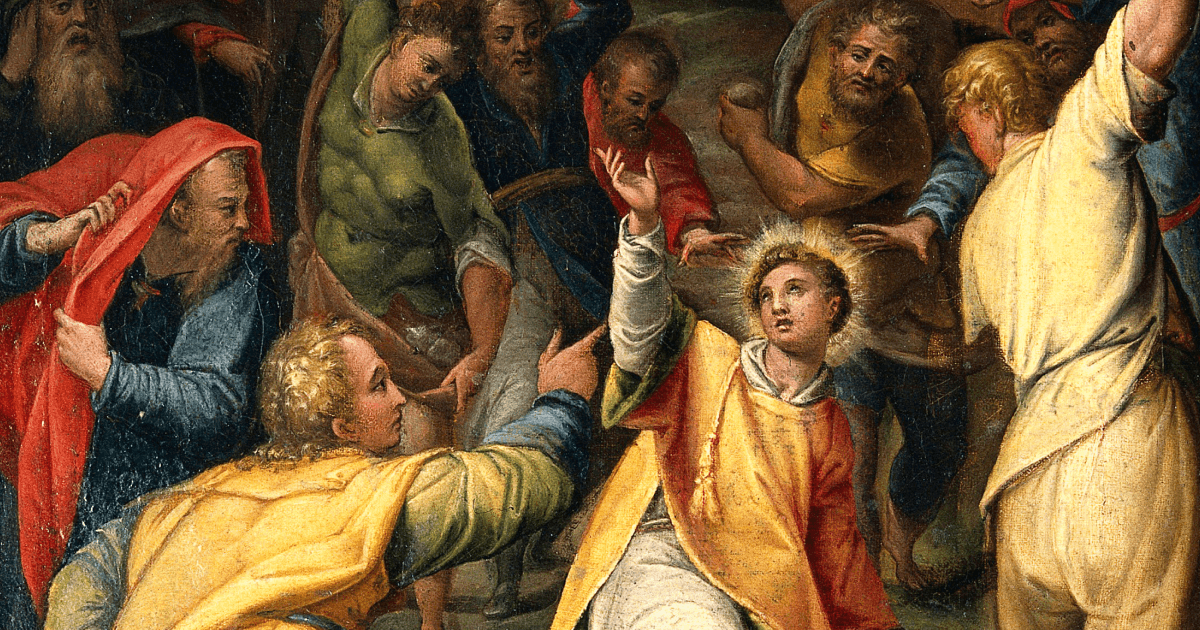
In these days of Christmas, we celebrate the feasts of martyrs: Stephen on the 26th, the Holy Innocents on the 28th, and St Thomas of Canterbury on the 29th. Today is the Feast of St Stephen. Stephen was one of the original seven deacons and the first Christian martyr. We hear his story in Chapters 6 and 7 of the Acts of the Apostles. Stephen upsets the leaders by doing great wonders and signs among the people. They bring forward false witnesses and accuse him of threatening the destruction of holy places and subverting the customs of Moses.
Stephen’s response beautifully recalls how God has acted in history and the wilful rejection of God’s will by his people. Now, says Stephen, those persecuting the Church share in that guilt. They have rejected Jesus and seek to prevent the spread of the Gospel. Stephen’s hearers are enraged, but he sees a vision of heaven and declares: “Behold, I see the heavens opened, and the Son of Man standing at the right hand of God.” They seize Stephen and stone him to death.
The gift we receive at Christmas is Jesus, and we can only truly appreciate that gift if we appreciate who he is. We do not simply celebrate a sweet tale of the birth of a baby in Bethlehem. Rather, we celebrate the birth of the Word, who was made flesh and dwelt among us. Christmas is empty except for the marvellous fact that this is the one who comes among us as man and who is God’s decisive act in the redemption of mankind. The one who is born in that stable and who dies on the cross is the one who has risen and ascended into heaven.
On this Feast of St Stephen, let us look to the crib and say, “O come, let us adore him,” and, at the same time, with Stephen, let us look up to heaven, where the same Jesus, the Son of Man, is standing at the right hand of God.