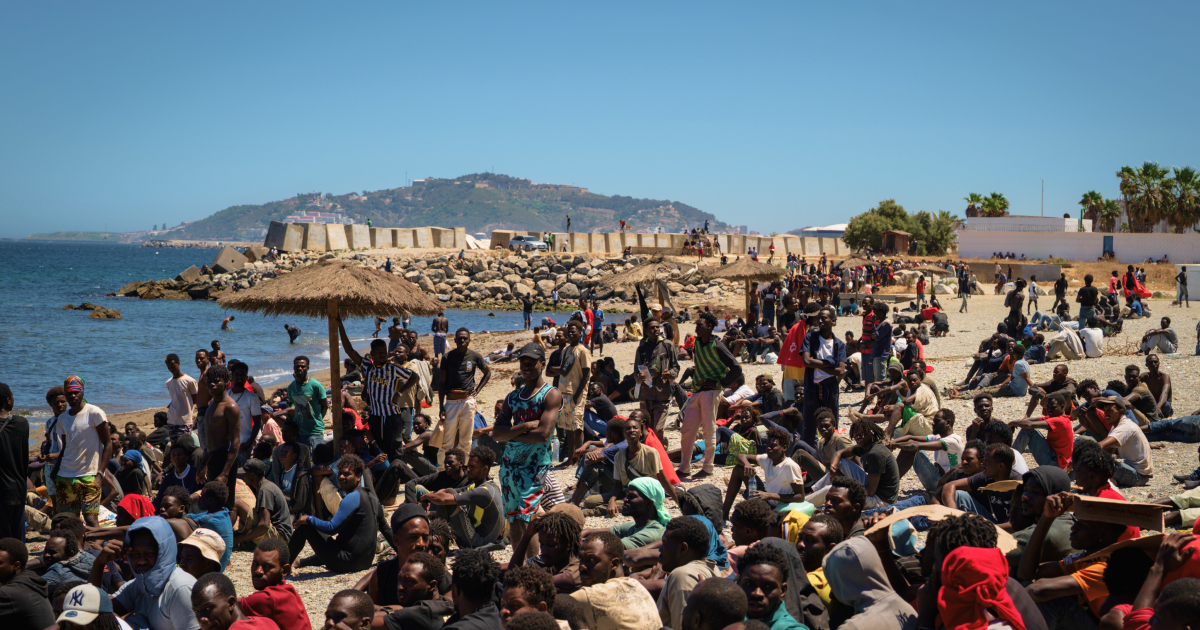


The scenes from Ceuta last week should shame every European capital. Tens of thousands of young men from Morocco, sub-Saharan Africa and possibly further afield surged across the border into Spain’s North African enclave by land and sea. Some swam; some scaled fences and breakwaters. Dozens died in the crush and the water. The tiny territory of roughly 85,000 residents was overwhelmed. Reception centres collapsed. Beaches filled with exhausted people. Then, within days, the great majority returned or were returned to Morocco.
What remains is a residual crisis, political recriminations and the sickening knowledge that this will happen again unless we change course. In one Reuters interview, I watched one man, Mujaheed Ahmed from Sudan, speak clearly and in English. He was not Moroccan. He said he would rather die than return to Sudan. He framed return as a violation of his human rights because he would not be safe. He was articulate, determined and risk tolerant: the very profile any country should want. Yet Europe cannot take millions like him. Too many end up dependent on welfare systems already strained by our own citizens. The irony is sharp: Sudan needs men of his calibre far more than Europe does. Every such departure is a loss for the place he fled.
Europe has become the softest touch. The combination of relatively open access, slow processing and easy welfare creates a powerful magnetic pull. Economic migrants and those fleeing genuine danger travel the same routes, often facilitated by traffickers who exploit both desperation and our legal frameworks. The result is chaos at the frontier, resentment in host communities and the hollowing out of the very societies these people leave behind.
There is a better way. European countries, Great Britain included, should establish secure safe havens adjacent to, or preferably inside, countries of origin such as Sudan and others generating large outflows. These would be places of genuine protection where people at risk of death or persecution could find shelter, food, medical care and order until conditions allowed return or orderly resettlement. Security would be provided by European and possibly other allied armed forces. We already pay for those forces. If they are not effectively securing our own borders, they can usefully help create and protect zones of safety nearer the source of the problem.
This must be done in conjunction with much tighter border controls. Europe’s external frontiers – Ceuta, Melilla, the Mediterranean, Russia, the East and the English Channel – require physical barriers, rapid interception and consistent enforcement. Processing of those who do arrive must be swift: genuine refugees identified and protected, and economic migrants and those with no claim returned promptly.
Critically, the “draws” that pull people across continents must be removed as a matter of urgency. Easy and immediate access to welfare, housing and benefits for those who enter irregularly is an invitation. It is not compassion: it is an open door that undermines both social cohesion and the integrity of asylum itself.
Some will cry “neo-colonialism”. That charge is false and lazy. This is humanitarian action of the most practical kind. It does not seize territory for resources or impose governance for our benefit. It creates temporary, protected space so that lives are not lost in the desert, at sea or under the wheels of trucks. It respects the sovereignty of African and Middle Eastern states while offering partnership: European resources and security expertise applied where the need is greatest.
The alternative – the status quo – is the real extraction. We take the young, the energetic and the ambitious and leave behind the weak, the elderly and the warlords. That is a form of predation dressed up as virtue. The costs of the present system fall heavily on European societies: strained housing, welfare budgets, public services, social trust and political polarisation.
Safe havens, properly designed and secured, would be far less costly. They contain the problem closer to its origin, reduce the lethal journeys, foil traffickers and allow Europe to help far larger numbers without importing the scale of demographic and cultural disruption we are currently experiencing. More importantly, they serve the long-term future of the countries these people are leaving. When talent and labour remain or return, when security is stabilised and investment can follow, those societies have a chance to recover. Permanent out-migration of the able-bodied is a slow death for nations already struggling with conflict, governance failure and economic stagnation.
This approach is entirely consistent with Catholic teaching. The Church has always taught the dignity of every human person and the duty to welcome the stranger. “I was a stranger and you welcomed me” (Matthew 25:35) remains binding. Yet Catholic social teaching is not a suicide pact. It includes the rights of nations to regulate their borders, the principle of subsidiarity, the common good of the host community and the obligation to address root causes rather than merely manage symptoms. The Catechism affirms both the right to migrate and the right of states to control immigration for the common good.
True charity does not require Europe to dissolve its own social fabric in order to signal virtue. Pope Leo XIV, in his Angelus address of August 2, spoke with pastoral concern about the alarming situation in Ceuta. He prayed, through the intercession of Our Lady of Africa, for solutions that bring peace, stability and justice. He did not prescribe open borders or the abandonment of European order. He called for solutions.
Establishing protected safe havens, combined with firm and fair border enforcement and the removal of perverse incentives, rises to meet that call. It offers real protection to the vulnerable, reduces deaths at the frontiers and works towards the stability of the regions from which people are fleeing, whether from mortal danger or from economic despair.
We cannot continue to pretend that the current model is either sustainable or Christian. It is neither. It kills people at the borders, burdens European societies beyond endurance and starves countries of origin of the human capital they need to rebuild. Safe havens, secured borders, rapid and honest processing and the end of welfare magnetism form a coherent, humane and realistic policy.
It is the policy of a civilisation that still believes it has something worth preserving and something worth offering the world: not by inviting the world to overwhelm it, but by helping the world’s most desperate people where they actually are. Europe has the resources, the military capacity and the moral tradition to do this. What it has lacked is the will. Ceuta has shown us the cost of that failure. The time for half-measures and pious slogans is over.