

February 12, 2026

Fine art: How David Hockney escaped naturalism

Miguel Cullen
More
No items found.
Related
Min read
share

David Hockney, or David Mockney, for the purposes of this article, is having a show at the Tate Britain. He’s got all he asked for – fame, artistic pre-eminence, glamour – how does someone live with all that? It must be a weight on the soul, as well as a blessing.

To quickly catalogue his oeuvre, he began his career in the late 1950s, at the Royal College of Art, doing prints (one of his last three major exhibitions in London was of his printmaking at Dulwich Picture Gallery), Alan Davie-inspired abstracts, and self-avowed “gay propaganda” works of playful self-discovery. In the early 1960s he moved to America (like WH Auden, whom he admired) and became a painter of swimming pools and the cruel nostalgia of summer (The Rooms, Tarzana for instance, of which more anon).
He continued into flat, naturalistic portraits that showed “complex emotional dramas” (as Nanette Aldred put it) that seemed like Picasso’s Neoclassicist style of real life. To escape naturalism he painted the roads south of Santa Monica and Colorado, with a “multi-viewpoint” idea. He moved back to his native east Yorkshire in the 1990s, famously depicting the Wolds in the same way – shown at the Royal Academy in 2012.

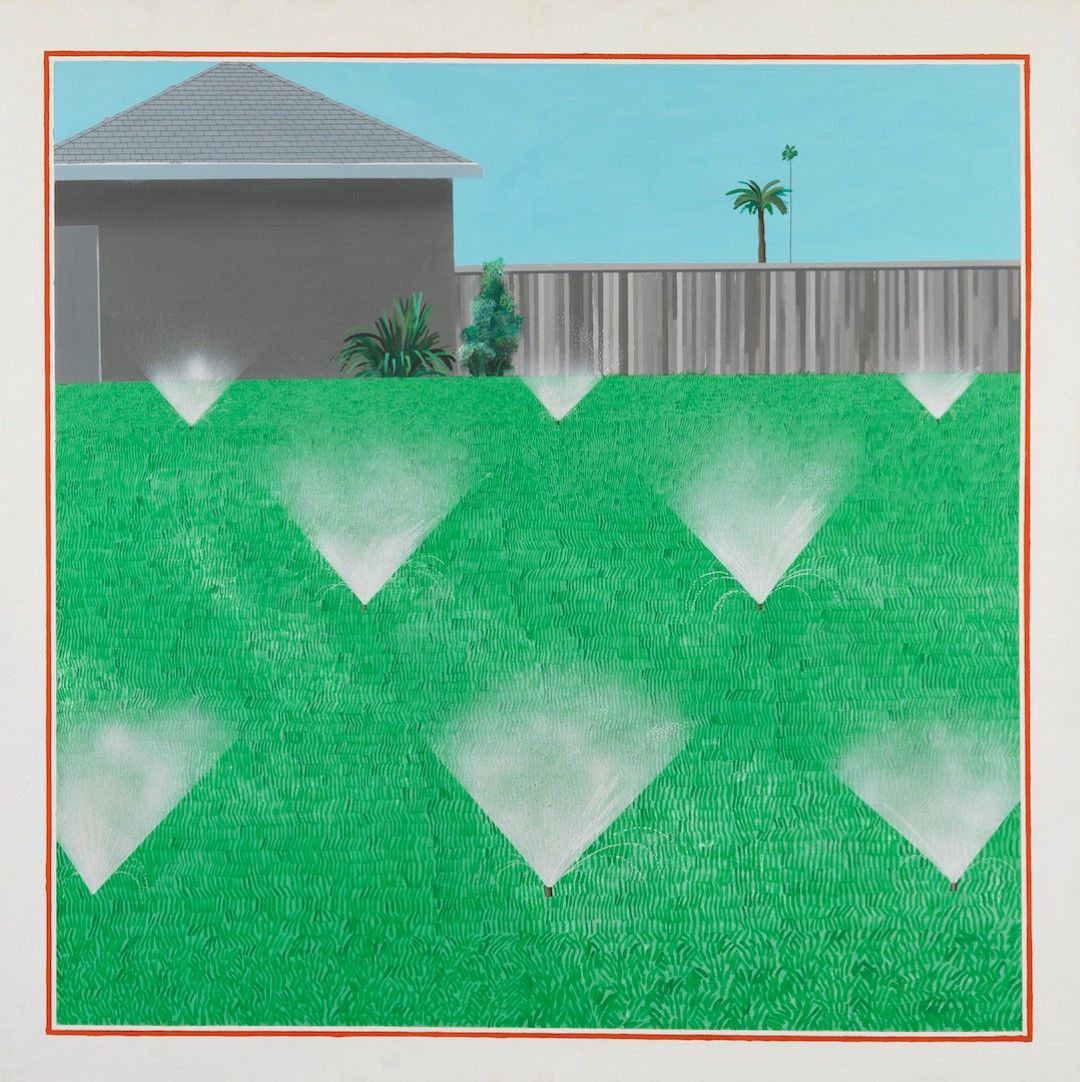
In a time of civil unrest, and premonitory instability, it would seem unwise to salve ourselves with the artificial, acrylic paint of David Hockney. Spectators arrive at the Tate, beleaguered by what is going on around us. We are greeted by a guy who’s a bit of a comedian. Peter Getting out of Nick’s Pool; American Collectors; Domestic Scene, Los Angeles, drawling, matter-of-fact titles, with their hidden catch of shamingness, trap us in their allure and, ironically, beguile us. I must do a (shamed) about-face, and admit that I, unwisely, love the show’s room “Sunbathers”. It transmits, as mentioned earlier, the summer, or, to quote from García Márquez’s One Hundred Years of Solitude: “ bones filling up with foam, a languid fear, and a terrible desire to weep.” Paintings that do this are A Lawn Being Sprinkled, The Rooms, Tarzana and Sunbather.

In other paintings the old David Mockney still haunts us, with his depressingly off-hand, shorthand symbols for things – his genius loci, a diffident capture of the essence of a place or person. Like Andy Warhol, Hockney uses shorthand to “label” scenarios or things. His screwball takes on LA housewives could just as well be “labels”. Warhol also used this, but inserted Pop Art.

De Chirico’s tailor’s dummies, with the symbols he rather laboriously links them with, also come to mind in his big, ugly late 1960s and early 1970s portraits. Anyhow, don’t worry: Mockney hasn’t got the better of all of us. In a recent catalogue of his portrait show at the RA, he notes with regret that Jacob Rothschild didn’t choose to pose for him for longer than one sitting. A humbling experience, no doubt. Back in your box, Mockney!

David Hockney, or David Mockney, for the purposes of this article, is having a show at the Tate Britain. He’s got all he asked for – fame, artistic pre-eminence, glamour – how does someone live with all that? It must be a weight on the soul, as well as a blessing.

To quickly catalogue his oeuvre, he began his career in the late 1950s, at the Royal College of Art, doing prints (one of his last three major exhibitions in London was of his printmaking at Dulwich Picture Gallery), Alan Davie-inspired abstracts, and self-avowed “gay propaganda” works of playful self-discovery. In the early 1960s he moved to America (like WH Auden, whom he admired) and became a painter of swimming pools and the cruel nostalgia of summer (The Rooms, Tarzana for instance, of which more anon).

He continued into flat, naturalistic portraits that showed “complex emotional dramas” (as Nanette Aldred put it) that seemed like Picasso’s Neoclassicist style of real life. To escape naturalism he painted the roads south of Santa Monica and Colorado, with a “multi-viewpoint” idea. He moved back to his native east Yorkshire in the 1990s, famously depicting the Wolds in the same way – shown at the Royal Academy in 2012.

In a time of civil unrest, and premonitory instability, it would seem unwise to salve ourselves with the artificial, acrylic paint of David Hockney. Spectators arrive at the Tate, beleaguered by what is going on around us. We are greeted by a guy who’s a bit of a comedian. Peter Getting out of Nick’s Pool; American Collectors; Domestic Scene, Los Angeles, drawling, matter-of-fact titles, with their hidden catch of shamingness, trap us in their allure and, ironically, beguile us. I must do a (shamed) about-face, and admit that I, unwisely, love the show’s room “Sunbathers”. It transmits, as mentioned earlier, the summer, or, to quote from García Márquez’s One Hundred Years of Solitude: “ bones filling up with foam, a languid fear, and a terrible desire to weep.” Paintings that do this are A Lawn Being Sprinkled, The Rooms, Tarzana and Sunbather.

In other paintings the old David Mockney still haunts us, with his depressingly off-hand, shorthand symbols for things – his genius loci, a diffident capture of the essence of a place or person. Like Andy Warhol, Hockney uses shorthand to “label” scenarios or things. His screwball takes on LA housewives could just as well be “labels”. Warhol also used this, but inserted Pop Art.

De Chirico’s tailor’s dummies, with the symbols he rather laboriously links them with, also come to mind in his big, ugly late 1960s and early 1970s portraits. Anyhow, don’t worry: Mockney hasn’t got the better of all of us. In a recent catalogue of his portrait show at the RA, he notes with regret that Jacob Rothschild didn’t choose to pose for him for longer than one sitting. A humbling experience, no doubt. Back in your box, Mockney!

subscribe to
the catholic herald

Continue reading your article with a subscription.
Read 5 articles with our free plan.
Subscribe

subscribe to the catholic herald today

Our best content is exclusively available to our subscribers. Subscribe today and gain instant access to expert analysis, in-depth articles, and thought-provoking insights—anytime, anywhere. Don’t miss out on the conversations that matter most.
Subscribe