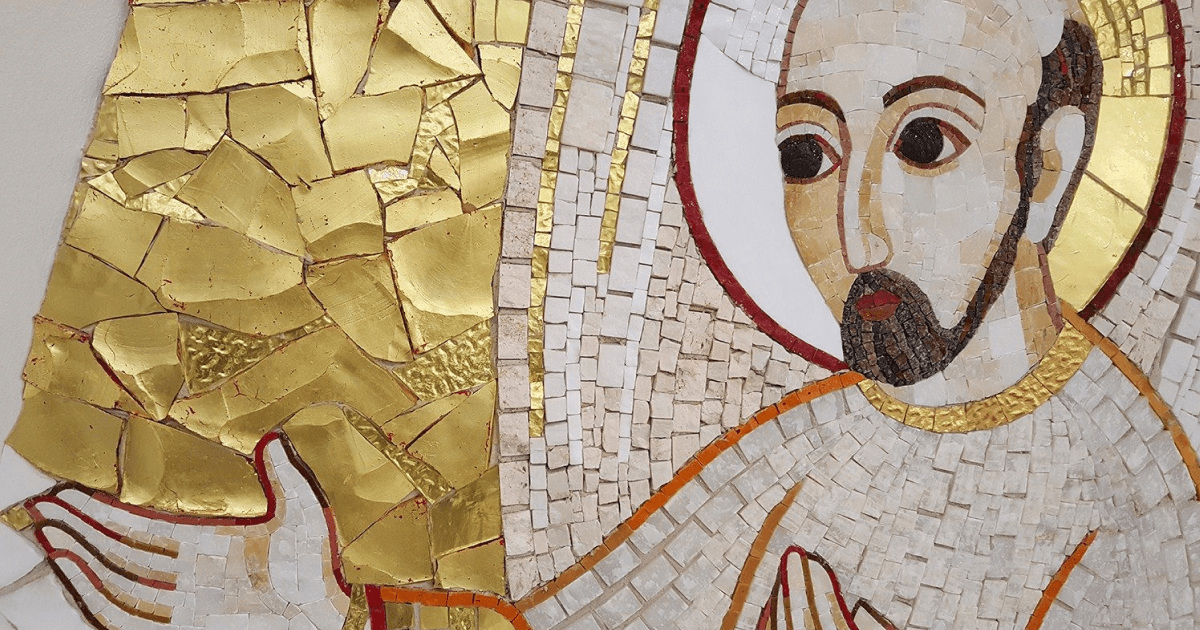
You may never have heard of Marko Rupnik until the allegations against him became public, but you have almost certainly seen his work. The same enormous eyes, crooked mouths and flattened faces appear at Lourdes, Fatima, Padre Pio’s shrine, Ta’ Pinu in Gozo and churches across the world. They appear inside the Vatican itself, most prominently in the Redemptoris Mater Chapel of the Apostolic Palace.
By the beginning of this century, Rupnik’s pseudo-iconography had become something close to the official visual language of institutional Catholicism. His mosaics can reportedly be found in around 200 churches and sacred spaces. The question is not merely how a man now accused by numerous women of grave abuse received so many prestigious commissions: his canonical trial is ongoing, and its outcome should not be prejudged. The prior question is simpler: how did an artist whose work is, at the very best, mediocre become so omnipresent throughout the Church?
Ta’ Pinu offers a good example. The basilica is one of the loveliest churches in the Maltese islands, built from the warm limestone of Gozo and set dramatically against the surrounding countryside. Rupnik’s mosaics cover the walls around the parvis. They look distinctly out of place, as though an international brand had been imposed upon a sanctuary with a character of its own.
Some people genuinely find his work moving, and that’s fine. But taste alone can’t explain success on this scale, not in a Church that has never been short of painters, sculptors and craftsmen.
The turning point was probably the Redemptoris Mater Chapel. In 1996, Pope St John Paul II gave its decoration to Centro Aletti, the atelier Rupnik directed, and the chapel was dedicated in 1999 inside the Apostolic Palace. That commission gave him something worth more than money: he was now the man who’d decorated the Pope’s own chapel. Once the Apostolic Palace had approved him, Fatima was an easy sell, and once Fatima had him, nobody was about to call him an odd choice for Lourdes, Padre Pio’s shrine or Ta’ Pinu: repetition itself started to look like proof of quality.
That’s a familiar pattern in how institutions settle on their taste. A bishop or shrine rector rarely has the time, or the confidence, to weigh up dozens of competing artists. An unknown painter is a risk. An artist Rome had already approved wasn’t, and if anyone objected to the result later, the patron could just point upwards.
Rupnik was also selling more than mosaics. Centro Aletti could decorate huge spaces, coordinate whole teams of craftsmen and produce a full iconographic programme, wrapped in enough theological explanation to answer any doubts before they were even raised.
Artistically, Rupnik gave the modern Church establishment exactly the compromise it wanted. His work is recognisably religious, unlike the abstract shapes and tortured metal that have scarred so many churches built after the war, but it never submits to the actual discipline of iconography, and it never returns to Western naturalism either. It looks as though it could be ancient, though it isn’t. It borrows the vocabulary of Eastern icons without answering to the tradition behind them. And it stays legible in a way a lot of self-consciously modern religious art refuses to be. He was offering a simulacrum of tradition to institutions that were nervous of the real thing.
The sameness across sites likely helped his cause too. A genuinely great artist might have let Lourdes, Padre Pio and Ta’ Pinu shape the work differently, drawing on the history and architecture of each place. Rupnik gave them all the same vocabulary instead, and the result was instantly recognisable, cheap to reproduce and perfect for institutional branding.
There’s no need to reach for a conspiracy here. Fashion, networking, convenience and a general institutional timidity are probably enough on their own. One important patron picks an artist, others copy him, the workshop grows large enough to take on jobs no rival can match, and its dominance quietly turns into proof, in everyone’s mind, that it deserved to dominate.
A few honest questions are still worth asking, though. Were there ever real competitions? What other artists were even considered? Who kept recommending Centro Aletti, and why? What did these commissions actually cost? Did bishops and rectors love the work, or did they just assume they should because people more important than them already seemed to?
This goes beyond questions of taste. Once a man becomes a celebrated priest, theologian and spiritual director as well as an artist, in effect a Catholic brand, criticising him starts to mean criticising the judgement of every institution that put him there. Whether the same network that spread his mosaics also helped cover for the allegations against him is a separate question, one nobody should answer without real evidence. But the culture of prestige and deference that got those mosaics into 200 churches is exactly the kind of culture that would make an accusation against a man like that hard to hear. Someone trusted by popes, cardinals, Jesuits and the custodians of the Church’s greatest shrines was always going to sound more credible than an obscure woman with an unwelcome accusation.
The live question now is whether Rupnik’s mosaics should be removed, covered or left as they are. Before answering it, the Church might sit with an uglier one first: how did they get there in the first place?
Maybe there’s no dramatic answer at all. Just fashion, clerical networking, a papal seal of approval and a reluctance to trust your own eyes. That alone would tell you something worth knowing about how the modern Church actually makes up its mind.