


The consecration of a church is a serious thing. Not for nothing is the anniversary of a cathedral’s consecration held as a feast throughout its diocese. The dedication of the Lateran Basilica is a feast throughout the Latin rite of the Church, while the Eastern rites celebrate the consecration of the Holy Sepulchre on September 13, the eve of the feast of the Holy Cross.
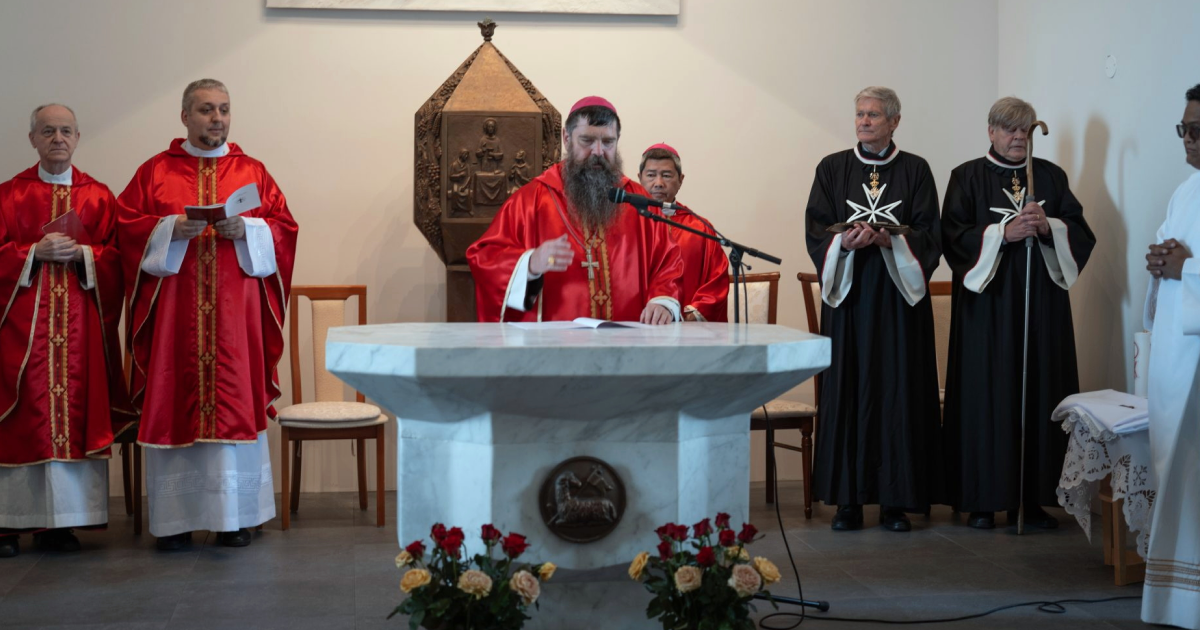
On September 5, some 600 people gathered by the banks of the Ölfusá river in Selfoss – the largest town in southern Iceland – for the consecration of the island nation’s newest parish church. The Church of the Holy Cross serves over a thousand faithful scattered across a large expanse of the country, some of whom previously had to travel long distances to fulfil their Sunday obligation.
The Bishop of Reykjavik, Dávid Tencer, declared that the consecration of Selfoss’s new parish church was not an act of completion: “Our efforts and the financial resources spent would be in vain if it were to end here,” the bishop said. “A mistake! In fact, this is where it all just begins.”
“Someone compared projects similar to ours to a woman knitting that beautiful Icelandic sweater known as lopapeysa,” the Slovak-born Capuchin continued. “If I may use this comparison, I would say that we are truly still only at the very beginning of the knitting endeavour!”
Catholicism in Iceland – a country in varying stages of union with Denmark until 1944 – was not just replaced at the Reformation but violently suppressed and eliminated. The last Catholic bishop in Iceland, Jón Arason of Hólar, was executed in 1550. He had resisted the Danish king’s attempts to impose Lutheranism on the island, raising bands of troops aided by several of his many illegitimate children (all by the same woman, if that’s any consolation).
Arason’s death marked the end of Catholic Iceland, with the Faith only returning in some form when two French priests were sent in 1857 to minister to French fishermen seasonally resident on the island. They set themselves up at Landakot in Reykjavík, where a group of sisters later established a school and a hospital. By the time a vicariate apostolic was erected in Iceland in 1929 – giving it a bishop for the first time since the Reformation – what is now the Cathedral of Christ the King had been built next door. The regular congregation there numbered barely 130 souls.
The most famous Icelandic Catholic of modern times was the children’s writer Jón Sveinsson – better known as ‘Nonni’ – who left the island for France in 1870, converted to Catholicism and ended up as a Jesuit priest. In the past century, the Icelandic polymath Hreinn Líndal – born in 1937 and still going strong – sang as a boy in the Catholic cathedral’s choir, converted while living in Italy in his 30s and has enjoyed a long career as an internationally recognised opera singer, humanitarian worker and former fashion designer. Líndal is one of only eight Knights of Malta who hail from Iceland.
There are now 15,900 Catholics registered in Iceland – four per cent of the country’s total population – but the expansion has been driven more by immigration than by evangelisation. Poles, Filipinos and Lithuanians fill the pews as well as native Icelanders. At Selfoss, the parish priest is from the Philippines, and much of the funding for the new church came from German Catholics. But the Church of the Holy Cross is not a foreign plant dropped into Icelandic soil: the altarpiece takes as its theme the words Ave Crux, spes unica – “Hail, O Cross, our only hope” – and is the work of the Icelandic artist Unnur Guðný María Gunnarsdóttir.
Whenever Catholicism in the Nordic lands is in the news these days, it is usually Norway that steals the limelight, with Bishop Erik Varden emerging as one of the Church’s most distinctive voices and Sigrid Undset now up for canonisation. Across the Nordic countries, ancient Catholic roots are finding new life in communities that are often immigrant in composition but becoming increasingly native in character.
If the dedication of a new parish gives cause for hope in Iceland, it is still part of a very mixed context. The country remains one of the most secular in the world. Earlier in 2026, Fr Jakob Rolland was placed under official investigation by the state after explaining on the radio that Catholics conscious of their own unconfessed grave sins (including homosexual acts) should not receive Holy Communion. There is also the more chilling eugenic aspect that Iceland has “eradicated” Down’s syndrome – by eradicating any unborn baby that is clinically diagnosed with it.
At the same time, the new church at Selfoss shows that the Church in Iceland is no longer just surviving but expanding. Acquiring buildings, forming parishes and putting down roots in the island nation just at the time when its teachings on life, sex and the human person are becoming more alien to the surrounding culture may mark it out as a voice of contradiction in a sometimes conformist country. Whether native or immigrant in origin, sometimes there needs to be a prophetic voice crying out in the wilderness.