



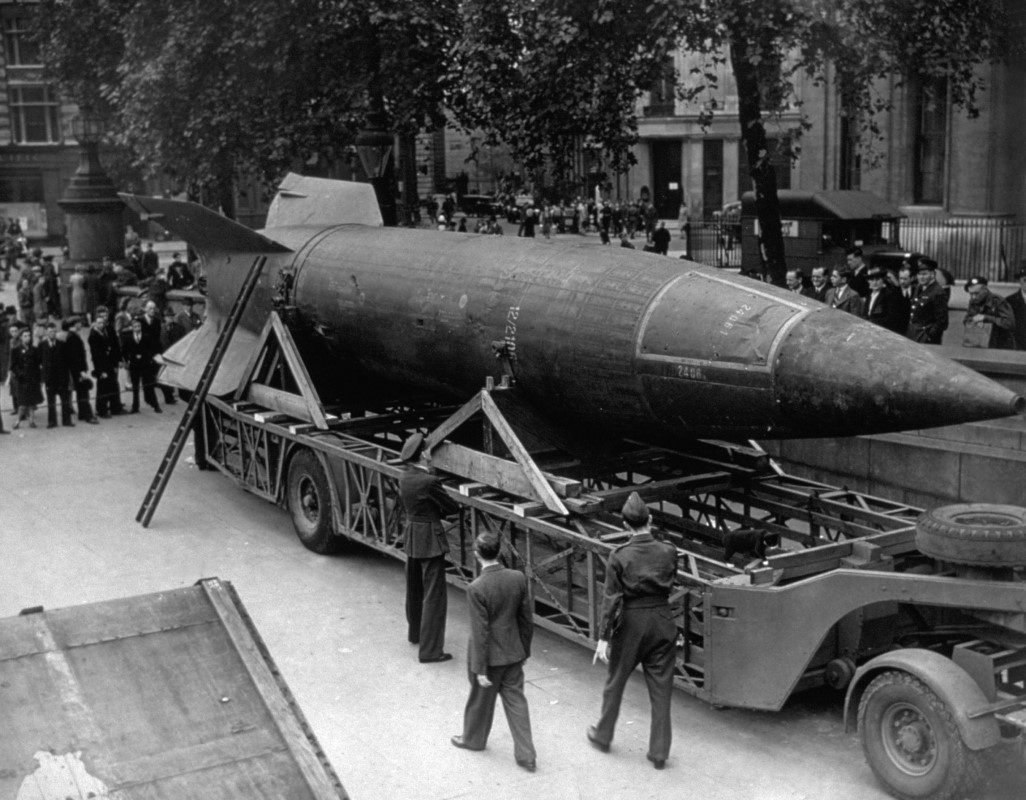
V2 By Robert Harris, Hutchinson, 312pp, £20 Robert Harris’s new novel starts with a bang. A young WAAF called Kay Caton-Walsh is in a flat in Warwick Court, central London, rearranging her smalls after a tumble with her married lover when a V2 bomb lands next door and, wham, blows everything up. The lover, injured, is carted off to hospital; Kay – dusty and shaken but no worse than bruised – puts on her uniform and returns to RAF Medmenham, where her job is to scrutinise aerial reconnaissance photographs in the hopes of figuring out where all these V2 rockets are coming from. Her mission now feels that bit more personal. At the other end of the rocket’s parabola is Harris’s other principal protagonist, a German flight engineer called Rudi Graf. Rudi is supervising the launches of the V2 from a wooded area near the Dutch coast. The rocket is fantastically big and heavy and powerful – it can send a ton of high explosive to the outer atmosphere and back – yet it can be transported by road and, camouflaged, is almost impossible to detect from the air. In the closing months of the war, with the Luftwaffe all but beaten and Hitler’s ground troops losing territory, the V2 is the “vengeance-weapon” with which he hopes to turn the tide. Nobody believes it will do so; and Graf isn’t convinced he even wants it to. His Nazi superiors are beastly, and – as a series of flashbacks and ruminations make clear – he didn’t get into the rocket-launching game for the sake of the Fatherland. Rather, he bobbed along in the slipstream of his charismatic and ambitious old friend Wernher Von Braun. Both of them dreamed of travelling to the moon, primarily, rather than terrorising and maiming civilians. But, at least for Wernher, if the road to outer space is paved with the bodies of civilians (and, for that matter, the use of slave labour in rocket factories), that’s a price worth paying. Rudi’s moral arc in the course of the novel suggests that he, at least, comes to have his doubts. As with all Harris’s historical adventures, the material of a thriller is slickly woven into the matter of history; a fictional card or two slid into the deck of real-life Top Trumps. Harris, in this case, takes longer than usual shuffling the cards – the plot only really gets into gear about halfway through – but you take pleasure in watching him do it. Harris has a deft touch with the workaday furniture of his world: “A day of sorts had dawned, it seemed reluctantly, over straggling suburban fields. Beyond the high chain-link fence, in the grey light, she could make out the shapes of aircraft hangars and a control tower.” He feelingly describes a landscape of bombed buildings, grim knickers, grey skies, mud-blue cars and fish-paste sandwiches. And amid all that drabness, is it any wonder that he has a crush on the V2 rocket? The burst and roar of the launch, the fragile beauty of the contrails, the sound it makes just before it blows you to smithereens. Really, he’s smitten. If anything, by the end of the novel you are rooting for the rocket itself. The Brits hit on the idea of using the mathematics of the parabolic curve to identify the V2’s launch sites. Radar sites in Holland pick up the trajectories of the V2s as they streak into the sky; then as soon as the things land in London, they combine the data to extrapolate back to the launch site. If the site can be identified fast enough, they reason, planes can be scrambled to bomb the rocketeers before they have the chance to pack up their gear. To this end, a crack squad of WAAFs with logarithmic scales and slide rules are dispatched to Holland to do combat algebra – and Kay (that married boyfriend, an Air Commodore, pulls strings) arranges to be among them. Our protagonists, then, circle each other for most of this story without meeting or being aware of each other’s existence. The governing metaphor of that parabolic arc, and of mathematical inferences, is asked to do the job of holding these two stories together. It just about does – or, at least, the two stories chime well enough thematically to feel like a single novel. Will Kay and her slide rule figure out what Graf is up to in time to blow him up? Will Graf figure out what Kay is up to in time, perhaps, to blow her up? I can say in all truth that this is the most gripping book I’ve ever read that contains the equation y = ax2+bx+c.
1:00 AM
By the end of Robert Harris’s V2, you are rooting for the rocket
Sam Leith

4 min read



Already a subscriber? Sign in
5freearticles every month
Continue reading with a free account. No card needed.
- Five free articles every thirty days, on any device you sign in on
- The Catholic Herald newsletter, every morning
- Subscribe whenever you like for everything: every article and the magazine


subscribe to the catholic herald today
Our best content is exclusively available to our subscribers. Subscribe today and gain instant access to expert analysis, in-depth articles, and thought-provoking insights—anytime, anywhere. Don’t miss out on the conversations that matter most.
Subscribe



