

- Xavier Rynne II
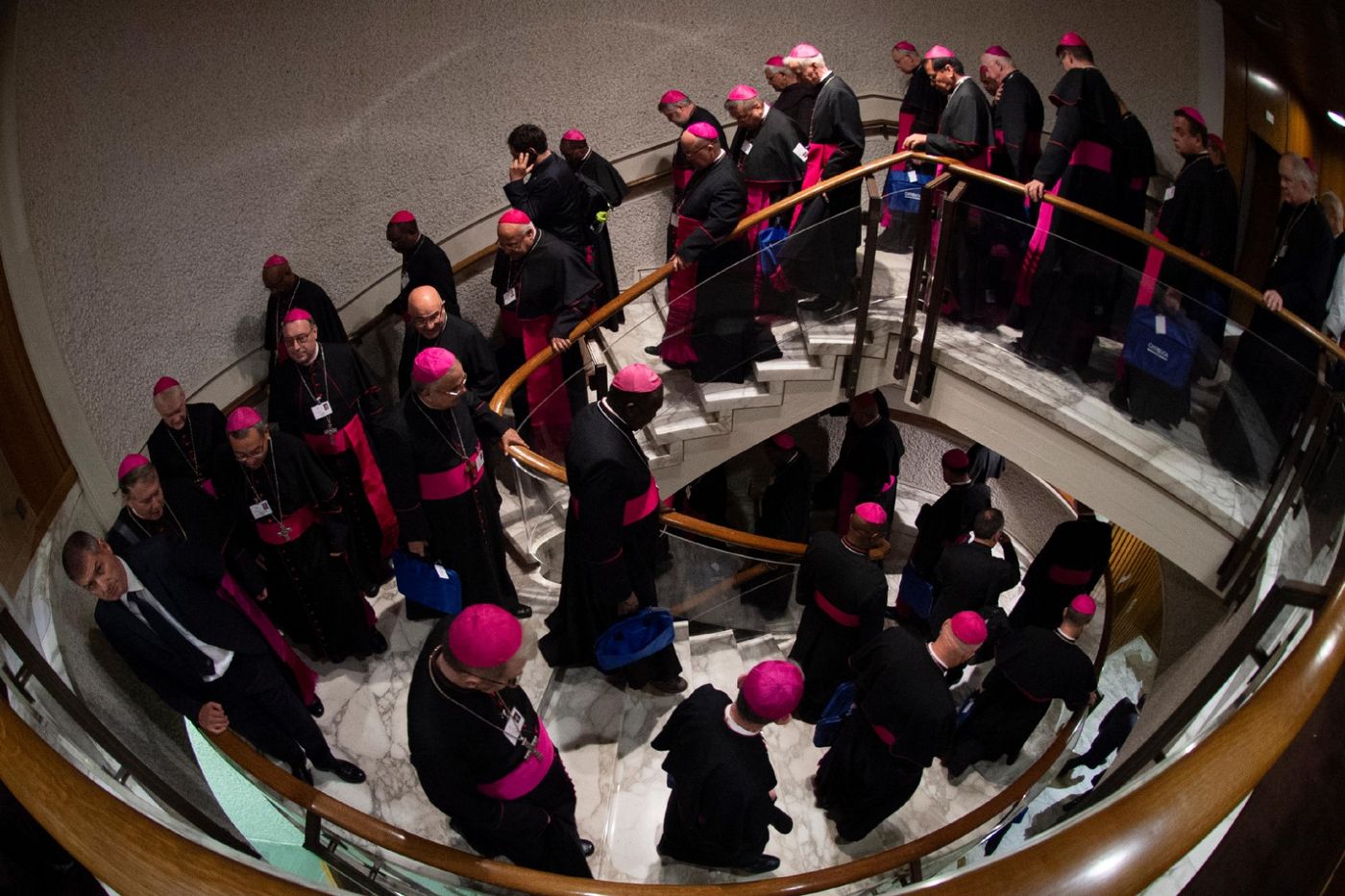
TESTIMONIES FOR THE SYNODLetters from the Synod-2018 has invited Catholics with a variety of experiences in living the synodal theme, “Youth, the Faith, and Vocational Discernment,” to share those experiences with our global audience and with the Synod fathers and auditors. Today’s reflection was written by Katrina Gallic, a graduate of the University of Mary in Bismarck, North Dakota, who lives in Washington, D.C. and works for the March for Life Education and Defense Fund.Standing on the stage on January 27, 2017, looking out at the seemingly endless crowd, the full weight of what was about to happen struck me. As I gazed over their heads at the Washington Monument, I realized I was seconds away from hearing my voice amplified to every person in the crowd. As the student speaker at the March for Life, I knew at that moment I was not only representing my university and my classmates. I was speaking for the millions who could have been our classmates, our teammates, and our friends, but whose lives were snatched from them. What I once thought was someone else’s battle, was in fact very much my own. A few years before I spoke at the March for Life, Nancy Keenan, then-president of NARAL Pro-Choice America, witnessed March participants outside her Washington office. In a media interview soon afterwards she commented, “They are so young. There are so many of them, and they are so young.” She was right! As the March for Life has grown older, its participants have become younger and younger. On average, about 80% to 90% of the participants at the March for Life are college age or younger. No other annual human rights march can boast of these numbers, not even popular marches that receive far more press coverage and funding. After witnessing the enthusiasm of the young pro-life marchers, Keenan stepped down as President of NARAL. What is it about the pro-life movement and the March for Life that brings young people together from every corner of the United States? As a recent college graduate, pro-life woman, devout lifelong Catholic, and March for Life veteran, I believe I have an answer.First, I cannot overstate that my generation has grown up with an access to information that was hitherto unfathomable. My younger siblings and I cannot remember a time before the internet. Every sonnet Shakespeare ever wrote, or the current weather in Moscow, all are available at the touch of a button. Seeing our unborn sibling’s sonogram pictures on the family refrigerator and listening to their hearts beat is not a novelty for us; it is simply a part of waiting to meet our new brother or sister. Every year since we can remember, our society has grown in scientific knowledge and technological power.But no amount of discovery answers the simple yet profound question: What should we do with that knowledge and power?Scientific capabilities believed to be confined to the realm of science fiction novels – cloning, in vitro fertilization, cosmetic gene-therapy – are creeping into everyday life. Difficult questions about how to deal with these capabilities are not as hypothetical as we hoped. And to make those questions even more challenging, the dogma of relativism, rejected by St. John Paul II, Pope Benedict XVI, and Pope Francis, coupled with the “tolerance at all costs” mandate frequently encountered in our society, leaves the full weight of deciding the correct course of action in all ethical dilemmas completely on an individual’s shoulders. The only moral norm society permits us to hold to is that we cannot hold others to a certain morality. And the ensuing chaos is called “progress.” We need look no further for proof than the recently vetoed California Senate Bill 320. The bill would have mandated every public university in the state to dispense abortion pills on campus. “It’s her choice,” supporters cry. “How dare you tell a woman it is wrong for her to end a pregnancy in her own body? Don’t you want women to be free to receive an education?” For the sake of the lesser goods of education and autonomy, we are to sacrifice the divine good of human life. Arguments defending Bill 320 and similar measures are bountiful and continue to topple traditionally life-affirming organizations. As institution after institution falls, one stands apart. Going against the tide of relativism and totalitarian tolerance is the Catholic Church. At her best, the Catholic Church does what only a living thing can do: she swims upstream. Catholic teaching has never wavered in defending human life from attack. Catholic saints who shook the twentieth century proclaimed with their words and deeds the fundamental Benedictine rule, “Let all be received as Christ”. As one of these towering figures, St. John Paul II, declared in his 1981 post-synodal apostolic exhortation, Familiaris Consortio: “The great task that has to be faced today for the renewal of society is that of recapturing the ultimate meaning of life and its fundamental values. Only an awareness of the primacy of these values enables man to use the immense possibilities given him by science in such a way as to bring about the true advancement of the human person…Science is called to ally itself with wisdom.” In a world dominated by cowardice, the Catholic Church’s centuries of firm clarity are impossible to ignore. While many might react in anger, young adults breathe a sigh of relief. Here, at last, is a rock to stand on. With our feet firmly planted on the rock of orthodoxy, we look out on our age’s great moral questions and issues. Of all these issues, none strikes at the core of today’s task of renewing society like abortion. Abortion tells us that it is better for the poorest in society to be killed than to be cared for. It claims that these poorest ones are the price of freedom and progress. If abortion wins the day, we will truly be a society without hope, without love.That is why young Catholic men and women come to Washington every year on a typically freezing January day: to stand up for a culture of life and to stand firm against state-sanctioned attacks on the innocent, which undermine the family and render our society cold and inhospitable to the smallest strangers among us. FROM INSIDE THE SYNOD HALLArchbishop Fisher’s October 4 InterventionThe following intervention was delivered to the general assembly of the Synod on October 4 by Archbishop Anthony Fisher, O.P., of Sydney, New South Wales, Australia:Today in your presence, Holy Father, and amidst my brother bishops, I want to say sorry to young people for all the ways we’ve failed them. For the shameful deeds of some priests, religious and lay people, perpetrated upon you or other young people just like you, and the terrible damage that has done; and for the failure of too many bishops and others to respond appropriately when abuse was identified, and to do all in their power to keep you safe; and for the damage thus done to the Church’s credibility and to your trust: I apologize.For the times Catholic families, parishes, and schools have failed to introduce you to the person of Jesus Christ, his saving word, and his plan for your life; and for the times we’ve seemed to you unwelcoming, distant, or harsh, or have not demonstrated the sheer joy of being Christians; and for the times when you were searching for your sexual, ethnic, or spiritual identity and needed a moral compass, but found Church people unsympathetic or ambiguous: I apologize.For when we’ve sold you short not encouraging you to live heroically your baptismal call to holiness and the paschal path to life through self-renunciation; or when we’ve provided too little youth ministry or other support, so you’ve found living as a young person of faith and ideals lonely in a secular, often cynical world; or when unbeautiful or unwelcoming liturgies have failed to inspire or include you, and when you’ve been denied the Church’s treasury of examination of conscience, reconciliation, adoration, pilgrimages, penances, and devotions: I apologize.For poor preaching, catechesis or spiritual direction that fails to convert, and for lack of imagination or enthusiasm for that new evangelization to which the recent popes have called us; and for our failures to demonstrate God’s mercy, as Pope Francis has insisted we must, and to involve you in campaigns for Christ-centered justice and in works of mercy; and for families, dioceses, and religious orders that with a contraceptive mentality have given up on generating new vocations and so have not nurtured yours: I apologize.To any young person we have let down in these or other ways: from the bottom of my heart I apologize to you. And to the Lord I pray: Kyrie eleison. But I say to young people also: never give up on Jesus because of our failures. Never give up on the Church that you can help make more faithful. Never give up on the world that, with Christ and the Church’s help, you can make a better place.In Jesus Christ, the Ancient of Days is made young – for you. The Creator of this beautiful universe comes close to your life to save you. He calls you to “come, follow” him and become his young disciple. He sends you out as a missionary to our world. You can be a hero, for nothing is so exciting as the adventure of the Gospel!So: when you are lost and need direction, know that the young Jesus is the eternal Way for you! When you are confused and need sound teaching, know that the young Jesus is the eternal Truth for you! When you are searching for the vocation that will most fulfil you, know that the young Jesus is eternal Life for you!In the presence of the Holy Father and amidst my brother bishops, I recommit myself to young people and to drawing them closer to Christ who is always there for them.Archbishop Chaput’s October 4 InterventionThe following intervention was delivered on October 4 to the general assembly of the Synod by Archbishop Charles J. Chaput, O.F.M.Cap., of Philadelphia, Pennsylvania, reflecting on paragraphs 51-63 of the Instrumentum Laboris:Brothers: I was elected to the Synod’s permanent council three years ago. At the time, I was asked, along with other members, to suggest themes for this Synod. My counsel then was to focus on Psalm 8. We all know the text: “When I look at thy heavens, the work of thy fingers, the moon and the stars which thou hast established; what is man that thou art mindful of him, and the son of man that thou dost care for him?” Who we are as creatures, what it means to be human, why we should imagine we have any special dignity at all – these are the chronic questions behind all our anxieties and conflicts. And the answer to all of them will not be found in ideologies or the social sciences, but only in the person of Jesus Christ, redeemer of man. Which of course means we need to understand, at the deepest level, why we need to be redeemed in the first place. If we lack the confidence to preach Jesus Christ without hesitation or excuses to every generation, especially to the young, then the Church is just another purveyor of ethical pieties the world doesn’t need.In this light, I read Chapter IV of the Instrumentum Laboris, paragraphs 51-63, with keen interest. The chapter does a good job of describing the anthropological and cultural challenges facing our young people. In fact, describing today’s problems, and noting the need to accompany young people as they face those problems, are strengths of the Instrumentum overall. But I believe paragraph 51 is misleading when it speaks of young people as the “watchmen and seismographs of every age.” This is false flattery, and it masks a loss of adult trust in the continuing beauty and power of the beliefs we have received. In reality, young people aretoo often products of the age, shaped in part by the words, the love, the confidence, and the witness of their parents and teachers, but more profoundly today by a culture that is both deeply appealing and essentially atheist. The elders of the faith community have the task of passing the truth of the Gospel from age to age, undamaged by compromise or deformation. Yet too often my generation of leaders, in our families and in the Church, has abdicated that responsibility out of a combination of ignorance, cowardice, and laziness in forming young people to carry the faith into the future. Shaping young lives is hard work in the face of a hostile culture. The clergy sexual abuse crisis is precisely a result of the self-indulgence and confusion introduced into the Church in my lifetime, even among those tasked with teaching and leading. And minors – our young people – have paid the price for it. Finally, what the Church holds to be true about human sexuality is not a stumbling block. It is the only real path to joy and wholeness. There is no such thing as an “LGBTQ Catholic” or a “transgender Catholic” or a “heterosexual Catholic,” as if our sexual appetites defined who we are; as if these designations described discrete communities of differing but equal integrity within the real ecclesial community, the body of Jesus Christ. This has never been true in the life of the Church and is not true now. It follows that “LGBTQ” and similar language should not be used in Church documents, because using it suggests that these are real, autonomous groups, and the Church simply doesn’t categorize people that way. Explaining why Catholic teaching about human sexuality is true, and why it’s ennobling and merciful, seems crucial to any discussion of anthropological issues. Yet it’s regrettably missing from this chapter and this document. I hope revisions by the Synod fathers can address that.