





DISQUISITIONS ...being thoughts on Synod 2015 from various observers
An unexploded bomb in the Instrumentum Laboris?
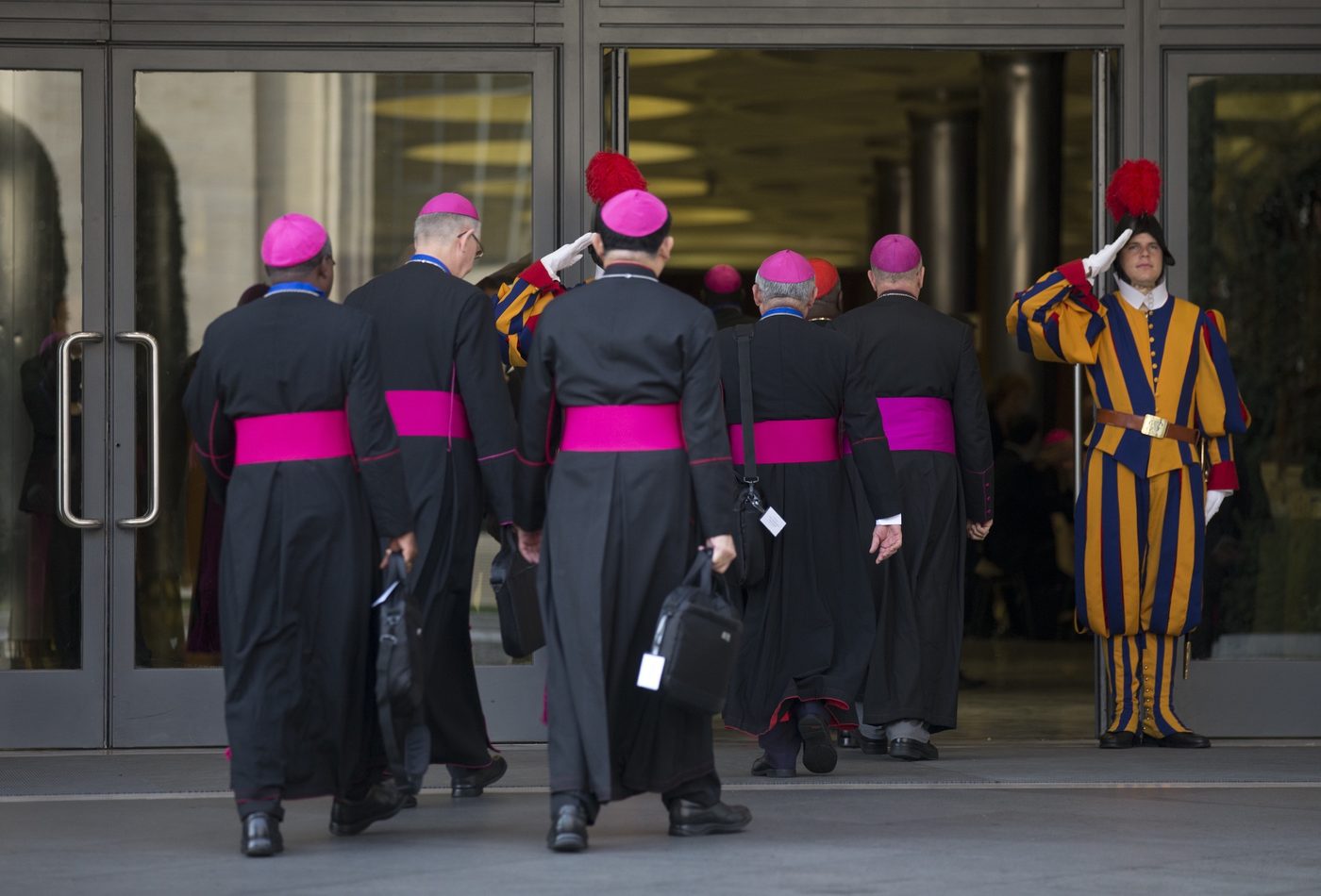
With the Synod on the Family well underway in Rome, considerable attention has been given (and not only in the media) to the “Kasper Proposal” to admit the divorced and civilly remarried to Holy Communion. No doubt discussion on this will continue, although Pope Francis has made it abundantly clear that he doesn’t want the Kasper Proposal to be the dominant issue, the principal focus of attention, at Synod-2015. But Kasper’s is not the only proposal with consequences. For buried within the Synod’s working document, the Instrumentum Laboris [IL], is another bombshell proposal with consequences just as radical – a proposal that, to date, has received little if any sustained attention. It’s found in the IL’s section on mixed marriages, at #128, and it’s something quite new, in that it did not appear in the final document of Synod-2014 and does not seem to have been a significant feature of last year’s discussion. The proposal seems to have been added to the IL (and thus to the Synod’s agenda) by Cardinal Lorenzo Baldisseri or his staff in the secretariat for the Synod. And it is not a reach to suggest that this was done at the behest of some German bishops, who have been quietly pressing the proposal (indeed, implementing it) for years. At first glance, IL #128 looks innocent enough, rather like an incremental extension of the circumstances in which members of other ecclesial bodies might receive the Eucharist in a Catholic rite: “Some suggest that mixed marriages might be considered as cases of ‘grave necessity,’ in which it is possible that a baptised person who is not in full communion with the Catholic Church, yet shares the Church’s faith in the Eucharist, be allowed to receive the Eucharist, when their pastors are not available and taking into account the criteria of the ecclesial community to which they belong (cf. John Paul II, Ecclesia de Eucharistia 45-46; Pontifical Council for Promoting Christian Unity, Directory for the Application of Principles and Norms on Ecumenism, 25 March 1993, 122-128).” Yet if one checks the references and examines the proposal carefully, this seemingly innocuous suggestion imports a revolutionary principle into the Synod’s basic working document. On the surface, the proposal looks like the provisions that currently govern the reception of Holy Communion in Catholic rites by members of Orthodox churches. But because current Church law already provides for the Orthodox, the chief beneficiaries of the new proposal would be Protestants. In sum, the proposal is that Protestants who profess a faith in the Eucharist and who are in “mixed marriages” (that is, who are married to Catholics) be admitted to Holy Communion at a Catholic Mass on a routine basis, even at a daily Mass, simply because they are married to a Catholic. (The condition that their own pastor must not be “available” is added, but in practice this would likely be interpreted quite loosely.) Adoption of this proposal would work a monumental change, not only in the Church’s discipline for Holy Communion, but in the Catholic doctrine of the Eucharist. The Eucharist is not just a sign or instrument of social inclusion. It is a profound spiritual reality, with profound – indeed, divine – spiritual effects. (Like all the sacraments, it effects or brings about what it signifies.) A core dimension of that reality is ecclesial communion, or unity. Reception of the Eucharist signifies that one is in full communion with Christ’s visible body, the Church (and with the Pope and bishops who are Christ’s vicars), even as it brings about that communion and strengthens that unity. This is perennial Catholic Eucharistic theology, a towering theme running from St Paul through the Church Fathers, the medieval scholastics, and the writings of prominent 20th-century theologians like Fr Henri de Lubac, SJ. It was also a central element of St John Paul II’s encyclical, Ecclesia de Eucharistia. Receiving the Eucharist is (or should be) a deeply significant spiritual act that signifies, as part of its intrinsic meaning, that “I am in full communion with, and obedient to, Christ, and to this visible community.” If the Church routinely admits to Holy Communion those who are not in full communion with her, the fundamental link between the Eucharist and ecclesial communion will be ruptured – with severe consequences for the doctrine of the Eucharist itself. What is more, existing Church law and regulations make clear that a non-Catholic can only receive Holy Communion if properly disposed to do so. That means having made a sacramental confession. The proposal makes no mention of this. In fact, the existing rules expressly link access to the Eucharist with the sacraments of Penance and Anointing of the Sick, and provide for this kind of Eucharistic sharing only in rare cases of grave necessity (e.g., someone dying in a hospital who manifests a Catholic faith in the sacraments and asks for them, even though he or she has not yet been received into the Church – and who then receives the sacraments of Penance and the Anointing of the Sick, and the Eucharist as viaticum). The proposal at IL #128 suggests a change in Catholic doctrine as monumental as the original Kasper Proposal to admit the divorced and civilly remarried to Holy Communion after their undertaking a “penitential path.” Protestants in mixed marriages would be admitted to Holy Communion, even though they have not received absolution for any sins committed after baptism. All of the doctrinal and pastoral dangers of inviting to Holy Communion those who are not disposed to receive it – and St Paul’s warning against this is solemn and grave (1 Corinthians 11:27-30) – are present in this proposal just as much as in Kasper’s. The IL texts suggests that being in a mixed marriage is a case of “grave necessity” permitting Protestants to receive the Eucharist. That simply is not the case. The gravity pulls in precisely the other direction. We don’t propose cohabitation as a strategy for building a good marriage. You don’t start off with the most profound act of communion in the hope that the commitment will someday follow. All too often, the result is not commitment, but its opposite, paired with the loss of the any sense of the sacredness of the act itself. This unexploded bomb should be defused when the Synod fathers take up Part III of the Instrumentum Laboris – and it would no bad thing for more than a few Synod fathers to flag it, and dissect it, beforehand, perhaps in the Synod’s general assemblies. – Xavier Rynne II