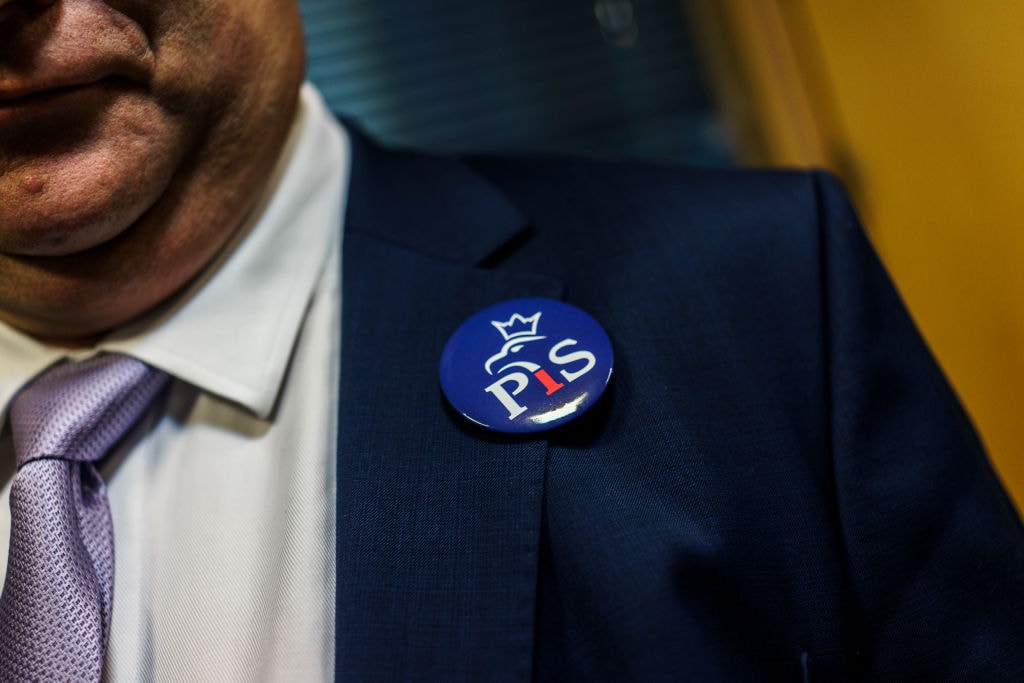
When Poland’s Law and Justice party (PiS) was returned to government on October 13, Church leaders were cautious in their public comments. While most bishops will be privately relieved, they will also be wary of the challenges ahead.
“Neither they nor the Church as a whole speak with one voice now, and there are certainly opposition supporters among them,” explained Malgorzata Glabisz-Pniewska, a senior presenter with Polish Radio. “Although the media present things in black and white, suggesting close reciprocal Church ties with PiS, the reality is much more nuanced.”
Despite adverse publicity abroad for its reform programme, and threats of European Union sanctions for alleged constitutional improprieties, PiS romped to victory with 44 per cent of lower house seats against the opposition Civic Coalition’s 27 per cent – the biggest vote for any party, on the highest turnout, since the 1989 collapse of communist rule.
But PiS lost its Senate majority, taking 48 of the 100 seats, compared to its 2015 tally of 61, and it will now have to compete with a rival conservative bloc, as well as a hard-left party which came third with 13 per cent.
Despite this, PiS’s chairman Jarosław Kaczyński hailed the outcome as a vindication. Having also triumphed in European Parliament elections last May, the government seems to be preparing for further confrontations with the European Commission, which referred Poland to the European Court of Justice just three days before the election, claiming political interference in the appointment of judges.
Not everyone is pleased with how the election was conducted. Observers from the Organisation on Security and Co-operation in Europe (OSCE) complained of “clear media bias”, and accused some candidates of deploying “nationalist and homophobic rhetoric”. Concerns had also been raised, the report added, about the use of religious buildings for “several PiS campaign events”.
Some Catholic groups have echoed the criticisms. One, called We Want the Church Back, which was formed before the election, has accused Polish clergy of “dividing people and spreading hostility”, while at least one prominent Catholic voiced his alarm that support for PiS was strongest in Poland’s traditional Catholic heartlands.
“Some Catholic hierarchs give the impression they’ve formed an episcopate not for Poland but for the governing party,” Stefan Frankiewicz wrote in the Catholic Więź quarterly. “I now fear one thing – an even stronger alliance of throne and altar.”
Such claims are vigorously contested. The Church has common aims with PiS in certain areas, Catholics point out, such as in opposing recent campaigns for gay marriage and adoption by same-sex couples. And since other parties have demanded heavier church taxation and measures to exclude the Church from public life, it’s hardly surprising that PiS has attracted Catholic votes. But the Church as a whole has avoided taking sides.
In September, Poland’s Primate, Archbishop Wojciech Polak of Gniezno, reprimanded Mr Kaczynski after he told a PiS convention in Lublin that the Catholic Church offered “the only universally known system of values in Poland” and urged “every good Pole” to recognise that the only alternative was nihilism.
“This is absolutely not the Polish Church’s position,” the 54-year-old Primate said in a sermon. “The statement has nothing in common with Church teaching – it’s just the view and vision of the person who made it.”
In a rare direct reaction to the election, Archbishop Józef Kupny of Wrocław congratulated the winning deputies and senators in an open letter, and urged them “to build a state which devotes special care to the family, human life, bringing up the young generation, respecting the right to work and discerning the nation’s main concerns, sensitive to the needs of the real person, notably the poor and fragile.”