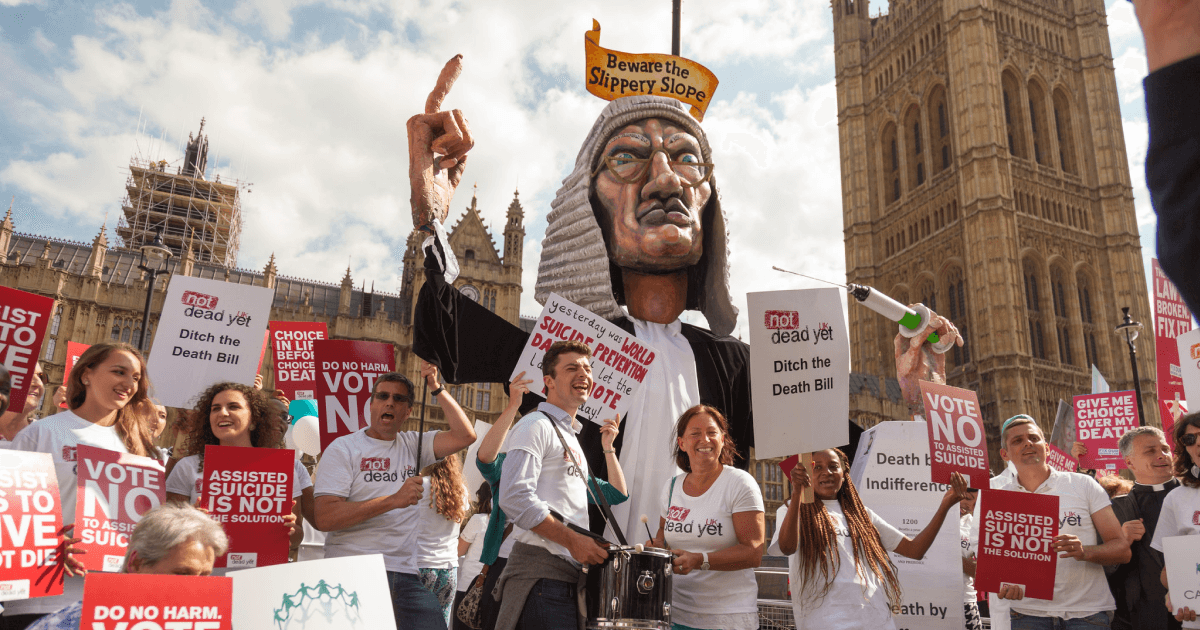




For a brief moment earlier this year, it looked as though the assisted suicide Bill had been defeated. Not by some great parliamentary revolt, but simply because the clock ran out.
Kim Leadbeater’s Terminally Ill Adults (End of Life) Bill had passed the Commons, but became bogged down in the House of Lords: peers tabled more than 1,000 amendments and spent 14 days examining it in committee. When Parliament was prorogued at the end of April, the Bill had not completed its remaining stages, and it fell.

Naturally, supporters cried foul. Opponents had frustrated the will of the elected House; the Lords had filibustered. There is just one problem with this account: this is what Parliament is for.
This was a Private Member’s Bill proposing an enormous change in our law. It was not a government manifesto commitment, so the Salisbury-Addison convention did not apply. The Lords Constitution Committee said as much, adding that peers were constitutionally entitled to amend or even reject it.
Nor was all that scrutiny invented for the sake of delay. The Bill had already changed substantially in the Commons. Its original headline safeguard – approval by a High Court judge – was removed in committee and replaced by assisted-dying review panels, one change among more than 500 amendments considered at that stage.
Sir David Beamish, the former Clerk of the Parliaments, was asked last November whether the Lords was deliberately going slow. He said he would not call it that and had seen nothing that looked like filibustering: peers were discussing important questions of principle and trying to make sure the Bill was fit for the statute book.
The supposed victory did not last long. Lauren Edwards MP was drawn second in this session’s Private Members’ Bill ballot and has reintroduced the Terminally Ill Adults Bill, with its second reading scheduled for September 11.
Bringing it back in essentially the same form also matters procedurally. If the Commons passes the same Bill in successive sessions and the Lords again refuses to pass it, the Parliament Acts may, in certain circumstances, allow it to receive Royal Assent without the Lords’ consent. The Commons Library has explicitly noted the possibility in relation to the revived Bill.
And here, I think, is the lesson. The assisted suicide lobby understands politics. When the Bill fell, its supporters did not decide that Parliament had spoken and retire gracefully. They looked at the rules, found another route and tried again. If the Lords remains an obstacle, there is already discussion of how that obstacle might ultimately be overcome.
I do not particularly blame them for this. They think assisted suicide is right, and they are behaving like people who actually want to change the law.
We should perhaps take the hint. Conservatives, and Christians in particular, can sometimes behave as though politics were a debating society: make the sound argument, state the moral principle, and trust that everyone will eventually come round. We are then strangely embarrassed by the rather grubby business of actually winning. Our opponents rarely seem to have the same difficulty.
Politics has rules: timetables, amendments, committees and conventions. If supporters of assisted suicide are prepared to use every lawful avenue available to them, then those of us who oppose it should do the same.
That does not mean the end justifies the means. For a Catholic, it obviously cannot. But there is a wide gap between dishonesty and political effectiveness, and no virtue in refusing to use legitimate means merely because doing so feels ungentlemanly.
If a Bill needs a thousand serious amendments, table them. If it needs long debate, debate it. If MPs can be persuaded to change their minds, persuade them. The other side certainly will.
Right To Life UK has been very good at this. Throughout the assisted suicide debate it has combined the moral case with the less glamorous business of practical politics, such as making it easier for ordinary people to contact their MPs.
Ahead of September 11, it has launched an EasyAction tool. Enter your postcode, it finds your MP and gives you an editable message asking them to vote against the Bill. It takes a couple of minutes.
That may sound trivial, but it is precisely the sort of thing that matters. A hundred Catholics complaining to one another after Mass achieves rather less politically than a hundred Catholics writing to the MP who will actually cast the vote. And MPs can change their minds. At second reading in November 2024, the original Bill passed by 330 votes to 275, a majority of 55. By third reading the following June it passed by 314 to 291, a majority of just 23.
This is not some irresistible historical tide against which Catholics can do nothing except compose eloquent obituaries for Christian civilisation. The last Bill fell, and support for it in the Commons had already weakened considerably. The next vote is winnable.
There is a peculiar comfort in deciding that defeat is inevitable, because it absolves us of responsibility. If assisted suicide is simply the next stage of modernity, then all we need do is object honourably and lose. But MPs can be moved, Bills can be defeated and parliamentary procedure matters.
The assisted suicide lobby knows that being convinced that you are right is not enough. You have to organise, count votes, recover from defeats and come back again. We should learn to do the same.
There is no virtue in losing gracefully when you could have won.