

Pope Leo XIV has officially moved into the traditional papal apartment in the Apostolic Palace.
The Vatican confirmed that the Pope formally took possession of the residence on Saturday afternoon, moving into the rooms historically used by his predecessors. The announcement came in a brief notice from the director of the Holy See Press Office, Matteo Bruni, who said: “This afternoon, Pope Leo XIV will take possession of the apartment in the Apostolic Palace, moving, with his closest collaborators, into the spaces previously occupied by his predecessors.”
The move follows a short period during which Pope Leo continued living in the Palazzo del Sant’Uffizio, a residence inside Vatican City where he had already been living before his election while serving as Prefect of the Dicastery for Bishops. Remaining there during the early weeks of his pontificate allowed time for renovation work to be completed in the papal apartment.
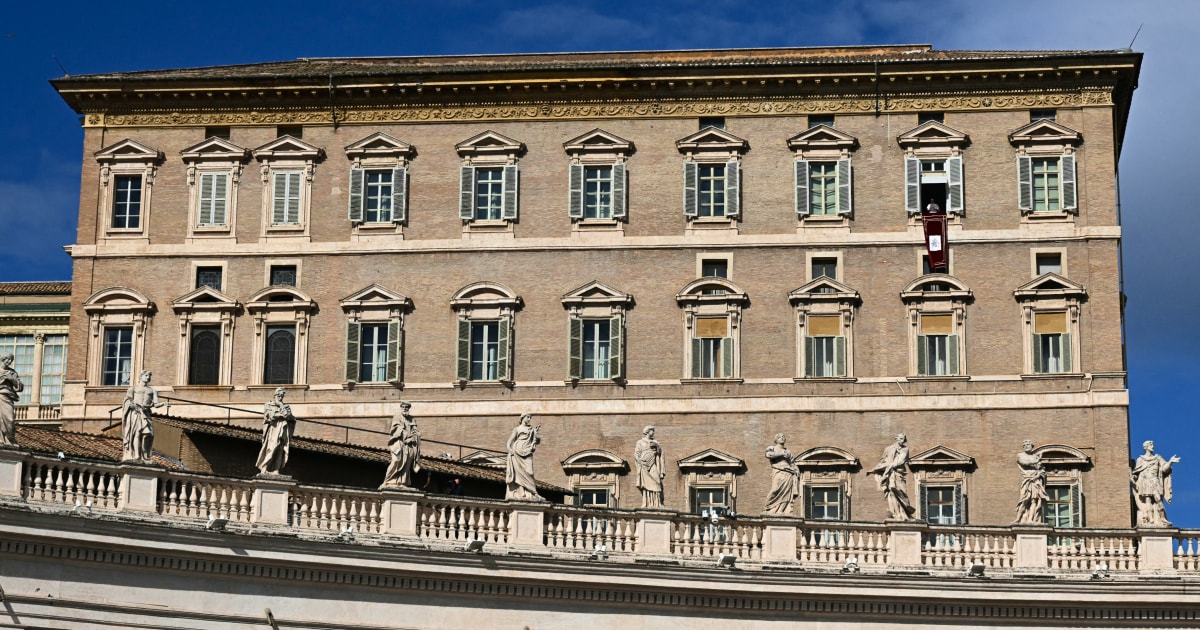
The residence occupies the third loggia of the Apostolic Palace overlooking St Peter’s Square. It includes the Pope’s private study, the room whose window is used each Sunday for the Angelus address, as well as a library, private chapel and a number of living quarters. Italian reports have also suggested that the renovated apartment now includes a small exercise room.
The Pope had already signalled his intention to use the apartment earlier this year. On May 11, 2025, he removed the seals placed on the door of the residence after the death of Pope Francis. Sealing the papal apartment is a routine procedure carried out when a pontiff dies, protecting documents and marking the formal end of a pontificate until a successor decides how the rooms will be used.
Pope Leo will live there with several close collaborators who form the small household surrounding the Pope. Among them is his private secretary, the Peruvian priest Mgr Edgard Iván Rimaycuna Inga, who is often seen accompanying him during public appearances. Also based in the papal household is Fr Edward Daniang Daleng, an Augustinian priest from Nigeria who serves as vice-regent of the papal household and helps manage access to the Pope.
Two lay officials complete the small inner circle assisting the new pontiff. Anton Kappler, a former lieutenant in the Swiss Guard, has been appointed as an administrative aide, while Piergiorgio Zanetti, previously a Vatican gendarme, works alongside him in the Pope’s office.
The previous pontificate under Pope Francis famously declined to live in the traditional papal apartment and instead chose to remain at the Vatican guesthouse known as Casa Santa Marta.
Francis explained that he preferred to live in a community environment rather than in what he described as the isolation of the palace residence. The move was widely interpreted as part of his emphasis on simplicity and a rejection of what he saw as unnecessary papal formality.
In practical terms, however, the arrangement meant that much of the second floor of the Santa Marta residence was reserved for papal use, reducing the building’s normal capacity for visiting clergy and guests.
The rooms in the third loggia were first used as a papal residence by Pope Pius X after his election in 1903. The apartment was substantially remodelled in 1964 during the pontificate of Pope Paul VI, with subsequent popes making smaller adjustments while retaining the overall layout.