.png)


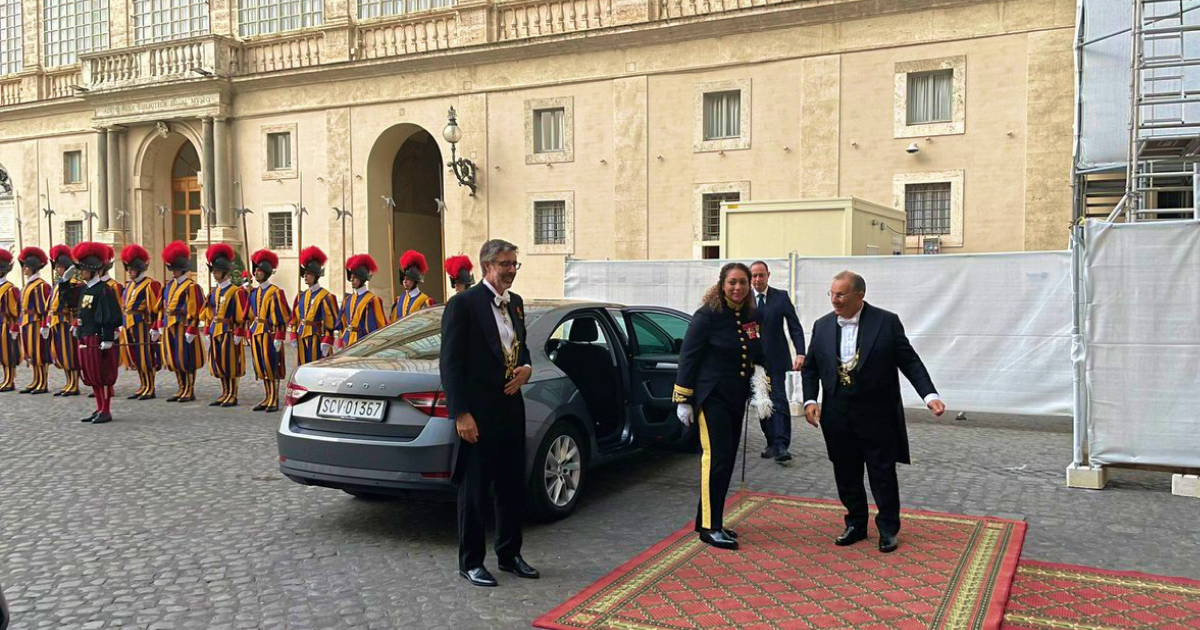
After a year, we are still trying to clarify what kind of Pope we have been given. Every month brings a new opportunity to fill out a clearer papal identity. Our latest opportunity was provided by the first-ever papal address to the Spanish Parliament – a joint session of the Congress of Deputies and the Senate – which he delivered in expert Castilian Spanish on June 8. Spectacularly, he drew a seven-minute standing ovation, accompanied by chants of “¡Viva el Papa!”
In one respect, it is a matter of joy and pride to see the Holy Father so warmly received. In another respect, it raises questions. Is there a parliament in the world where the visit of a Pope should not carry at least as much disturbance as admiration? Where was the disturbance?
In fact, the Pope did provide ethical and prophetic disturbance, and to his great credit. The Holy Father built the whole address around a single question with an anthropological foundation:
“Every legislative task ultimately confronts a decisive question: what conception of the human person inspires laws, and what kind of society do those laws build?”
It has dawned on many of us that the philosophical question producing the greatest conflict today is precisely the question of anthropology.
The great threat of secular progressive ambition expresses itself in abandoning the sacred nature of humanity, which bears the image and likeness of God, and replacing it with a sub-human utilitarianism. The consequences of this are both terrible and dangerous, and the Pope’s unerring instinct to make this his target was more than commendable.
His remarks drew on the School of Salamanca, particularly Francisco de Vitoria, and the post-conciliar reflection on the irreducible value of every human being and the moral limits of power. He also referenced Pope Emeritus Benedict XVI’s 2011 Bundestag address, recalling that human dignity “precedes any concession by the State and cannot be subordinated to shifting social consensus or majority opinion.”
He moved on, quite rightly, to cite his own encyclical Magnifica Humanitas, warning Spanish parliamentarians against the “throwaway culture” and, with considerable courage and charity, tying together the unborn, the elderly, the sick and the migrant within a single account of human dignity.
The parliamentarians should have been disturbed by his defence of the unborn and the elderly. But it seems that the ears of the commentariat were tuned far more directly to what he had to say about migration.
Yet migration was only part of his journey into Catholic anthropology. Because he had framed the defence of life not as a partisan confessional interest but as a goal of civilisation itself, he was defending beneath each of these questions a Catholic anthropology that provides an entire account of the human person: expressed through the grammar of sexual morality, the human body, sexual difference and its ends, a conception of parenthood and of the family that flows from them – all in contradistinction to a culture that has carelessly but effectively abandoned them.
The issues were the presenting symptoms, but the anthropology was both the substance and the solution. To tell a secular assembly the whole difficult truth about the human person, about life, the body and the family, without apology and without softening, was an act of enormous courage.
We as Catholics can indulge in a profound sense of relief and pride. Before we make any criticism or reservation, we should offer our support and our congratulations. And yet we are left with questions. And they have to do with the very aspect of the speech that we suspect most excited the Spanish parliamentarians – concerning migration.
So, having offered our unqualified enthusiasm, let us try to draw the contours around the elephant in the room. The Pope offered Parliament what he called a twofold vision of social justice. First, to provide safe and legal pathways, respectful welcome and real opportunities for integration. Secondly, to defend the right of people to remain in their own land so that no one is forced to leave because of civil war, poverty or climate crisis.
It was a humane and serious formulation. But both concerns face in the same direction. Both are orientated entirely towards the migrant. Welcome him when he comes; spare him the need to come. The receiving society appears only as the host whose duty is to open the door either more widely or more justly.
But this is not the whole burden of Catholic teaching. The Catechism, in paragraph 2241, holds two truths in a single tension. The first is that prosperous nations are obliged, insofar as they are able, to welcome vulnerable strangers seeking safety and the livelihood they cannot find at home. That is not the same thing as economic migration.
But the second – and strangely Leo did not refer to it – is that political authorities, responsible for the common good, may regulate immigration by law. Such regulation imposes real obligations on migrants to respect with gratitude the material and spiritual heritage of the country that receives them, to obey its laws and help bear its burdens.
This doctrine has two eyes. On Monday, the Pope looked through a telescope using only one. Inevitably, we know that presenting half a teaching is not actually teaching error. Everything the Pope said was true. But sometimes what you leave out is as important as what you put in.
And then the question becomes: why was it left out, and what effect does its absence have? There are two vulnerabilities at stake here. The first is that of the displaced migrant. The second is that of the displaced post-Christian nation. Where was the Pope’s concern for the slow dissolution of social glue, shared memory, inherited trust, cultural confidence and the underlying Christian faith without which a society cannot remain a home to anybody – least of all the newcomer?
Where was the Pope’s protection for those who feel that their cultural continuity and sense of belonging are not merely being eroded but actively withdrawn from beneath them? Why are they any less wounded than the economically poor of the global South? Is it more dangerous to lose your identity than to lose your income?
The same Catholic account of the person that Leo so courageously defended in the register of the body and the family insists that man is not only an embodied soul but a member of a people, constituted by belonging, inherited memory, shared trust and culture, without which the individual human being becomes dislocated, disorientated and disowned.
The defence of the family and the defence of a people’s continuity are not two separate causes. They constitute one anthropology. There are two dimensions to that anthropology: the individual in his uniqueness and the individual as a member of society. To pass over the second in silence is to assume – without argument or examination – that one woundedness, economic fragility, is real, while another, the loss of belonging and shared identity, is somehow less real.
Some people will attempt to psychoanalyse Cardinal Robert Prevost. What happened to him in Peru? How does he integrate the gift of an American upbringing with decades of South American experience? In this speech we heard clearly from the South American cardinal. But the boy and young man who grew up in Chicago seemed less inclined to defend the inheritance entrusted to him and to which he would always remain indebted.
The flaw in this remarkable speech is ultimately a political one. The moment Catholic teaching is reduced to one of its two halves, it becomes useful to one side and less useful to the other. The man has not necessarily become political, whatever his deeper intentions. But the effect is political. The standing ovation was evidence that his listeners recognised and welcomed a message in their own language. And their language, as is so often the case in contemporary Europe, is a political one – and, by definition, a pro-migration one.
Does the Catholic Church have no responsibility for the culture that gave it birth, that it in turn shaped, sculpted, nourished and defended? It would be impossible to argue otherwise. Why, then, did the Pope choose to focus on the woundedness of the migrant and not on the exhaustion, dissolution and disturbance of post-Christendom?
Pope St John Paul II loved to say that the Church must learn to breathe with both lungs. By this he meant the Christian East and the Christian West. But it is an image that stretches beyond its original application and becomes paradigmatic of what Catholicity itself means. Catholicism is not the triumph of one tradition over another, one partisanship over another, or one argument over another. It is the integration of realities that cannot be themselves apart from one another. There is a way of being Catholic that consists precisely in holding together complementary truths. A person who breathes with a single lung is diminished.
On the most pressing question now facing Europe, Pope Leo brought much of the inheritance of a Catholic mind and heart – but not the full inheritance. Not because what he said was false. But because he left half of it unspoken.
The remedy is not to abandon the migrant. It is to become more alert to the woundedness of Christendom. We should compliment the Holy Father on his ethical courage and particularly on his clarity concerning Catholic anthropology. But we are also entitled to ask him to come to the aid of a wounded, abandoned, assaulted and disorientated Christendom that our forebears gave everything to create and defend.
We human beings do not exist in abstraction. We are born into families, languages, memories, loyalties and traditions. We inherit a story before we can tell one. We belong before we choose.
The same Catholic vision that protects the vulnerable migrant must also protect the vulnerable culture into which all arrive as migrant souls. The same Church that asks nations to exercise generosity must also defend their right to remain recognisably themselves. Otherwise anthropology becomes individualistic, and the person is detached from the very web of belonging that allows him to flourish.
The remedy is not less compassion for the migrant. It is more compassion for Christendom – for Christendom too is wounded. And if the Church cannot find a voice for her own civilisation, who will?