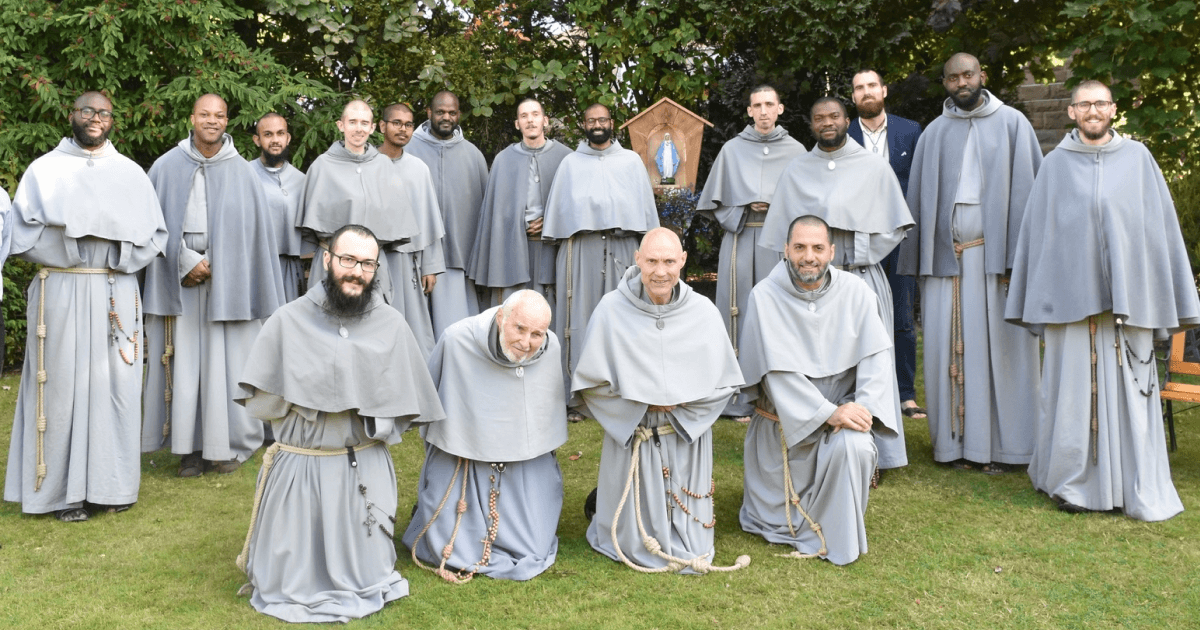
Four days after the Family of Mary Immaculate and St Francis (otherwise known as the Marian Franciscans) formally ceased to exist as a public association of the faithful at midnight on May 31, 2026, further information has surfaced regarding the factors that led a traditionalist community showing signs of growth and apostolic vitality to petition for its own canonical suppression.
The trustees of the Friends of the Marian Franciscans, in a detailed Q&A document released with the announcement, stated that the friars had reached their decision after “a period of discernment about the long-term future of the community in the UK”. They added: “Despite growth in numbers and apostolic activity, it was not possible to secure the practical and canonical support needed for formation, sponsorship, and future priestly ordinations. In those circumstances, the friars concluded that petitioning for dissolution was the responsible course.” The document stressed that the request “was not the result of, or a reaction to, any single incident or series of incidents” but “arose from broader questions about the future viability of the community and its mission in the UK.”
The community originated among friars who departed the Franciscan Friars of the Immaculate following the 2013 apostolic visitation. Welcomed by Bishop Philip Egan, they established a presence in the Diocese of Portsmouth in 2014, assumed care of a parish, launched the Radio Immaculata apostolate and were erected as a public association on December 8, 2018. They expanded their work to include retreats, pilgrimages, pro-life initiatives and a demanding schedule of prayer and penance inspired by St Francis and St Maximilian Kolbe. Four members were ordained in 2019. A move to the Diocese of Dunkeld in 2022, at the invitation of the late Bishop Stephen Robson, ended after his successor, Bishop Andrew McKenzie, asked them to depart in February 2025.
Reporting by The Pillar on June 2 drew on anonymous sources with knowledge of the community to suggest that the background was more complex. The sources alleged the existence of safeguarding complaints, a lack of due diligence in recruitment, severe ascetical practices that purportedly adversely affected members’ health and the misleading presentation of the community as a religious order rather than a public association of the faithful. One source also referred to the death of a former member who had struggled with mental health issues.
In a statement sent to The Pillar on the same day, the Marian Franciscans responded directly to these claims. On the question of safeguarding, they said: “The friars do not wish to engage with generic and vague claims about such a sensitive and important topic,” and referred back to their Q&A document. They noted that “Bishop Egan has permitted the friars who are incardinated in the Diocese of Portsmouth to wear a modified habit and to ‘continue the Masses, sacraments and devotions’” at existing locations, and that both Bishop Egan and Bishop McKenzie had publicly recognised the value of their ministry. “These statements do not align with there being serious, substantiated safeguarding concerns about the community,” the statement added.
Regarding recruitment, the friars described their approach as diligent: “No one is permitted to even visit the religious community for discernment until they have had a personal one-to-one Zoom meeting with the community’s vocations director. Specific questions are asked to establish whether the candidate is deemed suitable for religious life. A medical report of good health is also required before admission, as well as other important documentation.” They acknowledged that “no system of vetting and discernment is perfect” but attributed difficulties to candidates withholding information.
On claims of extreme asceticism, the statement declared: “There is no evidence to show that any of the members’ health has been affected by ‘acts of severe asceticism’. The friars are generally all in good health and have certainly never been instructed to eat spoiled food. Mouldy food is thrown away.” They explained their dependence on donations: “Sometimes they do receive food donations which may be past their ‘best before’ date. These are checked carefully before being served at the community meals – if they have spoiled, they are disposed of.”
Concerning the presentation of their identity, the friars stated: “The Family of Mary Immaculate and St Francis were a public association of Franciscan friars. In his statement, Bishop Egan referred to the members of the association as ‘friars.’ It is a normal, contemporary practice for new religious communities to begin as either private or public associations of the faithful before being erected as institutes of diocesan right.”
They added that any misunderstanding on the part of others “cannot be blamed on how the friars have presented themselves” and would, at worst, have been “an innocent mistake”. A consulted canon lawyer had confirmed that such practices align with expectations for public associations.
On the former member who died, the statement noted that he was no longer in the community at the time of his death and that the friars had offered him support during his mental health struggles and remained close to his family.
These matters remain allegations made by anonymous sources; the community has denied them and neither diocese has published formal findings of canonical wrongdoing. Bishop Egan has allowed incardinated priests to continue certain apostolates while they explore joining another association of a similar charism. The sisters’ community in Dundee continues for the time being.
Latin Mass Society of England and Wales chairman Joseph Shaw observed that the friars had accepted the situation with “exemplary and touching” docility. He wrote that “the inability of the Church in England and in Scotland to make use of these men should be a source of national embarrassment”, while acknowledging that their style “is not everyone’s cup of tea”. He added: “These men have their limitations, because all human beings do, but they are also intelligent, kind, and totally committed to the Faith.”
As the friars transition to new arrangements, many traditional Catholics continue to express gratitude for the spiritual fruits of the community’s eight years of existence while praying that its distinctive charism of total consecration to the Immaculate may find a stable future elsewhere in the service of the Church.

.png)

.png)


.png)