

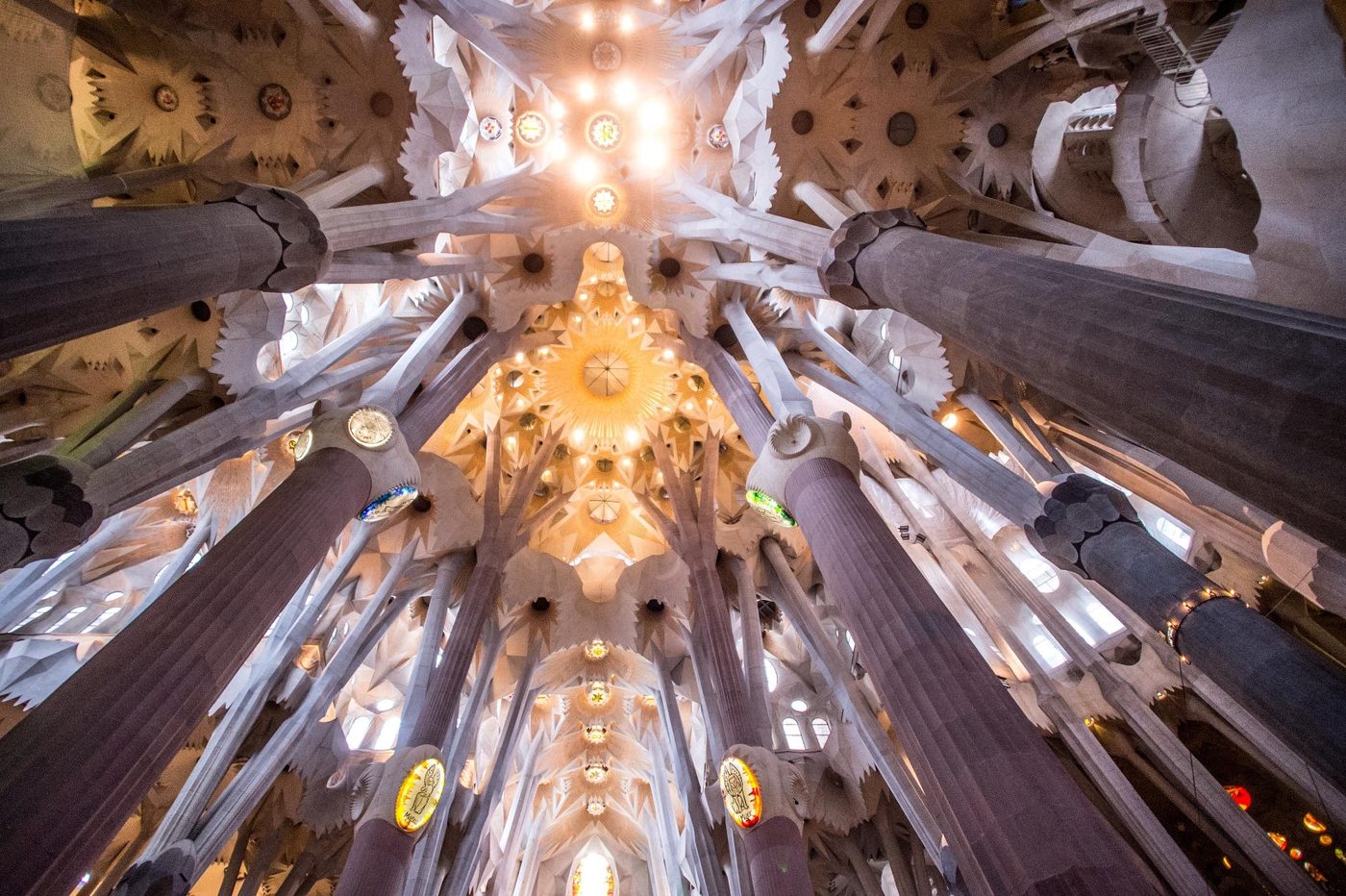
The Sagrada Familia By Gijs Van Hensbergen, Bloomsbury, £20 The cause for Antoni Gaudí (1852–1926) was opened in 1998. Why might this architect be made a saint? He was a bachelor, teetotaller, vegetarian, and a daily Mass-goer, who practised epic self-denial. In 1914, he abandoned his wider architectural practice to devote himself totally to the Sagrada Familia, but lived only to see one of its projected 18 towers and spires built. His final year he spent on the site in his own workshop, which was to be destroyed 10 years later. His Catholicism was lived out against the dark background of violent anarchism and anti-clericalism – associated with him are the causes of 12 martyrs of the Sagrada Familia assassinated by the Reds between 1936 and 1939. He subscribed to an “integrist” view of Catholicism, which in Catalonia, as in contemporary Croatia, Flanders and Ireland, was also allied to language-revival movements and separatist nationalism. Gaudí was the son of a coppersmith – naturalistic metalwork is one of the hallmarks of his style – and he was educated by the Piarist fathers. At Barcelona architecture school (1874-8), like all good architecture students, he despised the teaching, while making lifelong professional friendships. He was taken up by integrist and nationalist patrons, designing a model industrial town, and blocks of flats for the wealthy in Barcelona, as well as for bishops, counts and marquises. Two church schemes were begun but left incomplete, while his ruthless reordering of the cathedral of Palma de Majorca (1903-14) was an example of early liturgical-movement thinking expressed in rich Symbolist style and metalwork. The Expiatory Temple of the Holy Family was the project of the Spiritual Association of Devotees of St Joseph. It was founded in 1866 by a Catholic bookseller, Boccabella, with the priest founder of the Congregation of the Sons of the Holy Family, to counter pressing threats to the Catholic family. This was symbolised by urbanisation, industrialisation and exploitation as Barcelona became the Manchester of Spain. The site was bought in 1881 and Gaudí was appointed in 1883. As an architect, he followed the romantic readings of the Gothic from Goethe to Ruskin, and the “rationalist” teachings of Viollet-le-Duc (and of Pugin, though he is not mentioned in this book). His ideas were worked out in models, rather than drawings. Strictly architectural and engineering considerations seemed to have remained in his head. Although he opened the crypt church in 1889, and a school in 1909, only the walls of the apse and of the Holy Family transept of the upper church were begun in his lifetime. Here Gaudí ran a chantier of resident labourers, masons, sculptors and assistants, and an atelier of architects. After his death, three generations of loyal assistants, two of them having entered the workshop as teenagers, carried on the work, building the answering Passion transept (1954-1976). The clou to the church is the replacement of the Gothic arch, buttress and vault with a parabola or catenary arch which melded pier and vault into one, although the first nave bay to attempt this was not built until 1957. Gaudí’s other concern was its teeming naturalistic and narrative architectural sculpture. Figurative animal sculpture was cast from life while an attempt to cast from the figure of an assistant was unsuccessful. His architecture might be said to be painterly or sculptural, rather than architectonic, as the sinuous forms and riotous decoration of his domestic architecture shows. Although 40 Barcelona churches had been destroyed by the Reds –who tried unsuccessfully to dynamite Sagrada Familia itself – not everyone agreed that the city needed yet another one. The dead architect was denounced by Picasso, by Salvador Dali, and in the architecture schools. In 1965 a letter opposing the continuation of the church in the Gaudí style was signed by the architect gurus Alvar Aalto, Le Corbusier and Ricardo Bofill. Critical re-evaluation came less from Spain than from the English-speaking world. Gaudí’s house is now a museum, and no less than seven of his buildings are Unesco World Heritage sites. Sagrada Familia is currently one of the largest building projects in Europe and should be complete by 2026. Pope Benedict XVI consecrated its high altar in 2010. Van Hensbergen, although a Hispanophile, comes from a Dutch Calvinist background. For him the Spanish church is of course “feudal and anti-liberal” and his popes fail all the usual liberal hurdles. He seems to think that Gaudí went daily to Confession, heard Mass in Catalan and drank from the chalice. He has written a cultural biography of the architect, rather than a monograph on the church – there are no plans or illustrations. The 19th-century Catholic Revival saw Gothic Revival cathedrals built from Cove to Zagreb, but none of them is as megalomaniac and sui generis as the Sagrada Familia. Perhaps it should become the cathedral for Europe? Dr Roderick O’Donnell is an architectural historian
1:00 PM
The masterwork denounced by Picasso and Dali
Roderick O Donnell

5 min read



Already a subscriber? Sign in
5freearticles every month
Continue reading with a free account. No card needed.
- Five free articles every thirty days, on any device you sign in on
- The Catholic Herald newsletter, every morning
- Subscribe whenever you like for everything: every article and the magazine

subscribe to the catholic herald today
Our best content is exclusively available to our subscribers. Subscribe today and gain instant access to expert analysis, in-depth articles, and thought-provoking insights—anytime, anywhere. Don’t miss out on the conversations that matter most.
Subscribe



