The story of Jesus has to begin with the Incarnation; without it, there would be no story at all. Plenty of great teachers, mystics, martyrs, and saints have made their appearance at different times in the world, and lived lives and spoken words full of grace and truth, for which we have every reason to be grateful. Of none of them, however, has the claim been made, and accepted, that they were Incarnate God. In the case of Jesus alone the belief has persisted that when he came into the world God deigned to take on the likeness of a man in order that thenceforth men might be encouraged to aspire after the likeness of God; reaching out from their mortality to His immortality, from their imperfection to His perfection. It is written in the Old Testament that no man may see God and live; at the same time, as Kierkegaard points out, God cannot make Man His equal without transforming him into something more than Man. The only solution was for God to become Man, which He did through the Incarnation in the person of Jesus. Thereby, He set a window in the tiny dark dungeon of the ego in which we all languish, letting in a light, providing a vista, and offering a way of release from the servitude of the flesh and the fury of the will into what St. Paul called the glorious liberty of the children of God.
This is what the Incarnation, realized in the birth of Jesus, and in the drama of his ministry, death, and Resurrection, was to signify. With it, Eternity steps into Time, and Time loses itself in Eternity. Hence Jesus; in the eyes of God, a man, and in the eyes of men, God. It is sublimely simple; a transcendental soap-opera going on century after century and touching innumerable hearts; from some bleak, lonely soul seeking a hand to hold when all others have been withdrawn, to vast concourses of joyful believers singing their glorias, their kyries, their misereres. There have been endless variations in the script, in the music, in the dialogue, but one thing remains constant – the central figure, Jesus. After the great Jehovah before whose wrath even the gentiles bow down, the Lamb of God; after the immutable Law handed down to Moses from on high, grace and truth embodied in a gospel of love; after the Creation, the Incarnation, when the momentous announcement: Fiat Lux! which begins our human story finds its fulfilment in another: Ecce Homo! Let there be Light!, and then: Behold the Man! With the Light came the universe, and all its creatures; illimitable space to be explored, and the tiniest atoms to be broken down into yet tinier ones. With the Incarnation came the Man, and the addition of a new spiritual dimension to the cosmic scene. The universe provides a stage; Jesus is the play.
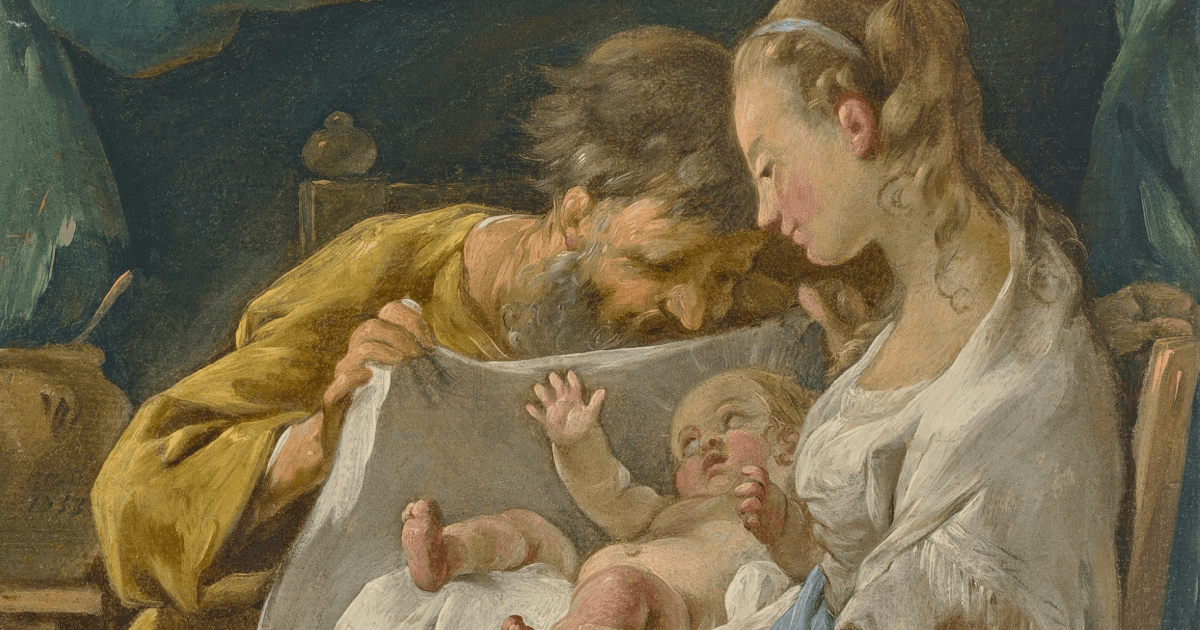
The exigencies of the play require that his birth shall be both miraculous and ordinary. Wise Men attend it, and also shepherds; a new star announces it, and yet it takes place in the lowliest of circumstances – in a manger, with the beasts of the field that are housed there looking on expressionlessly as Jesus emerges from his mother’s womb. Gifts of gold, frankincense, and myrrh signify a royal birth, the coming of a prince of the House of David; the homely greetings of the shepherds welcome a friend of the poor, the lowly, and the oppressed – a man for others. Similarly, Mary, in delivering Incarnate God into the dangerous world, has to be, at once, the most radiant and warm-blooded of mothers whose breasts gush with milk, and a virgin untouched by any sensual hand or carnal experience. The Holy Child has to come, fleshly, out of her flesh, and, at the same time, not through fleshly processes. As she proclaims in her Magnificat, God has regarded her lowliness, and made her blessed in the eyes of future generations, by bestowing upon her the inestimable privilege that in her womb the Incarnation happens.
Until comparatively recent times Christians found little difficulty in combining these two themes of perfect motherhood and perfect virginity. The Madonnas of the Middle Ages, endlessly painted, sculpted, celebrated in verse and prose and Plainsong, are glowingly alive without being involved in our human concupiscence. One comes across them in obscure churches as in great cathedrals and abbeys – faces of transcendental beauty that are also enchantingly homely, and even droll, in wood and stone and marble; still with candle flames flickering in front of them and flowers heaped before them, and a few figures kneeling, touched with wonder at a Mother of God, who was, at once, so sublimely motherly, and so humanly divine. Such faces, blending physical and spiritual beauty into a sort of celestial coquetry, are likewise to be seen among nuns – or were until they put aside their habits and rules to follow Demas and the fashions of this present world. In humanistic times like ours, a contemporary virgin – assuming there are any such – would regard a message from the Angel Gabriel that she might expect to give birth to a son to be called the Son of the Highest as ill-tidings of great sorrow and a slur on the local family-planning center. It is, in point of fact, extremely improbable, under existing conditions that Jesus would have been permitted to be born at all. Mary’s pregnancy, in poor circumstances, and with the father unknown, would have been an obvious case for an abortion; and her talk of having conceived as a result of the intervention of the Holy Ghost would have pointed to the need for psychiatric treatment, and made the case for terminating her pregnancy even stronger. Thus our generation, needing a Savior more, perhaps, than any that has ever existed, would be too humane to allow one to be born; too enlightened to permit the Light of the World to shine in a darkness that grows ever more oppressive.
To a twentieth-century mind the notion, of a virgin birth is intrinsically and preposterously inconceivable. If a woman claims – such claims are made from time to time – to have become pregnant without sexual intercourse, no one believes her. Yet for centuries millions upon millions of people never doubted that Mary had begotten Jesus without the participation of a husband or lover. Nor was such a belief limited to the simple minded and unlettered. The most profound and most erudite minds, the greatest artists and craftsmen, found no difficulty in accepting the Virgin Birth as an incontestable fact – for instance, Pascal, who in the versatility of his gifts and the originality of his insights was regarded as the Aristotle of his time. From a contemporary point of view, this is the more surprising in that little effort would seem to have been made to achieve consistency or credibility in the account in the Gospels of Jesus’s birth. Thus, the genealogical table purporting to establish Jesus’s descent from King David in accordance with Messianic prophecy is traced through Joseph, with whom, if the Virgin Birth really happened, he had no blood relationship.
Are we, then, to suppose that our forebears who believed implicitly in the Virgin Birth were gullible fools, whereas we, who would no more believe in such notions than we would that the world is flat, have put aside childish things and become mature? Is our skepticism one more manifestation of our having – in Bonhoeffer’s unhappy phrase – come of age? It would be difficult to support such a proposition in the light of the almost inconceivable credulity of today’s brain-washed public, who so readily believe absurdities in advertisements and in statistical and sociological prognostications before which an African witch-doctor would recoil in derision. With Pascal it was the other way round; while accepting, with the same certainty as he did the coming of the seasons, the New Testament account of Jesus’s birth, he had already seen through and scornfully rejected the pretensions of science. Now, three centuries later, his intuition has been amply fulfilled. The dogmatism of science has become a new orthodoxy, disseminated by the media and a state educational system with a thoroughness and subtlety far exceeding anything of the kind achieved by the Inquisition; to the point that to believe today in a miraculous happening like the Virgin Birth is to appear a kind of imbecile, whereas to disbelieve in an unproven and unprovable scientific proposition like the Theory of Evolution, and still more to question some quasi-scientific shibboleth like the Population Explosion, is to stand condemned as an obscurantist, an enemy of progress and enlightenment.
Does this mean that we must consider Pascal as having been, in his scientific capacity, an admitted genius, but, in his capacity of apologist for the Christian religion, a credulous fool? Is his work on the vacuum, his invention of the computer, of dazzling originality, but his Pensées no more than the vain imaginings of a naturally skeptical mind seeking for transcendental certainties at any cost? On the contrary, it is through the Pensées that his fame has been kept alive; it is to the Pensées that innumerable seekers after truth, up to and including our own time, have turned for enlightenment and inspiration, and never in vain. The key to this seeming disparity between Pascal the scientist, scrupulously observing facts and weighing their relevance, and Pascal the Christian, bowing his head, bending his knees, humbling his proud mind, before the Virgin Mother of Jesus, lies in the one word “faith”: what the writer of the Epistle to the Hebrews called the substance of things hoped for, the evidence of things not seen. Faith that bridges the chasm between what our minds can know and what our souls aspire after; faith which so dwarfs whatever we may consider ourselves to have achieved, or been, that it makes all men – the humblest, the simplest, the most, in worldly terms, foolish – our equals, our brothers; faith which so irradiates our inner being and outward circumstances that the ostensible exactitudes of time and measure, of proof and disproof, lose their precision, existing only in relation to eternal absolutes which everything in the universe proclaims, and in which all life has its being – the stones and the creatures, the pig’s grunt and the nightingale’s song, the trees and the mountains, the wind and the clouds, height and depth, darkness and light, everything that ever has been, or ever will be, attempted, or done, till the end of time – all swelling the chorus of faith.
It was precisely to revivify and replenish the world’s stock of faith that the Bethlehem birth took place. Seen with the eye of faith, the shepherds rejoice, the Wise Men prostrate themselves and offer their gifts, the very stars are rearranged – though I have always considered myself that it was probably the Morning Star in its familiar place that the Wise Men followed, shining so wondrously on that momentous occasion that it was taken to be a new intruder into the heavens. Seen with the eye of faith, everything falls perfectly into place, faith being the key which enables us to decipher God’s otherwise inscrutable communications. The centerpiece is, of course, Mary, a Virgin Mother, with God sucking voraciously at her breast; bearing in her arms the new light that has come into the world to lighten, not just the Jews, but the Gentiles, all mankind, as well. So it has been celebrated year by year through the centuries of Christendom, in carols, in crèches, in plays and processions, in a combination of public worship and private acts of giving, until now, when faith seems to be expiring, and the light has grown correspondingly dim, it has become a mighty exercise in salesmanship, a gala occasion in the great contemporary cult of consumption, an act of worship directed towards our latest deity – the Gross National Product.
Excerpted from Jesus, the Man Who Lives, recently republished in a new, fiftieth-anniversary edition by Creed & Culture Books, with an introduction by Peter Hitchens.


.png)
.png)