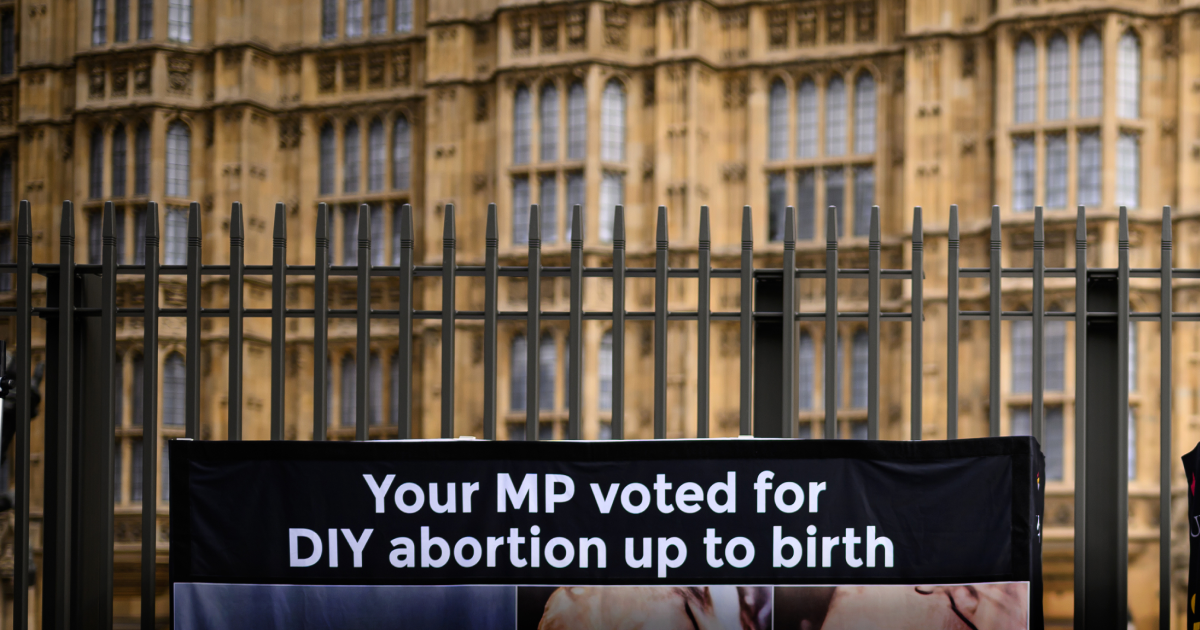


On 1 November, 27-year-old Paul Gardner, a former student at Cambridge and now a consultant, was showing two large posters of late-term unborn babies in and out of the womb, along with the image of an aborted foetus.
A member of the public complained to officers that the images were “offensive,” and Mr Gardner was arrested under Section 4A of the Public Order Act. He was taken to Cambridge police station and held for about six hours before being released; police later confirmed that no offence had been committed.
Mr Gardner, who was protesting with a small group from the Centre for Bio-Ethical Reform UK, said he was “very surprised” to find himself under arrest. “We were out on the street to inform the public about what most MPs have voted for… It feels absurd that I was arrested in Cambridge for showing what the MP for Cambridge approves,” he told the Telegraph.
He added that a passer-by had challenged them to produce a licence or other authority to justify their protest. “We have documentation that covers the rights that we have,” he said, pointing to a court case a decade ago that upheld the legality of displaying such images in public.
This clampdown on anti-abortion protesters is part of a nearly decade-long battle in Britain, where successive governments have sought to curtail pro-life views. Ironically, under the banner of defending the alleged “right to choose”, politicians have prevented women from accessing alternatives to abortion and have turned a blind eye in cases where women have been coerced into having one.
The battle finds its origins in April 2018, when west London’s Ealing Council introduced the country’s first buffer zone, banning demonstrations and prayer within 100 metres of a local abortion clinic amid complaints of patient harassment. Over the next few years, a handful of other councils followed suit with similar orders. A government inquiry at the time found such blanket zones “disproportionate”, noting that instances of serious intimidation were “rare” and that police already had powers to tackle genuinely abusive behaviour.
For a while, ministers declined to legislate nationally. But progressive pro-abortion campaigners kept up the pressure, arguing that only a uniform law could end the “postcode lottery” of where peaceful protest was banned and permitted.
Across the union, legislatures in Northern Ireland and Scotland moved ahead with their own “safe access zone” laws. After the UK Supreme Court upheld the legality of Northern Ireland’s ban on pro-life prayer gatherings as compatible with human rights, pressure was applied on Westminster to enact its own restrictions.
Silent prayer outside abortion clinics effectively became an arrestable offence in England and Wales under Section 9 of the Public Order Act 2023, banning silent prayer or any protest near abortion facilities. A nationwide 150-metre “buffer zone,” legally termed a Safe Access Zone, was mandated. In a free vote in 2023, Parliament rejected an amendment that sought to exempt silent prayer by 299 votes to 116.
The far-reaching law criminalises any act of “influencing” outside abortion sites, from demonstrations and counselling to quietly praying or crossing oneself near the entrance.
The policy has already led to the arrest of peaceful pro-life volunteers. In Birmingham, 45-year-old Isabel Vaughan-Spruce was detained after a passer-by reported her for standing quietly near a closed abortion clinic. When police questioned her, she acknowledged that she “might have been praying silently” in her mind, at which point officers searched her, arrested her, and charged her with violating a local buffer zone order. She had been carrying no sign or leaflet, only engaging in silent prayer.
“It’s abhorrently wrong that I was arrested … simply for praying in the privacy of my own mind,” said Ms Vaughan-Spruce after being released. “Nobody should be criminalised for thinking, for praying, in a public space in the UK.” Her case was later dropped by prosecutors, but only after she had been arrested a second time on the same charge weeks later.
Hers is not an isolated incident. In another case, a Catholic priest, Fr Sean Gough, was prosecuted for quietly praying and holding a sign about free speech within a Birmingham censorship zone, though a judge ultimately dismissed the charges.
In Bournemouth, Army veteran Adam Smith-Connor was convicted and penalised last year for silently praying for his deceased son outside a clinic, in breach of a council-imposed buffer zone.
As the policy took effect, former Home Secretary Suella Braverman wrote to all police chiefs to insist that “silent prayer, within itself, is not unlawful,” urging officers to use common sense and respect freedom of thought when enforcing the rules.
Scotland has also seen its police clamp down on dissenting views. In September of this year, Rose Docherty, a 75-year-old grandmother, was arrested for standing silently near a hospital with a placard around her neck bearing the words: “Coercion is a crime. Here to talk, only if you want.”
A video of the scene showed Docherty being arrested and searched, with two male officers taking the 75-year-old by the arms and placing her in the back of a police van. Having recently undergone a double hip replacement, she struggled to get into the van and had to crawl inside.
In Mr Gardner’s case, he was released without charge after being interrogated at Cambridge police station. The case shows the fragility of free expression in the UK, particularly when it pertains to the unborn, and while Mr Gardner’s case is the latest in the authoritarian crackdown on the UK’s pro-life movement, it will likely not be the last.