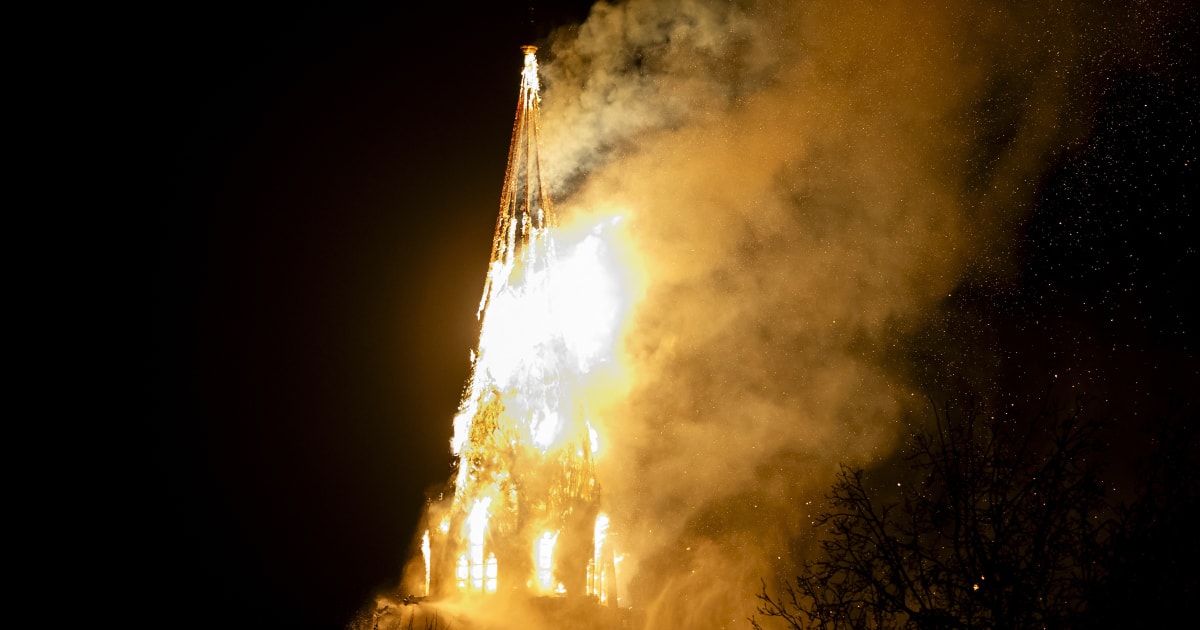

A historic church in Amsterdam was devastated by fire in the early hours of New Year’s Day as the Netherlands endured a turbulent New Year’s Eve marked by widespread disorder linked to fireworks.
The Vondelkerk, a nineteenth century former Catholic church overlooking the capital’s Vondelpark, was engulfed by flames shortly after midnight on 1 January. Emergency services were called as the blaze intensified, with firefighters quickly declaring a major incident. By the early morning, the church’s roof and its nearly 50 metre high tower had collapsed, and local authorities confirmed that the building could not be saved.
Residents in nearby properties were evacuated as a precaution because of heavy smoke and the risk of falling debris, but no injuries or fatalities were reported in connection with the fire. Officials said the cause of the blaze remained under investigation, although it was believed that fireworks played a role, amid reports of youth gangs setting off explosives in the area.
Amsterdam Mayor Femke Halsema also visited the scene of the fire. “It’s a very intense and terrible fire in this monumental church,” she said. “Our first concern and priority now is the well being and homes of the immediate residents.”
A local authority spokeswoman said the church was “no longer salvageable”, adding that “the entire church is on fire”. An emergency services spokesman warned that burning embers from “old wood” were being blown towards the city centre, while electricity supplies to around 100 nearby homes were cut during the night.
The fire at the Vondelkerk came during what Dutch authorities described as an exceptionally violent New Year’s Eve nationwide. The head of the Dutch Police Union, Nine Kooiman, reported an “unprecedented amount of violence against police and emergency services”, saying she herself had been pelted three times with fireworks and other explosives while working a shift in Amsterdam.
Across the country, attacks on police and firefighters were reported, including incidents in which petrol bombs were thrown at officers in the southern city of Breda. Two people, a seventeen year old boy and a thirty eight year old man, died in fireworks related accidents, while three others were seriously injured. Hospitals also reported a surge in injuries, with an eye hospital in Rotterdam treating fourteen patients, including ten minors, two of whom required surgery.
The disorder followed record spending on fireworks ahead of an expected ban on unofficial displays. According to the Dutch Pyrotechnics Association, 129 million euros was spent, despite the designation of firework free zones in several cities, which appeared to have limited effect.
The Vondelkerk was built between 1872 and 1880 to designs by the architect Pierre Cuypers. Originally consecrated as the Church of the Most Sacred Heart of Jesus, it served the Catholic Diocese of Haarlem Amsterdam until 1977. One of the first churches in the world dedicated to the Sacred Heart, it was constructed in a Neo Gothic style using distinctive coloured brickwork and innovative steel elements in its tower.
After its deconsecration, the building was adapted for cultural use, hosting concerts and private events, while other parts were converted into offices. The church had already survived a major fire in 1904, when its original tower collapsed during repair work but the rest of the structure endured and was later rebuilt.
The larger issue raised by the destruction is not only one of vandalism or civic disorder, but a philosophical one, whether Europe still understands what it is losing when its Christian inheritance is allowed to burn, literally and symbolically. The fate of churches is rarely only about buildings. It is an indicator of the health of the communities that once built them, sustained them, and believed in God.
The New Year’s fire echoes events from more than a century earlier. The blaze reads less like an isolated incident and more like a parable of Europe’s long spiritual unravelling. In 1904, the church also burned. According to official records, the cause was accidental, when a bucket of hot lead used to repair the tower clock tipped over and strong winds spread the flames. Within half an hour the tower collapsed, though the rest of the church survived and was later rebuilt.
That fire occurred in a Europe still confident enough in God and its culture to restore what was damaged. The church rose again, reconstructed by the architect’s son. Today’s fire feels different. The Vondelkerk, deconsecrated in the late twentieth century and repurposed, had come to be regarded primarily as a cultural venue, which itself signalled a retreat. When the flames came again, there was no shared sense of the loss of God, only evacuation zones, damage assessments, and official statements.
This is why the destruction resonates beyond Amsterdam. The violence of New Year’s Eve in the Netherlands, often attributed to disaffected youth, fireworks culture, or failures of policing, points to a deeper erosion of social cohesion. A society confident in its moral and spiritual foundations does not so easily descend into chaos. The Church has long taught that the natural order is not repression but harmony directed towards the good, and where that vision fades, disorder follows.
The parallel with 1904 is almost poetic. Then, fire broke out during an act of repair. Now, fire consumes what was no longer widely regarded as worth restoring. Europe, too, has lived amid smouldering embers since the Enlightenment, through secularisation, the sexual revolution of the 1960s, and internal ecclesial turmoil. What once might have been contained has been fanned by strong cultural winds into something far harder to control.


.jpg)
.jpg)
.jpg)
.jpg)