

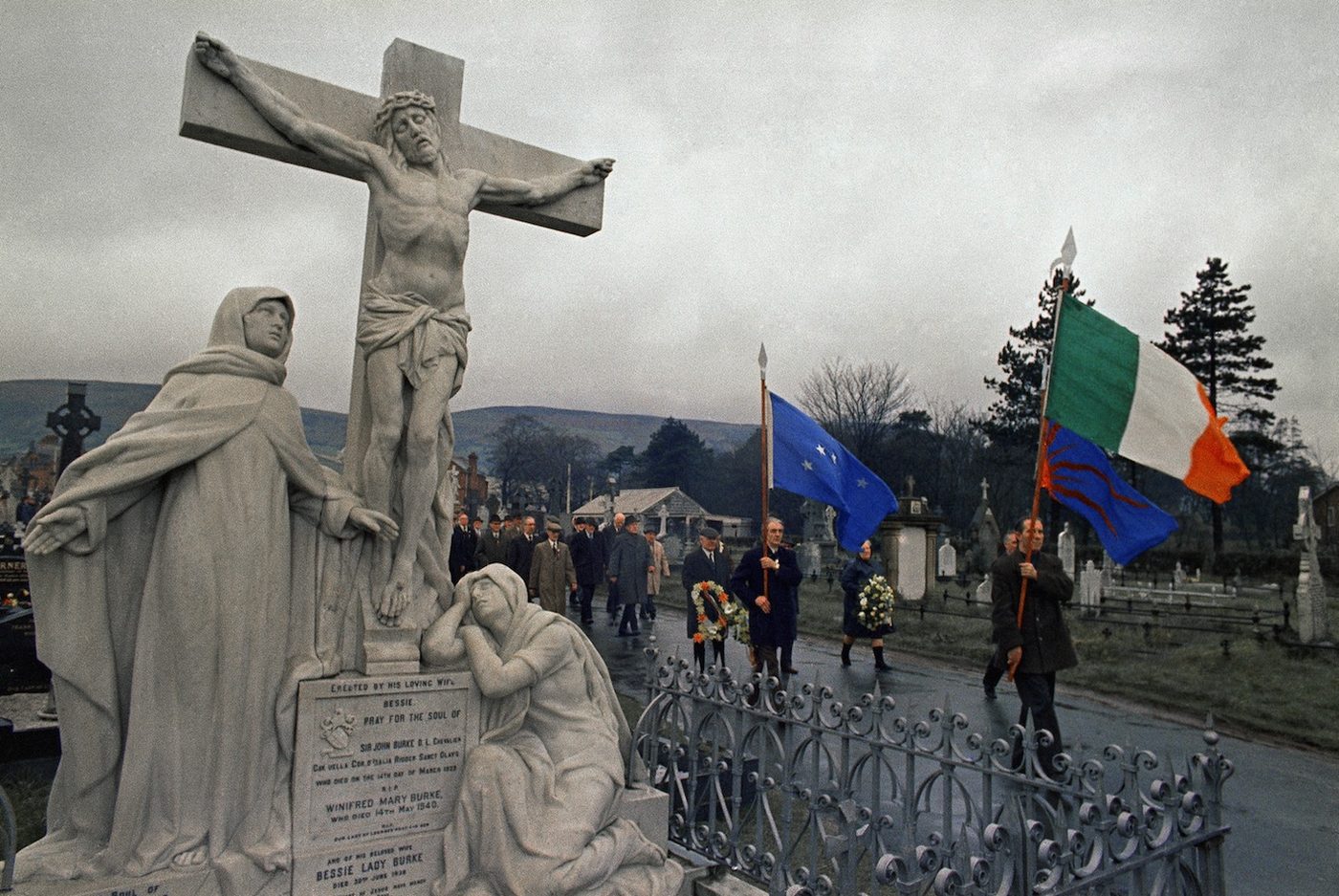
The Seven: The Lives and Legacies of the Founding Fathers of the Irish Republic by Ruth Dudley Edwards Oneworld, £14.99 The 1916 Easter Rising has always been held in renown, and infamy, for its religious rhetoric and symbolism. It was an event suffused with the language of sacrifice, blood-letting, martyrdom and rebirth. Its timing was scarcely coincidence, while the appellation “Rising” has firmly supplanted “Insurrection” and “Rebellion” as the name by which we all know it. And, even though the Easter Rising isn’t obediently venerated by Irishmen today as it once was, the events still serve as a foundation myth for the Irish state – hence the current swathe of commemorations in the country. The Rising’s most notorious protagonist, its chief signatory and its spiritual leader, Patrick Pearse, is often held to embody its quasi-religious nature. An austere, pious character, Pearse most infamously said that “Blood is a cleansing and sanctifying thing.” In the opinion of the late Conor Cruise O’Brien, “Pearse saw the Rising as a Passion Play with real blood”. Yet, as Ruth Dudley Edwards shows in this account of the lives of the seven signatories of the Proclamation of the Irish Republic, Pearse was not quite the puritanical oddball of modern legend. Although a devout Catholic, he frequently clashed with bishops and the hierarchy on account of his belief in lay education. He made enemies, too, with Irish language purists who sought total cultural purification. Pearse, who would recite Shakespeare as a youth, was no enemy of the English language. And while he drank deep from Gaelic literature, he was just as fascinated by Norse mythology and the works of Richard Wagner – who proved a fertile source for Pearse’s potent ideas about “masculinity, national identity and cultural regeneration”. The leaders of the 1916 rising were fiercely intelligent men, and very much of their time, being high-minded, aspirational Edwardians possessed of various idiosyncracies. There was the solemn and confident Fenian veteran Thomas J Clarke, who had previously survived solitary confinement in Britain, and whose father served in the British Army and fought the Russians in Crimea. While the Scotsman and socialist James Connolly could be both eloquent and tyrannical, Thomas MacDonagh was a self-deprecating poet and dreamer. The handsome idealist Seán MacDiarmada was a Belfast tram conductor who was sacked for smoking on the job. Then there was the shy and diligent Éamonn Ceannt, who as a youth would go down to the Dublin quays when a foreign boat arrived, in the hope of practising his French or German on foreign sailors. Or the sickly Joseph Plunkett, who studied at the Jesuit college Stonyhurst, Lancashire, and idolised GK Chesterton. Plunkett’s interests also included physics, poetry, chemistry and aeronautics, and in 1907 he helped to establish the Irish Esperanto Association. That such fertile minds should have become gunmen seems bizarre, if not wasteful. Their execution by the British makes the waste seem even more needless. It was the latter act that helped garner support for the rebels, most of whom were heckled by ordinary Dubliners in Easter 1916. Many of their husbands and sons were away on the Western Front and the so-called “stab in the back” was felt just as harshly by the Irish as by the British. Fewer than 1,800 were involved in the Easter Rising while around 200,000 uniformed Irishmen served in the army during the Great War. The Seven is a fascinating study, albeit burdened by a superabundance of quoted sources and unnecessary footnotes. Perhaps bewildering for the uninitiated, the book is nonetheless an ideal companion for those with a sound grasp and interest of the events of that time, and the debates on 1916 that have ensued since. Although Edwards decries the action of the insurgents, their naïvety with regard to Ulster and its loyalist populace, and their divisive legacy which only really achieved closure in 1998, she sees her subjects in all their humanity, for their idealism, romanticism and eccentricities, conceding that “the rebels were brave, and though the Seven had no conceivable justification for taking it upon themselves to bring death and destruction on their country, there was no denying their many fine qualities.” If the Easter Rising has much of its roots in Christian narrative, it’s because tales of youthful self-sacrifice – misguided or not – will always fascinate and haunt us. So, too, will hubris and tragedy. Consider the account of the London-born Irish intellectual Desmond Fitzgerald, an eyewitness to the events. In the denouement, he couldn’t help but feel sorry for Pearse as he looked upon his face: “Its natural gravity now conveyed a sense of great tragedy. There was no doubt in my mind that when he looked round at all the men and girls there, he was convinced that they must all perish in the Rising to which he had brought them.” If only Pearse had listened to the appeals of his sister Mary Brigid, who pleaded with him on the first day of the Rising: “Come home, Pat, and leave all this foolishness.”
1:00 PM
Why Ireland’s idealists turned into gunmen
Patrick West

5 min read



Already a subscriber? Sign in
5freearticles every month
Continue reading with a free account. No card needed.
- Five free articles every thirty days, on any device you sign in on
- The Catholic Herald newsletter, every morning
- Subscribe whenever you like for everything: every article and the magazine

subscribe to the catholic herald today
Our best content is exclusively available to our subscribers. Subscribe today and gain instant access to expert analysis, in-depth articles, and thought-provoking insights—anytime, anywhere. Don’t miss out on the conversations that matter most.
Subscribe



