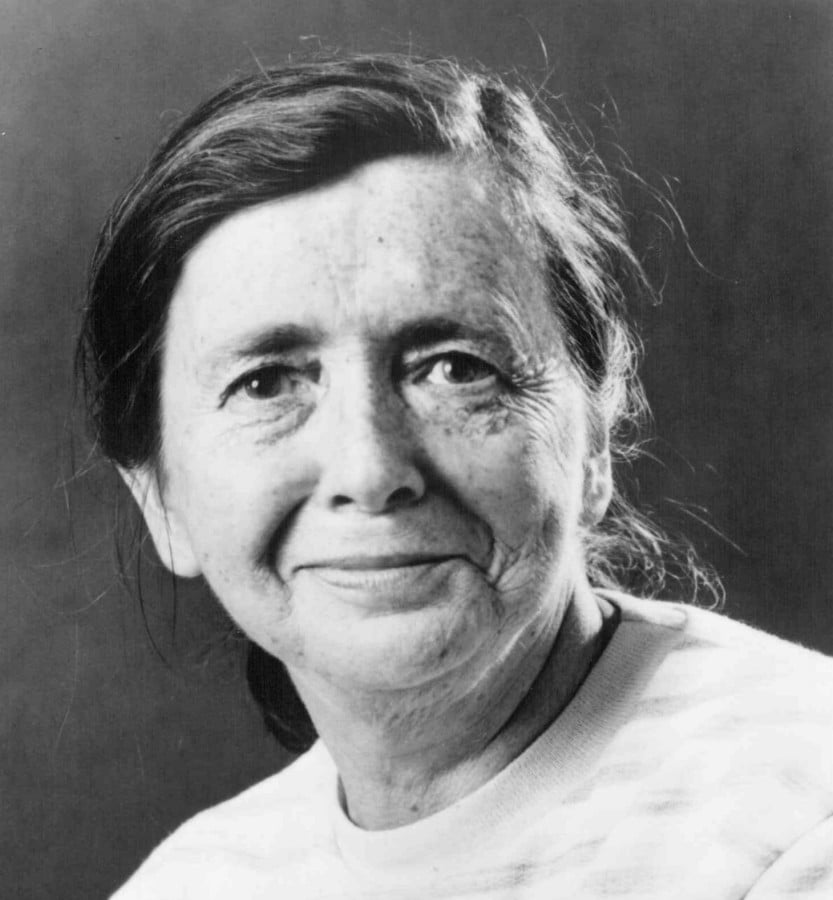


Orphaned and elderly and yet a child For so I am when thoughts of you return, Return and batter me and I'm not mild But close to rears and scarred for these tears burn, You tamed me when most wild..."
Accident prone and plagued by headaches and blackouts, Jennings nevertheless recalls her childhood as a lost Golden Age. While other children were amusing themselves with dolls or playing Cowboys and Indians, she was either talking to her imaginary brother, Jack Baycock, who lived in the garage, or simulating Mass with her sister, using a toy stove as a makeshift tabernacle and gibberish for Latin. "I envied the boys lighting candles and swinging incense," says Jennings, laughing. "I had a very rich imaginative life." But for a sensitive child with a vivid imagination, the darker side of Catholicism provided a breeding ground for doubt and fear. "First Confession" records the dread inspired by the confessional's "impersonal grille". Introspection set in, "awful storms of fear" raging before each confession thereafter. Her teenage years were to be the worst of her life. "I showed all the classic signs of a juvenile delinquent. I just had this terrible rage. I shall never forget that feeling of being beside yourself, out of control. Oh! I wouldn't have 15 to 18 again. All the inward turning, the doubts, the difficulties." Poetry was to be the lifelong outlet for this tumultuous inner life and by 15 she was already writing steadily. After reading English at Oxford, Jennings worked at Oxford City Library for eight years followed by two years at Chatto in the late 1950's. But working, and socialising whilst also trying to write proved too much for Jennings and in 1960 she had a nervous breakdown, leading to two years in a psychiatric hospital followed by years of therapy. "To say I didn't get on very well with the doctors is an understatement." An engagement at Oxford and various love affairs never led to marriage. "I wouldn't have been a good proposition for marriage. I jump out of bed to write poems. I don't like housework. I think I like being independent. I am a romantic and I don't think romance lasts. I can't bear things ending." Home is a rented room in north Oxford where she is surrounded by a cherished collection of dolls' houses, Dinky cars, books and musical boxes. "The only good thing about not being a millionaire." she suggests cheerily, "is that you wouldn't have the fun of collecting." Film and theatre are other favourites but, says Jennings, "I usually sleep at the beginning of every film I see because I don't sleep much at night. I nearly always have to go two or three times. My lifelong pin-up is John Gielgud." This sets in motion praise for a gallery of stars which includes the "wonderful" Kenneth Branagh, Al Pacino, whose performance in Scent of a Woman" she deems "extraordinary" ("It's about human goodness. I've been to see it umpteen times"), the Queen ("and not just because she gave me an award"). and the "swept" Sue Lawley. "I was so thrilled to be on Desert Island Discs. I was visibly shaking." In fact, with the exception of John Major and Margaret Thatcher, she doesn't have a bad word for anybody. "I like looking up to people. I hate cynicism." She is knowledgeable and effusive about favourite poets Auden, Eliot ("a great man") and Catholic staples like Hopkins and Walter de la Mare. Even the misanthropic Philip Larkin she found to be "delightful and charming". Of herself she says that she would like to be remembered "as someone who wrote good poems..." The "sure days of childhood" longed for in "An Age of Doubt" have never returned. "I often have doubt," she says, into a long pause. "I think everybody does, don't you? What I find very difficult is to think what it's like when the spirit is taken away from the body. Jennings's biggest fear is "the fear of never being able to write again. Sometimes I feel that an act of the imagination is more use than an act of faith. You may read Jennings' review of a book of memories of C. S. Lewis ("at first sight something of a disappointment") here.