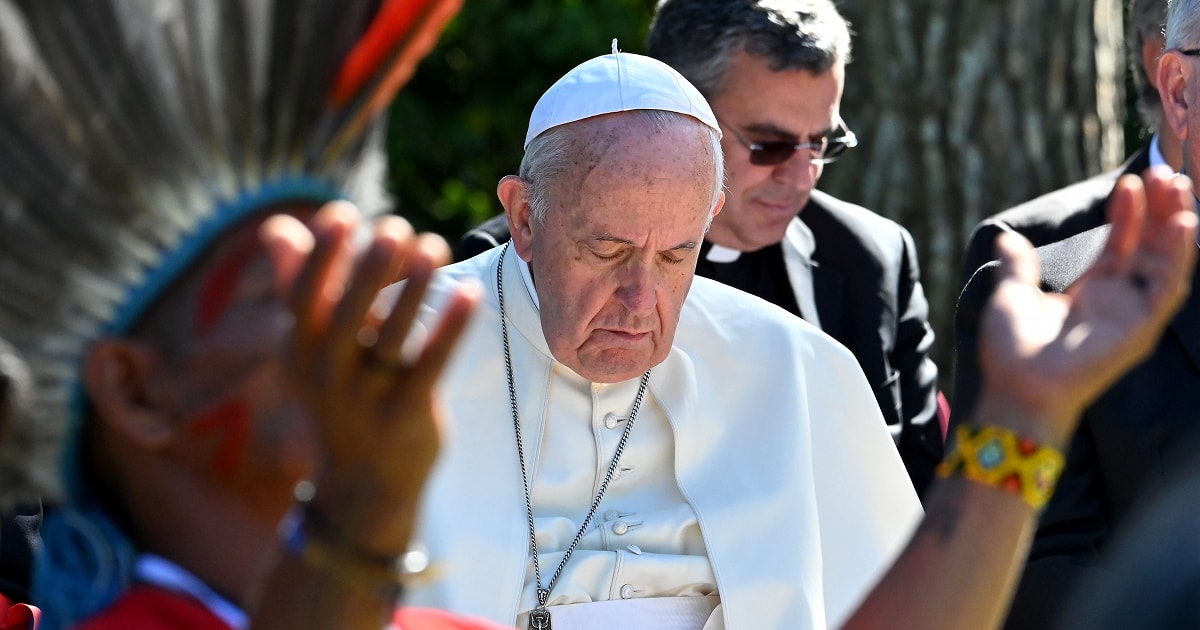


The retired Amazonian bishop Erwin Kräutler has claimed that “pressure” prevented Pope Francis from permitting the ordination of married men after the 2019 Synod on the Amazon.
Speaking to Kath.ch on March 27, Kräutler said the Pope had appeared receptive to reform during the synodal process but ultimately stepped back when issuing the 2020 apostolic exhortation Querida Amazonia. “That makes me wonder: who is responsible for this rift?” he said, pointing to what he regards as a clear divergence between the synod’s direction and the final papal text.
The former Bishop of Xingu, who led the Brazilian prelature from 1981 to 2015 and was closely involved in preparing the synod, was more direct in his assessment of the decision-making process.
“I still believe that Pope Francis didn’t want it, but that he was under so much pressure that he couldn’t do otherwise, psychologically, personally,” he said. “He then no longer dared to allow the ordination of married men to the priesthood, even though he had previously encouraged bold proposals.”
The ordination of viri probati, married men of recognised faith and standing, had emerged during the synod as a widely supported proposal to address the chronic shortage of priests across vast areas of the Amazon basin. In many communities, the Eucharist is celebrated only infrequently because of the scarcity of clergy, a situation repeatedly highlighted by bishops during the October 2019 gathering in Rome.
According to the synod’s final report, more than two-thirds of participants backed the idea. The measure was framed not as a general relaxation of clerical celibacy but as a limited and pastoral response to exceptional circumstances. Yet when Querida Amazonia was published in February 2020, the proposal was absent.
Kräutler described the document as initially promising. “Until the Church’s vision, we were all happy,” he said, adding that the ecclesial sections themselves were “formulated ‘wonderfully’”. He pointed in particular to passages stressing the need to ensure that the faithful in the region have access to the Eucharist. “And then came the break,” he said. “I ask myself: Who is responsible for this break?”
He acknowledged that he could not identify the source of the alleged pressure. “Even today, when I read about it, it seems to me that there was a second hand, or a third hand, or someone else behind it,” he said, while conceding that he lacked “the necessary access” to determine who might have intervened.
The bishop also indicated that the expectations of the Amazonian episcopate had extended beyond the question of married clergy. “We wanted women to also have access to Holy Orders,” he said, noting that many communities in the region are already effectively led by women in the absence of priests. “Most small parishes are already led by women.”
He argued that such changes fall within the Church’s disciplinary competence rather than its unchangeable doctrine. “These are all canonical decisions that can be reversed with a signature,” he said, suggesting that the bishops had anticipated decisive action following the synod.
Kräutler has previously spoken of his disappointment at the outcome of the process. In an earlier interview following the publication of Querida Amazonia, he said he had expected “a bold decision” from the Pope, especially given Francis’s repeated encouragement to the bishops to propose “courageous” solutions. He also drew attention to the pastoral realities on the ground, observing that “in some regions, thousands of communities celebrate the Eucharist … only a few times a year due to a shortage of ordained ministers.”
At the same time, the bishop has consistently expressed admiration for Francis’s broader approach to the Amazon and to environmental questions. Reflecting on the 2015 encyclical Laudato si’, he said: “That is beyond question. No pope before him has published an encyclical on the environmental issue.” He added that the Pope had made “an urgent appeal to all men and women of goodwill … to hear the cry of tormented creation”.