By April 2011, something remarkable was beginning to happen. Across England, groups of Anglican clergy and lay faithful were quietly preparing to cross the Tiber together, stepping into the unknown with the newly created Ordinariate of Our Lady of Walsingham. Mgr Keith Newton and his two assistants, Mgrs Broadhurst and Burnham, had already been ordained to the priesthood on January 15, 2011. Now the next wave of candidates was assembling dossiers and CVs for Rome, while during Holy Week entire parish groups were being received into the full communion of the Catholic Church alongside their pastors.
You might be wondering how this disparate group of clergy, about a hundred in number, along with their groups of faithful, managed to arrive at this point. This is a story in itself, and its many twists and turns would take an age to tell, but the process began the previous autumn when, by word of mouth, by email, by phone call, various clergy were sounded out about whether they were minded to accept Pope Benedict’s offer. Gradually, and perhaps somewhat surreptitiously, a group of clergy was assembled, and we met, first, at the offices of the traditional Anglo-Catholic organisation Forward in Faith in Gordon Square, London. In the early stages, the meetings included a variety of opinions: the definitely committed, the nearly-theres and some not-quite-so-sures. When, inevitably, news of these gatherings leaked, we met at the Carmelite Priory in Kensington Church Street. By this time, our minds were made up, our groups were taking shape and our resignations taking effect on Palm Sunday 2011.
If it sounds hectic, believe me, it was. By now, the clergy, candidates for ordination, were meeting regularly at Allen Hall, the Archdiocese of Westminster’s seminary, for lectures. Quite what the seminarians at the time made of these regular invasions by a large and noisy crowd of recent converts from the Church of England being warp-speeded towards ordination is anybody’s guess, but they were very kind.
But there’s no denying that it was a stressful time. Exciting, yes, but also painful. Not every friendship endured the parting of the ways, and the smell of cordite from the battlefield that we had just left took some months to leave our nostrils. On this side of the Tiber, the welcome was generally warm, but it is fair to say there were some whose enthusiasm for this new jurisdiction was far from unbounded.
From the Anglican side – perhaps not surprisingly – there was a considerable degree of hostility from some quarters. In 2010, an interview with the then Archbishop of York, John Sentamu, gives some sense of the intensity of feeling. Interviewed on Radio 4’s Sunday Programme on February 6, 2010, he said: “If people genuinely realise that they want to be Roman Catholic, they should convert properly, and go through catechesis and be made proper Catholics. This kind of creation – well, all I can say is, we wish them every blessing and may the Lord encourage them. But as far as I am concerned, if I was really, genuinely wanting to convert, I wouldn’t go into an Ordinariate. I would actually go into catechesis and become a truly converted Roman Catholic and be accepted.”
This kind of comment was not unusual, even if it was understandable, given the strength of feeling at the time. Some in the Church of England interpreted Pope Benedict’s Apostolic Constitution as a hostile act, akin, as one prominent Anglican churchman said at the time, to parking a tank on the Church of England’s lawn. Nonetheless, the gibe that those who intended to accept Pope Benedict’s invitation, extended through the Apostolic Constitution Anglicanorum coetibus, would somehow not be proper Catholics landed, followed us around and became difficult to shake off. One online wit coined the term “fraudinariate”, another (slightly more clunkily) “backdoordinariate”.
But such noises off were by no means the whole story, and many Anglicans, while not agreeing with our decision, or with the reasons for it, wished us well.
A great many gallons of water have flown under the Ponte Sant’Angelo since then, however, and mercifully some of the wounds of that era have begun to heal.
After all, the Ordinariate was brand new, and very suddenly a job lot of ex-Anglican clergy was appearing on the scene, along with their groups of lay faithful. There was accommodation to be found, and buildings to be identified for their use, ministries to which they could be assigned. For a Church that likes to think in centuries, the erection of the Ordinariate, and the breakneck speed of the events that followed, must have been a great shock to the ecclesial system, and any negative reaction to our presence at the time was akin to an immune response from a body not quite sure whether this new entity was friend or foe. As we geared up for the great adventures that lay ahead, we also had to ponder the question of Anglican patrimony. What, actually, was it?
The Anglo-Catholic scene in Britain, especially since the 1980s, very largely embraced the reforms of the Second Vatican Council. What is more, many clergy adopted the missal that emerged from it as well. In the Edmonton Episcopal Area of the London Diocese, for instance, where I served all my parochial ministry in the Church of England, it was the proud boast of many of its parishes that Anglican liturgical books were rarely to be found, much less used.
So it was that the question of what constituted Anglican patrimony was a pressing one, not least for many of those of us offering ourselves for service within the Ordinariate. For some of us, it might be said that these were lessons we had to relearn before we could start teaching them to others.
Just prior to my diaconal ordination, the fifteenth anniversary of which was May 6, 2011, I had an interview with Cardinal (then Archbishop) Vincent Nichols. During the course of it, he asked me to address this very question. When I attempted a response I found myself saying that, if I had any Anglican bones in my body, they were very small, but very significant. They were the bones in my ear, and they helped me to fall in love with the great musical patrimony of the Anglican Church: the music of Sumsion, Stanford, Howells, Wesley and Parry, and the dignified beauty of Anglican chant. Even, and perhaps especially in a cold cathedral in February, if Evensong cannot point us in the direction of Heaven, nothing can.
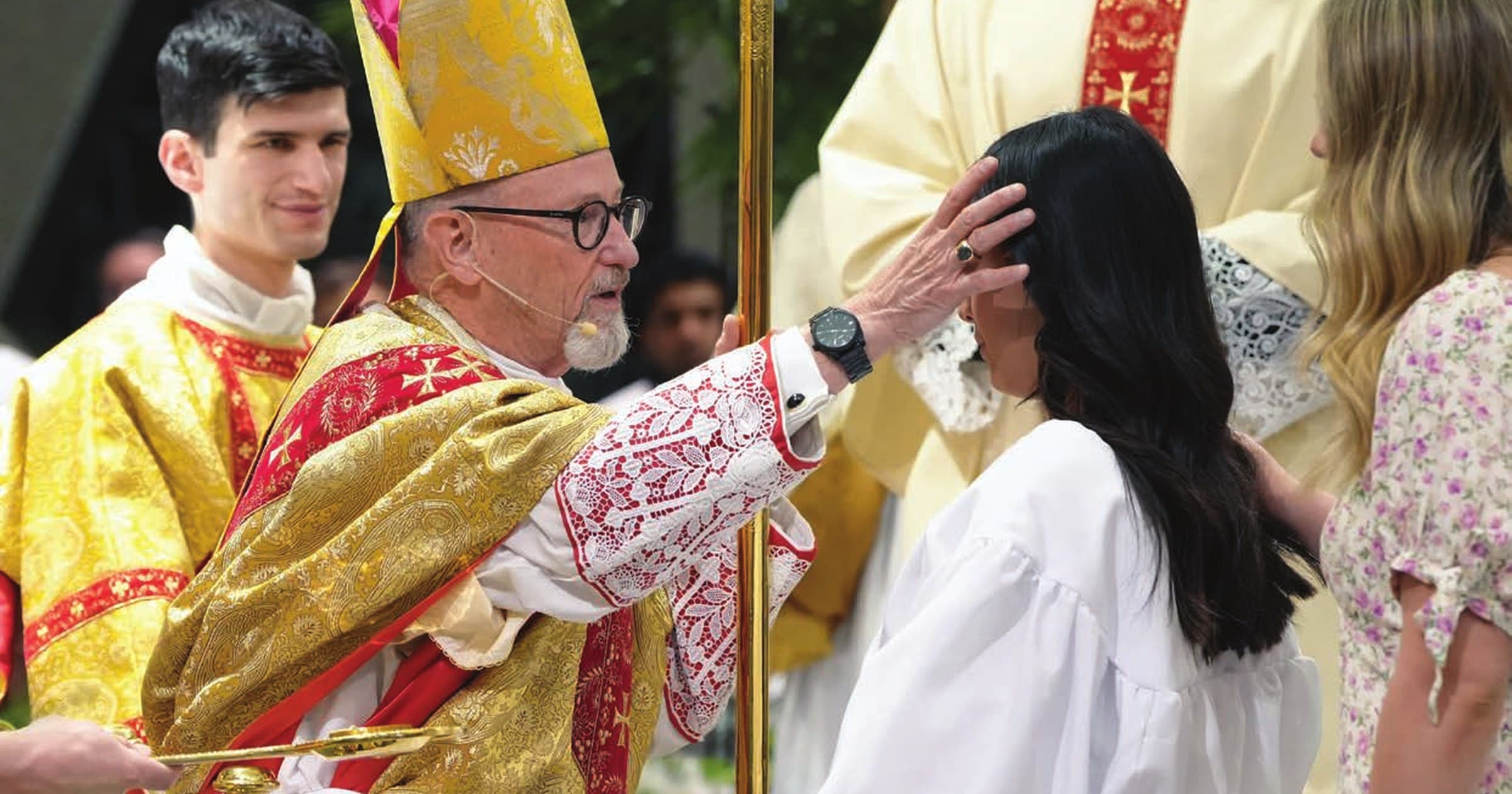
During the course of 2011, those who had come forward and offered themselves as candidates for ordination found themselves in cathedrals up and down the land, standing before various bishops and archbishops, and promising obedience and respect to our Ordinary, lying prostrate on the ground, entrusting themselves to the intercession of the Apostles and Evangelists, to martyrs and confessors, and to all holy men and women, and finally, kneeling before the bishop who, in the laying on of hands and prayer, bestowed on us the dignity of the priesthood.
There are no words to convey the sense of adventure of this period. Suddenly, all the upheaval of the previous weeks and months, the anxiety of leaving what was secure and settled, and setting out on this wild journey into the unknown, became worthwhile, and we began to knuckle down to the various ministries to which we had been assigned. In my case, it was to be the Catholic chaplain to the Whittington Hospital in Highgate, north London, and then, in 2013, to be the parochial administrator, and later rector, of the Church of Our Lady of the Assumption and Saint Gregory, Warwick Street.
How have we fared in the years that have passed since then? And what might we learn from what has happened since those early days? Our first task was to establish ourselves as a Particular Church, with a distinctive mission and identity. This was not easy at first. No criticism is intended here, but the new batch of Catholic priests and one or two permanent deacons were, only months before, still serving in the Church of England. Those of us in the first wave were ordained at lightning speed, which I have no doubt caused understandable resentment in some quarters. I can imagine that some bishops, too, used to ordaining seminarians after they had spent six years in seminary, wondered what they were letting themselves in for when they ordained men they barely knew.
After all, we had left the Church of England, and it wasn’t an entirely amicable separation. We had been an awkward squad and, to a certain extent, a thorn in the side of a Church that wished to press ahead with the ordination of women to the episcopate, despite the new and seemingly insuperable obstacle to Catholic unity this would create. Would this group of possibly bloody-minded men, with the Oil of Chrism barely dry on their hands, settle and adjust to their new setting and culture?
Small though we are, we hope we have done so, while carefully navigating the delicate boundary between being a Particular Church and working within diocesan structures. It’s a ticklish balance to strike, and the challenge for Ordinariate priests is how to do justice to the work of being, say, a prison or hospital chaplain, and also having the care of an Ordinariate group.
This is one challenge. A second is that we are still numerically small. While we are blessed with a healthy number of clergy, we serve only about 1,870 lay faithful. As many a priest has pointed out to me, “that’s the size of one or two large Catholic parishes!” It’s a fair comment.
What the Ordinariate has shown time and time again is that when energetic and enterprising clergy are entrusted with buildings, numbers do increase. The people who feel drawn to Ordinariate communities are often young, and often searching for something that speaks to them of the eternal, the true and the beautiful.
A recent document that was drafted by the Dicastery for the Doctrine of the Faith following the meeting of the three Bishop Ordinaries in Rome spoke of the unique gifts that the Ordinariates bring to the universal Church.
One of these gifts was evangelisation through beauty. No one would deny that this is naturally true of Catholicism in general, but there is a special awareness in the Ordinariates of the power of dignified liturgy and of sacred music to lead minds and hearts to God. This is not aesthetics for the sake of aesthetics. It isn’t High Churchery for the sake of High Churchery. Rather it speaks to the fundamental human intuition that beauty is a reflection of God’s love for us, and our love for God.
Liturgy has the ability to remove the heart of stone and give us a heart of flesh. To contemplate the Eucharistic Lord in the beauty of the liturgy is the beginning of wisdom, and inevitably leads us to seek his face in others, most notably the poor and marginalised. This, too, is one of the aspects of the core identity of the Ordinariates, and is rooted in Anglo-Catholic history, the so-called “slum priests” of the nineteenth century, with its focus on and devotion to the poorest and most underprivileged parts of society.
The words of Bishop Frank Weston, Bishop of Zanzibar, addressed to the Anglo-Catholic Congress of 1923, are probably engraved on the hearts of any self-respecting former Anglo-Catholic priest: “Go out and look for Jesus in the ragged, in the naked, in the oppressed and sweated, in those who have lost hope, in those who are struggling to make good. Look for Jesus. And when you see him, gird yourselves with his towel and try to wash their feet.”
Small can be beautiful. The groups that we do have may not be vast, but one advantage of this is that there is a strong sense of community. There is a domesticity about such groups, and where there is a social life alongside the liturgical, then the bonds of friendship and affection are strong, and, although the primary responsibility remains with the pastor, there is awareness that we are all in some measure responsible for each other.
So what might happen next? Predicting the future is a fool’s undertaking, but I think it is possible to make some tentative suggestions about how the Ordinariate will develop in the future, based on the recent past.
First, what will the presbyterate be like? At the very beginning, and for quite a few years after, the presbyterate was exclusively drawn from the ranks of former Anglican clergy. There was a second wave of such clergy in 2012, and a smaller third wave in 2013. Thereafter, a regular trickle of those offering themselves for ordination have continued to press the buzzer of the front door at 24 Golden Square, submit their dossiers to the Dicastery for the Doctrine of the Faith, and proceed to ordination.
More recently, though, a subtle shift has taken place, which I predict will alter the DNA of the Ordinariate somewhat: we now have priests who were not ordained in the Church of England, but who were received as laymen, and then discerned a call to priesthood through the Ordinariate, and who were formed for a full six years in seminary. Currently, we have three men in their first year of formation at Allen Hall. Please God, in due time they will serve as priests for many years. Unlike convert clergy, these will be men who have been formed alongside diocesan candidates and those in religious congregations.
This can only be a positive development. Six years is a long time, and during that time lifelong friendships are formed; and when people from very different backgrounds and traditions get to know each other, and to understand that difference is no threat, then the Church is enriched. Therefore I would like to suggest that the Ordinariate will, in time, be increasingly seen as just one other distinctive face of the Catholic Church in the land, with its own gifts and charisms. As the memories of the breach with the Church of England recede further, and eventually become part of history, the Anglican register of the Ordinariate liturgy will come to be seen, not as some niche corner of the Catholic Church, but as one crucial tool of evangelisation, uniquely suited to these isles.
Another shift will, I pray, happen in the next 20 or 30 years. The Ordinariate will not always be peopled exclusively with those who have been received into the Catholic Church from the Church of England or another corner of the Anglican tradition. There are now children of families who are members of the Ordinariate while also being cradle Catholics. They have known nothing other than being Catholics. One day, who knows, one of these will discern a call to priesthood, and will be the first cradle Catholic, born within the Ordinariate, to be ordained for service within it. That will be a sign that we have come of age.
Cardinal Víctor Fernández, Prefect of the Dicastery for the Doctrine of the Faith, preaching at the episcopal ordination of Bishop David Waller, our second Ordinary, noted that “the Ordinariate represents one of the faces of the Church, which, in this case, receives certain elements of the rich history of the Anglican tradition: elements that are now lived out in the fullness of Catholic communion”.
This is a crucial observation. This tradition has shaped English culture in ways that are far-reaching and enduring; it has influenced the work of Jane Austen, of Christina Rossetti, the poetry of TS Eliot, and the apologetics of CS Lewis; the music of Vaughan Williams, of Herbert Howells, of Kenneth Leighton and Benjamin Britten, and countless others. It is not only a rich inheritance. It is a priceless one. When harnessed to Catholic truth it endows the Church with a fresh potency to draw people to Christ, which after all is our primary purpose.
For the first 13 years, Monsignor Keith Newton worked ceaselessly to establish the Ordinariate here in the UK. It must have been a formidable task to bring this nascent structure to life: to steer the first candidates towards ordination, to oversee the first groups of lay faithful, to be in endless conversations with bishops throughout the UK, to travel its length and breadth and visit its communities. Thank you, Monsignor, for all that you did. It can’t have been easy.
Since 2024, Bishop David Waller, our second Ordinary, and our first bishop, has been building on those foundations, and preparing to take the Ordinariate on the next stage of its pilgrimage.
It has, without doubt, been the most extraordinary 15 years. We started, not quite sure where we were going, or how we were going to get there. Today, the Ordinariate is still finding its teenage feet, but as we continue to grow, we ask for the intercession of Our Lady of Walsingham, and of our patron, the newest Doctor of the Church, St John Henry Newman, that God will continue to guide us in the years ahead, and enable the Ordinariate to fulfil its vocation to be a treasure to be shared.