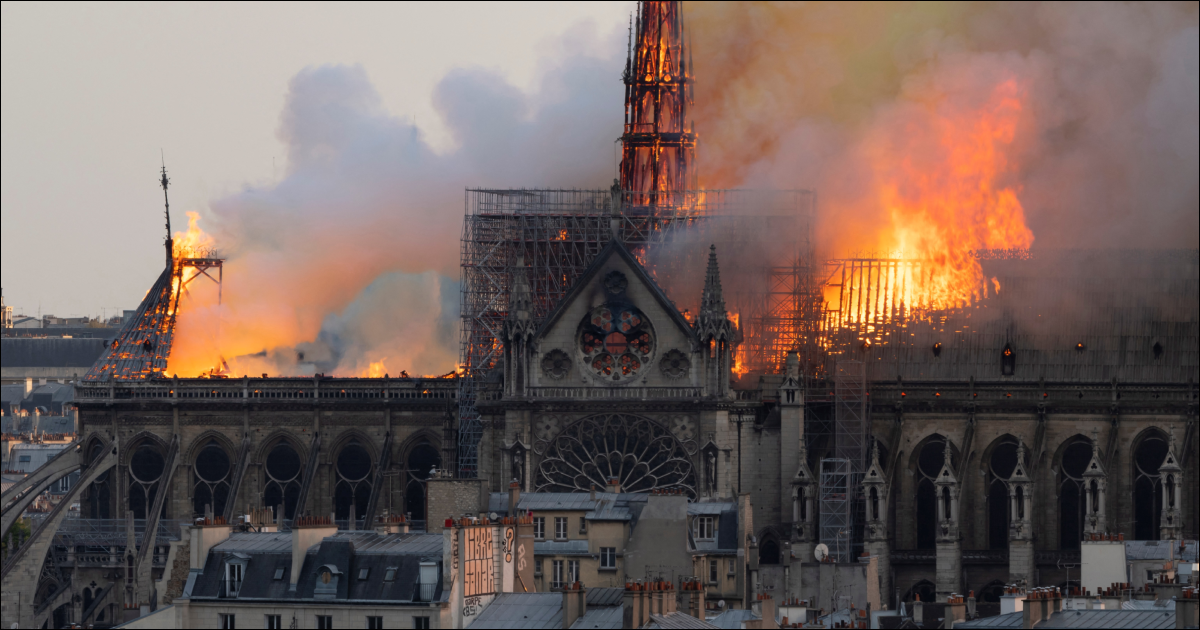


The French Church is suffering on all fronts. Low attendance is seeing the closure of churches across the country. The ever-increasing attacks on its buildings strike the parishes that remain open. Where it does see growth, namely in traditional forms of Catholicism, it represents a stark rejection of the new France in which the Church seems more and more unwelcome.
This month, three churches were vandalised within the Archdiocese of Tours. It was not the first time. In November 2024, four churches were targeted. Last week, however, the desecration of the Blessed Sacrament caused a reaction that bypassed any despondent acceptance of what churches now regularly suffer in the country.
The buildings were looted, objects were defaced and the tabernacle was forced open before the desecration occurred. The archdiocese said the “painful and hurtful events” reveal how French society “is permeated by forms of violence, lack of culture and worrying lack of civility”. It held Masses of reparation in response.
Mayor of Chambray-lès-Tours Michel Lamy said the incident had evoked “deep indignation” and called it an attack on “our heritage”.
The Catholic heritage of France is indeed under attack. A report published by the French Interior Ministry in May found that anti-Christian acts have been increasing for more than 15 years. In 2025, there were 817 anti-Catholic incidents, with almost 90 per cent of those involving attacks on Church property.
Those attacks come with an implicit message that the Church is unwelcome amongst an unignorable minority in French society. Sometimes, they also come with an explicit message. In December 2025, the church of St Marie-Madeleine in the Diocese of Marseille was vandalised, with graffiti reading: "The only church that illuminates is the one that burns".
That same month, a study by the Observatory of Religious Heritage found that France loses one religious building each week, with two-thirds of fires showing signs of deliberate arson.
The Observatory on Intolerance and Discrimination Against Christians (OIDAC) said the country continues to record the highest number of such incidents in Europe. Behind the vandalism can lie a number of motives, including militant secularism and Islamism.
It is not limited to France, either. OIDAC noted in its documentation of anti-Christian hate crimes in Europe: “Alarmingly, 94 arson attacks were recorded – almost double the previous year’s total. One-third of these occurred in Germany, where the Bishops’ Conference recently warned that ‘all taboos have been broken’ regarding church vandalism.”
It continued: “The most affected countries in 2024 were France, the United Kingdom, Germany, and Spain. In November, a 76-year-old monk was killed and several others injured during an attack on a Spanish monastery. In January, one man was shot dead in an ISIS-related attack during Sunday Mass at a Catholic church in Istanbul. In September, a historic church in Saint-Omer, France, was almost completely destroyed in an arson attack.”
The report believed that there was “significant underreporting” of aggression against clergy in Poland and Spain. Almost half of surveyed priests in Poland reported experiencing aggression in the past year, but more than 8 per cent did not report the incident to the police.
Thibault van den Bossche of the European Centre for Law and Justice, said to Europe1 last year that Christians do “not dare to complain. Not filing a complaint does not follow it up, the authorities cannot intervene and therefore do not give visibility to this phenomenon which is very real and dangerous and tragic”.
“The difficulty is that police statistics are not made in a homogeneous way. For example, in Germany, it is only politically motivated acts that are taken into account and not religiously motivated. It distorts the statistics made by the State,” he said.
He noted the prominence of Islamist physical attacks as well as the contribution of “exacerbated secularism” which aims not just at the neutrality of the State on matters of religion but of public space as well. The secularist position comes into direct conflict with France’s Christian roots, a fact van den Bossche said was “undeniable”.
“It contributes to the anti-Christian climate to hunt down Christian signs in the public space,” he said.
It has been noted before that there are two Frances. The distinction between them – the Catholic old and the secular new – has not always been as clear-cut as many would assume, but it is embedded into its society, history and conception of itself. French laïcité – secularism – pioneered both the concept and its rigorousness. It originated in the radicalism of the French Revolution to reduce the Church in whatever capacity it could. It remains today in a tempered, sanitised form.
A 2004 law presented by the Minister for Youth, National Education and Research to “reaffirm the principle of secularism” in public schools, colleges and high schools prohibited the “wearing of signs or clothing by which pupils ostensibly manifest a religious affiliation”. It allowed only for the possibility of “discreet” signs of religious affiliation.
The French Government notes that while public officials are free to engage in religious practice “in a private capacity”, they are bound by the obligation of neutrality. According to the obligation, they are forbidden from displaying their religious convictions.
And yet the intensity with which France demands secularism cannot, as van den Bossche noted, be separated from its deep Catholic roots. It is those roots which give rise to the need to manifest total religious neutrality. Part of the reason that France is losing so many churches is that it has such an abundance of them, a wealth of architecture created by centuries of labour and devotion.
As each church is lost, France leads the way for Europe as it gradually loses the cultural memory of what once defined it: the Catholic Faith. As that process continues, the Church finds herself in the unfortunate position of suffering abuse whilst wondering if there is anything that can be done to stop it.