When I first heard the news about Ann Widdecombe’s death, I was surprised. Seventy-eight is a ripe old age, but in recent months she had seemed quite undiminished in her usual vitality and verve. Then, when the news broke that this was a case not merely of an untimely death but of murder, my reaction turned to dismay.
Mixed in with that dismay was my scepticism over the police’s insistence that there was no suggestion of any political motivation for the heinous act. With the counter-terrorism police now taking over the investigation, it appears that that scepticism was well grounded.
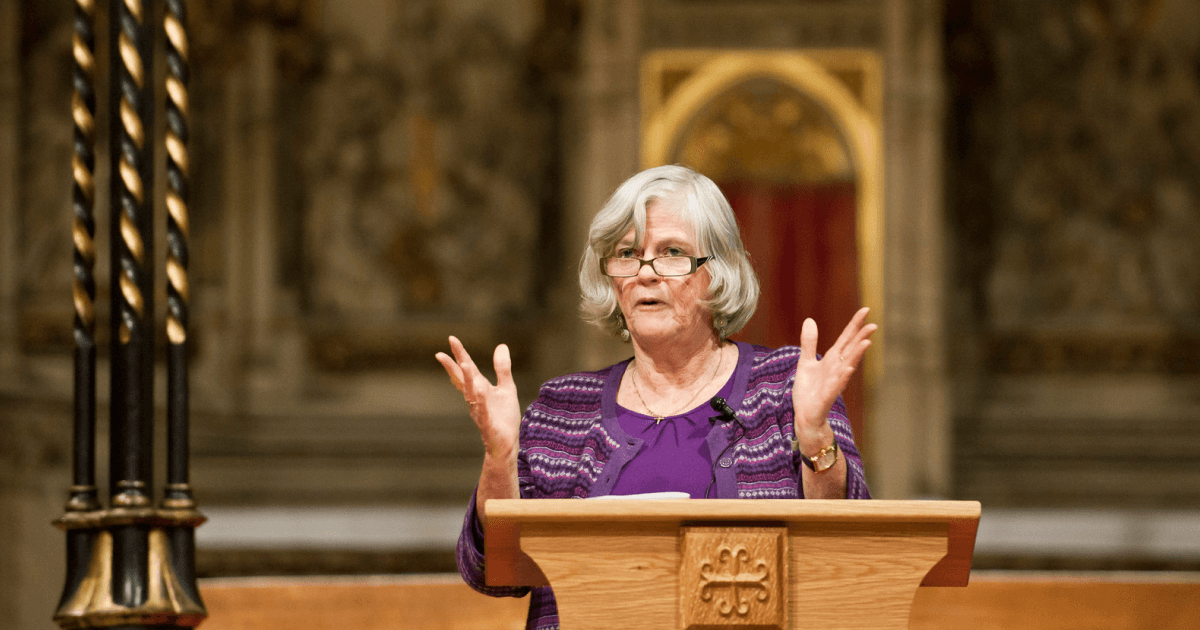
I first came across Ann Widdecombe in my mid-teens. While scrolling through YouTube one day, I stumbled across her 2009 Intelligence Squared debate on the proposition “The Catholic Church is a Force for Good in the World”. Widdecombe, who converted to Catholicism in 1993, was defending the proposition alongside Archbishop (now Cardinal) John Onaiyekan of Abuja, Nigeria. Opposing the motion were Stephen Fry and the late Christopher Hitchens.
It was a tough assignment. Widdecombe’s debating partner was uninspiring at best, and their task was made more difficult by the overwhelmingly hostile crowd. As for the opposition, it’s fair to say that, in the pompous Hitchens and the equally sanctimonious Fry, they faced two of the most skilled rhetoricians that the British intelligentsia had to offer.
Thoroughly undaunted, Widdecombe took up the gauntlet with gusto. In her opening speech, she robustly defended the Catholic Church’s historical record while at the same time pointing to its immense charitable efforts in the developing world. (Studies show that the amount of money Catholics donate to charity is 3.5 times that of their secular counterparts, while their level of volunteering is more than double. But you would never have guessed it based on Hitchens’s and Fry’s self-assured proselytising.)
In her conclusion, Widdecombe eloquently reminded her audience that the mission of the Catholic Church is not solely focused on this world:
“It isn’t only about the physical relief of the poor. It isn’t only about the work it does on Earth. But it is the message that it preaches. And that message is one of hope, that message is one of salvation. And it is all very well for some people in an intellectual arrogance to say, we can do without that. But actually billions of people across the world live by that message of hope and of salvation. They try to live by the commandments and also by the interpretation of those commandments by Christ. Yeah, sometimes they fail. Sometimes their leaders fail. Human beings do fail. But overwhelmingly, I say to you tonight with no apology whatever, that a world without the Catholic Church would be poorer, would be more hopeless, and would be a worse place in which to live.”
None of this is to suggest that Widdecombe put in a perfect debate performance. At times she struggled to respond succinctly to the many accusations that were levelled against her side, and in the end the proposition was defeated in a landslide. In many respects, it was an abysmal night for the Catholic Church. And yet the point that has struck me over the past few days is that, when so many others were afraid to step up, Widdecombe answered the call.
The story goes that the event organisers were struggling to find anybody at all who was willing to publicly support the proposition against such formidable opponents. Apparently the Archbishop of Westminster declined to take part, and in the end Archbishop Onaiyekan was recruited following a chance encounter in a hotel lobby after all other leads had been exhausted.
Why, we might ask, was it left to a former Prisons Minister to more or less single-handedly provide a defence of the Catholic Church in the UK public square? The question reveals something about the sore lack of courageous and articulate leaders within British Catholicism. It also reveals something about Widdecombe’s tenacious character. Widdecombe may not have been the most qualified apologist, but she stepped up when nobody else was willing, and she proceeded to defend the Church she loved with all her characteristic vigour and wit.
In rebuke of Christopher Hitchens’s fixation on contraception: “If he has a creed, it would be ‘I believe in condoms’.” In response to a question about women priests: “I don’t believe that it is any more possible for a woman to represent Christ at the point of consecration than for a man to be the Virgin Mary.” As for the charge that the Church is anti-Semitic for recognising the role of the Jewish Sanhedrin in the death of Christ, Widdecombe pointed out that it is Pontius Pilate – a Roman – whom we remember in the Creed every Sunday: “Yet I do not recall Mr Hitchens suggesting that because of that, the modern Catholic Church is anti-Italian.”
Widdecombe’s side may have lost the vote, but her whole life was guided by the conviction that truth is not determined by popularity. And as the years roll by and the New Atheism espoused by Hitchens and Fry fades into irrelevance, Widdecombe’s forthright defence of the Church may yet be vindicated in the eyes of the British public. Seventeen years on from the debate, a new generation of young people finds itself increasingly disillusioned with what our astonishingly shallow culture has to offer them.
Today influential commentators such as Joe Rogan, Konstantin Kisin, Dave Rubin and Andrew Huberman are far more willing to entertain religious belief than they were in the past. Public figures such as Russell Brand, Tom Holland and Ayaan Hirsi Ali talk openly about their newfound appreciation for Christianity. JD Vance, Shia LaBeouf, Tammy Peterson and Candace Owens are just a few of the growing number of souls who have found their way into the Catholic Church. Even Richard Dawkins now calls himself a cultural Christian.
The poet Wordsworth once characterised the ideal man-at-arms as a “happy warrior”. Within the past year, we lost one such warrior in the person of Charlie Kirk, and this past week we saw that tragedy repeated on the other side of the Atlantic. Ann Widdecombe was a happy warrior, and the many tributes that have followed her death testify to this fact.
Here was a woman fully committed to every aspect of the Church’s moral teachings, and yet her courage and conviction earned her the love and admiration of even her most ardent adversaries. Secular journalists not known for being lachrymose have struggled to hold back tears as they've discussed Widdicombe’s passing. As Chris Mason, the political editor of the BBC (not an institution known for its Catholic sympathies), opined in a heartfelt tribute: “What I can tell you is that plenty who knew her, whether they agreed with her or not, found her immensely likeable.”
Now Widdecombe has completed her race, and it’s up to us to take up the torch. May her example inspire our own efforts to build up the Kingdom here on earth, and let us pray that this brave and cheerful warrior is not long in receiving a warm welcome from the King she served:
“Well done, good and faithful servant; you have been faithful over a little, I will set you over much; enter into the joy of your master” (Matt. 25:21).