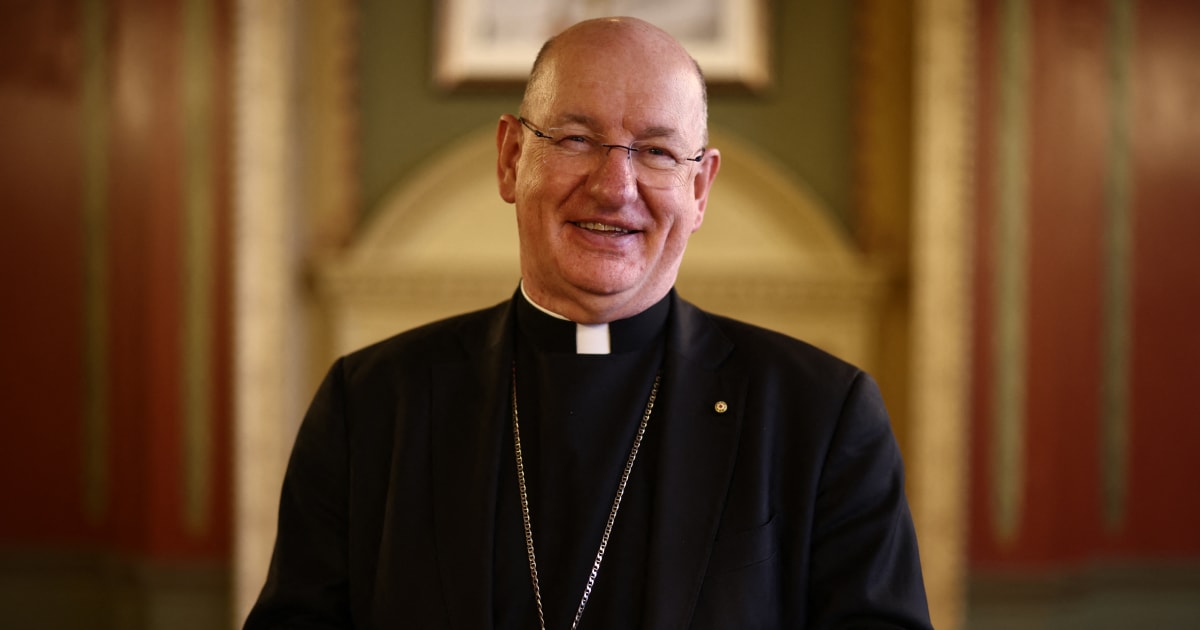
Archbishop Richard Moth gave his first press conference as the new head of the Catholic Bishops’ Conference of England and Wales today.
He was only recently back from Rome, where he joined the Archbishop of Canterbury, Sarah Mullally, in meeting Pope Leo. She had, he recalled, spoken at his installation, and he had done a reading at hers not long after, so when the invitation to Rome was extended to him, he accepted, and they turned up together at 9am for the audience with Pope Leo. ‘There was clear recognition by the Holy Father,’ said Archbishop Moth, ‘of obstacles and differences but also of the importance of being able to speak together.’ Was Sarah Mullally’s being a woman an additional impediment to unity? The differences, repeated the archbishop, were acknowledged by the Pope, but nonetheless there was a desire to prolong their conversation.
His own appointment as Archbishop of Westminster came, he recalled, as ‘a complete shock; I am still pinching myself’. And on many issues, he has still to familiarise himself with the situation in Westminster, after his time as bishop of Arundel and Brighton. Asked about reports of increased numbers of new converts, he said that the bishops’ conference has been discussing what has been talked about as the Quiet Revival. ‘It is certainly the case,’ he said, ‘that we are experiencing an increase in the number of baptisms and receptions [to the Church]. This year at Westminster, 790 people were candidates, a considerable number. It’s too early to know what is the case in the country overall.’ He was, in other words, cautiously optimistic.
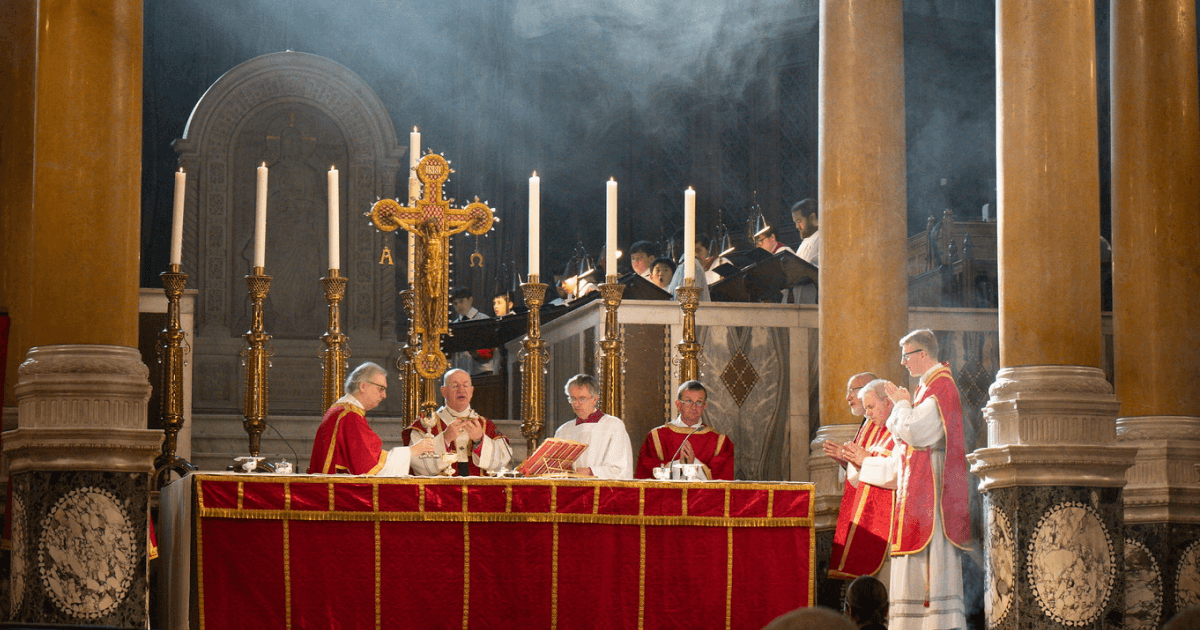
He had a number of priorities – prisons, on which he had thanked the Prime Minister for doing away with short-term sentences, and where he felt that the Church spoke for victims and prisoners’ families as well as inmates. AI was something the Church would be addressing, ‘as a challenge as well as opportunity’. As for his approach to access to the Traditional Latin Mass, he said that his priority would be, in Westminster as in Brighton, ‘pastoral need’. It was on that basis that he had approached the Dicastery for Liturgy for permissions to celebrate in the old form in his previous diocese, and ‘my requests had always been met’. He seems, in fact, reasonable on this neuralgic subject.
As for wider issues, such as the demographic decline in Britain as elsewhere, and what the Church’s response should be, he said that he brought the subject back to the commitment couples made during their marriage at the question: ‘Are you ready to accept children?’ For children, he said, were a wonderful gift.
As to his priorities, he said simply: ‘It starts with prayer. Without that we can do nothing.’
The new archbishop gets up at 5am, so an example to all. He did admit, though, that he had not had the opportunity to ride – his old pastime – since his new appointment. Pope Leo has four horses; what a spectacle it would be to see them riding together.