


VISUALS: See below at end
“There is no Christian I know in Syria who wouldn’t leave the country if they had the chance.’ My friend in northern Syria, normally so ebullient and full of life, suddenly sounded tired and flat. “Everywhere you go,” he added, “the Islamisation of the country is noticeable.”
More than 18 months on from former Islamist leader Ahmed al-Sharaa’s dramatic ousting of the Assad regime, a picture is at last emerging of what the sudden change of regime means in practice for Syria’s ancient, yet increasingly fragile, Christian community.
For those like me who have travelled to Syria many times and who have followed the situation for Christians closely for many years, the question is as follows: is the al-Sharaa regime ultimately committed to a hardline Islamist agenda witnessed in its former stronghold in Idlib, north-west Syria, or is it truly embracing a vision open to religious minorities?
Whatever might be said of the transitional government itself, a recent incident in Damascus demonstrates the increasing threat of militants at a societal level.
In spring 2026, a video suddenly started circulating online showing individuals gathering near a church in Qatana, a suburb of the capital.
The footage purportedly shows individuals gathering outside the church and chanting a Koranic phrase contemptuous of Christians as they prepared for Easter: “But they neither killed nor crucified him, it was only made to appear so.”
Although no physical attack was reported, clergy and lay people described the incident as typical of a pattern of intimidation which they say has become more pronounced in recent months.
Dominating the outlook for Christians is the inescapable fact that the constant hammer blows of oppression, persecution, economic crises and political upheaval have caused numbers of faithful to haemorrhage.
In the decade 2011-2022, Christians in Syria plummeted from more than 2 million (10 per cent of the population) to barely 300,000 (less than two per cent).
The exodus began in earnest in 2012 when the Arab Spring arrived in Syria and sped up during the genocidal violence of Daesh (ISIS) and other militant Islamist groups.
What Christians and other minorities suffered at that time of brutal violence and constant bombardment cannot be overstated. This I have witnessed for myself when, at the height of the civil war, I made multiple visits to the country as part of my work with the Catholic charity Aid to the Church in Need (ACN). The impact of this decline is eye-watering in terms of the decimation of the Christian community.
My contacts in Aleppo, formerly home to one of the largest concentrations of Christians, now report that numbers have fallen from more than 200,000 before the war to barely 20,000 – and that a disproportionate number of those who remain are elderly or infirm and would leave if they could.
While insisting that Christians still have a future in Syria, Cardinal Mario Zenari gave an interview in February at the close of 17 years as the country’s Apostolic Nuncio in which he described the collapse in numbers of faithful as “frightening”.
Such concerns for the future reached fever pitch last June when a suicide bomber struck at St Elias Church, Damascus, targeting a packed congregation attending Sunday liturgy.
At this church in the Dweila neighbourhood, at least 25 Christians died and more than 60 were injured.
The incident suggested the country was on the verge of descending into the nightmare of militant extremism from which it had only just emerged after more than a decade of civil war.
As international concern grew rapidly, a European Parliament resolution that same month – June 2025 – called for new frameworks to protect religious minorities.
Amid complaints from Church leaders and faithful alike that the regime was not doing enough to stop extremism in its tracks, critics pointed to a faultline in the transitional government’s early 2025 constitutional declaration which recognised religious minority rights while asserting the primacy of Islam and Islamic jurisprudence.
Soon after taking power in late 2024, President al-Sharaa moved quickly to assure Christian leaders of the Church’s status in society. Establishing a five-year transitional regime, the persona he presented suggested he was a changed man, very different from the days when he commanded the notorious Islamist militant group Hayat Tahrir al-Sham (HTS).
Announcing a commitment to putting in place an administration reflective of Syria’s diversity, the new President announced the dawn of “a new era far removed from sectarianism” and went as far as appointing a Christian as a government minister.
However, in March 2025, when armed groups including militants allegedly affiliated to the regime carried out strikes against religious minorities in Syria’s western coastal region, it seemed the new government was not sincere in its apparent sympathy towards Christians.
It subsequently emerged that the vast majority of those killed were Alawites and that Christians had escaped largely unscathed.
Reportage of the al-Sharaa regime began to portray a regime with no obvious violent intent against the Church.
Quoting a saying in Arabic popular in his neighbourhood, my contact in northern Syria said the regime had no agenda to silence dissent, saying: “We are told we can bark to our heart’s content.”
But against a backdrop of Islamic inculturation, a widespread prohibition on the sale of alcohol and even reports of a ban on musical instruments entering the country, concerns are growing that al-Sharaa’s Syria is increasingly intolerant of anyone not in sympathy with hardline Islamism.
There are reports of a growing backlash against so-called “cute Muslims” – Sunnis included – who are accused of betraying “pure” Islamic ideals by being pro-democracy, women’s empowerment and minority rights.
Matters came to a head earlier this year in Al-Suqaylabiyah, a predominantly Christian city in Hama governorate. Footage and other evidence emerged showing acts of violence and theft, and the targeting of cars, shops and property. Those responsible were accused of singing Islamic chants and shouting insults. Residents reacted by holding a protest, rejecting what was described as a “single-colour arm” – ie a force dominated by a single religious or ethnic group.
Church leaders in different parts of the country responded by scaling back Easter celebrations. Churches condemned the incident, saying attacks against the Christian community should not be dismissed as “individual incidents”.
To what extent the regime is ambivalent in the face of such attacks and a growing climate of Islamism intolerant of Christianity – or offers some degree of implicit support – is an open question.
Certainly, the problems Christians have faced are as nothing compared to those of Alawites, who have suffered deliberate and widespread attacks.
My contacts in Syria have asserted that the regime is determined to show the West a positive approach to Christians as part of its overtures to President Trump and other world leaders. Such is the price to be paid to end the sanctions against Syria and meet the urgent need to rebuild the country’s shattered economy.
Amid reports that 90 per cent of the country is below the poverty line, for the time being at least, the regime seems intent on tempering any Islamist instincts and yielding to the need to woo the West in a bid to rebuild the country after 15 years of chaos and destruction.
So long as the regime needs the West, the evidence suggests the government will at least refrain from any blatant oppression of Christians. Which means that, in the meantime, at the very least, Syria’s much reduced Christian community can dare to hope. Hence it is not unreasonable for them to cling tenaciously to the vision set out by Cardinal Zenari, who said: “For those [Christians] who have remained, there is a mission to be a glue, guarantors and promoters of internal unity, to act as a bridge… I continue to see a future for Christians in Syria. Even if they are only a small group, their role as a bridge will be essential.”
John Pontifex is head of press and public affairs for Aid to the Church in Need (UK)
IMAGES BELOW
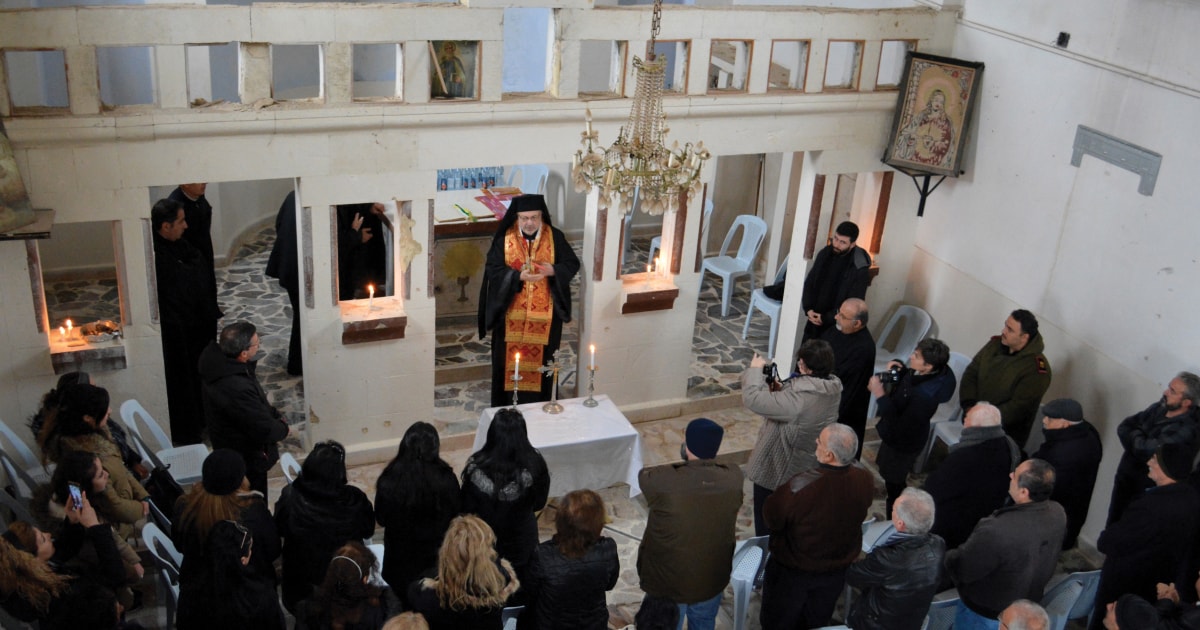
A liturgy under way at a church in the Valley of the Christians, near Homs (© Aid to the Church in Need)
A Syriac Orthodox priest outside a Syriac Orthodox church desecrated by Da’esh (ISIS) in al-Qaryatayn (© Aid to the Church in Need)