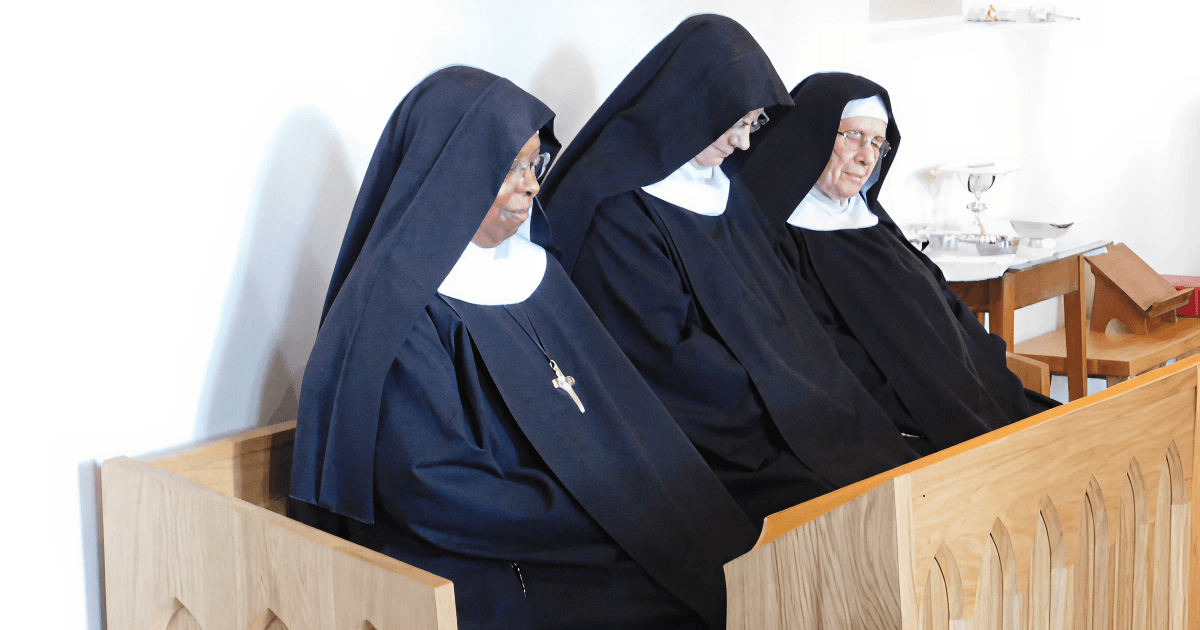

Thirteen years after their reception into the Catholic Church, the Sisters of the Blessed Virgin Mary – the only monastic community in the Personal Ordinariate of Our Lady of Walsingham – continue to live a joyful, hidden Benedictine life at Aston Hall, offering a powerful witness to the fruitfulness of corporate reunion with the See of Peter.
The community, originally part of the Anglican Community of St Mary the Virgin, founded in Wantage in 1848 during the Oxford Movement, entered full communion on January 1, 2013. Their story, first highlighted by Aleteia’s Matthew Green, remains one of the most inspiring examples of Anglicanorum coetibus, Pope Benedict XVI’s 2009 apostolic constitution, which opened a canonical path for groups of Anglicans to enter the Catholic Church while preserving elements of their spiritual and liturgical patrimony.
In a detailed personal testimony, Mother Winsome SBVM, the community’s superior, described the long journey that led the Sisters to Rome. Although the community already lived a highly traditional monastic existence – wearing the habit, singing Gregorian plainchant, reserving the Blessed Sacrament and taking lifelong vows – Mother Winsome explained that deeper issues had emerged.
“By the time I was elected Mother in 2006, the position was that although we had in Chapter meetings repeatedly agreed to retain our monastic roots and continue as a traditional monastic community, some sisters were striking out on their own, following a path where they would not live by the Rule, wear the habit or even live with others in community houses,” she wrote. “It was evident that these sisters were in danger of losing their monastic vocation, replacing it with a notion of a loose association of well-meaning women doing good works. But that is not monastic consecrated life.”
As the Sisters sought authentic renewal, they encountered structural limitations within Anglicanism. Mother Winsome noted: “Within the Anglican Communion there is no Vicar of Christ and no Magisterium. In the Church of England, decisions which have profound theological implications can be taken by an elected synod, some of whom may not have had any theological or other appropriate training.”
Several Sisters began to feel called to the fullness of Catholic communion. One Sister described her own discernment:
“In 2008, I was asked by Mother Winsome to go to our house in Harringay… During this time the parish made two pilgrimages to Walsingham… A priest there said to me: ‘Let’s face it, you’re not just a middle-of-the-road Anglican are you…’ When Pope Benedict issued his invitation via Anglicanorum coetibus I still didn’t think it had anything to do with me. The crucial factor was Cardinal John Henry Newman!… I was astounded by the account of his conversion… I thought, ‘But that’s just what I think!’ This was a defining moment for me.”
Another Sister wrote: “I have an absolute need to be in the See of St Peter… The Ordinariate basically opened a possibility I never imagined could be there for me as a Religious… To be able to be in full communion with the Catholic Church within my community is making sense to me of both aspects of my call, and of my whole life.”
After extensive communal discernment, 11 Sisters from CSMV, joined by one from another Anglican community, were received into the Catholic Church at the Oxford Oratory on New Year’s Day 2013. The transition was not without pain. Mother Winsome recalled the sorrow of leaving behind Sisters who chose to remain Anglican, but also the profound grace received: “It seems to me that each of us was given a very special gift of healing grace, so that we could experience true joy as we were received at last into the full communion of the Catholic Church.”
Providence marked every step. The Sisters were welcomed by the Benedictine nuns of St Cecilia’s Abbey on the Isle of Wight, who had exactly 12 empty cells prepared for a group from Paraguay whose arrival had been delayed. Mother Winsome recalled the moment with wonder: “Twelve empty cells, twelve Sisters!” The ferry that carried them across the Solent was named St Cecilia, and upon arrival one of the Ryde Sisters greeted them with the words: “Welcome home.”
The community later settled at Aston Hall in Staffordshire, a historic house with deep recusant Catholic connections and links to St John Henry Newman. Today they live fully according to the Rule of St Benedict, maintaining a strong Marian charism as the Sisters of the Blessed Virgin Mary. They remain the only monastic community in the Personal Ordinariate of Our Lady of Walsingham.
Mother Winsome has reflected on the deeper meaning of their journey: “We know that we are now in communion with the See of Peter, with all the saints that we love. When the conclave was electing Pope Francis, we were not on the outside looking in; they were electing our Pope, our Holy Father. We are now truly part of the Church.”
Their story illustrates a success of the vision of Anglicanorum coetibus, which has enabled hundreds of former Anglicans – including clergy, Religious and lay faithful – to enter full communion while bringing elements of their Anglican patrimony. The Ordinariate’s Divine Worship: The Missal incorporates distinctive Anglican liturgical expressions within the fullness of the Catholic Faith.
The Sisters of the Blessed Virgin Mary represent both continuity with the Oxford Movement’s longing for Catholic fullness and the joy of returning to the Rock of Peter. Their hidden life of prayer, work and hospitality continues the ancient monastic tradition that once shaped England’s Christian soul, now renewed in full communion with the universal Church.
More than a decade after their reception, the community stands as a quiet but radiant sign that authentic monastic vocation finds its true home in the Catholic Church, under the successor of St Peter. As Mother Winsome and her Sisters have shown, the call to “follow me” sometimes requires leaving much behind – but the grace received far exceeds the cost.


.png)