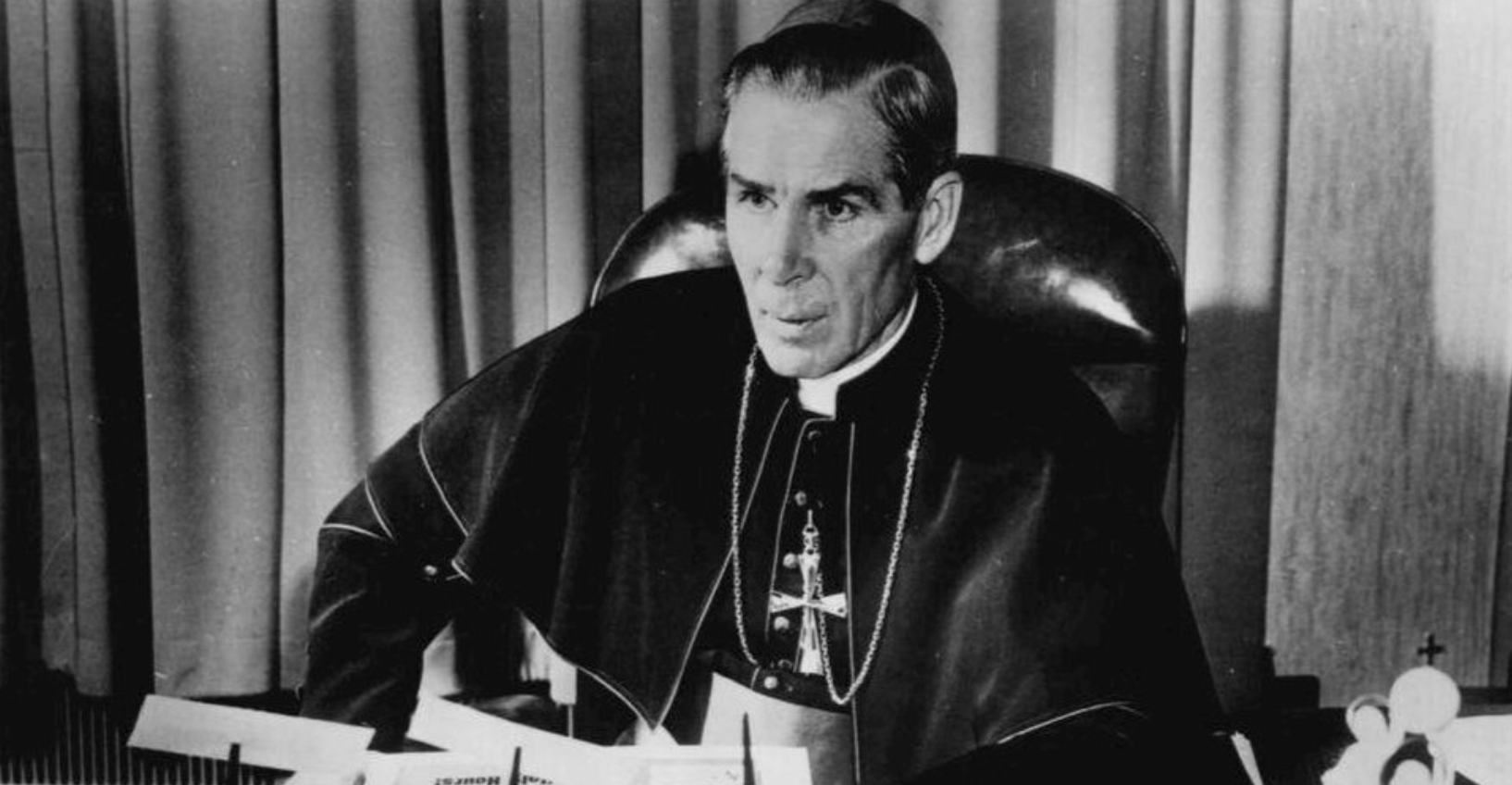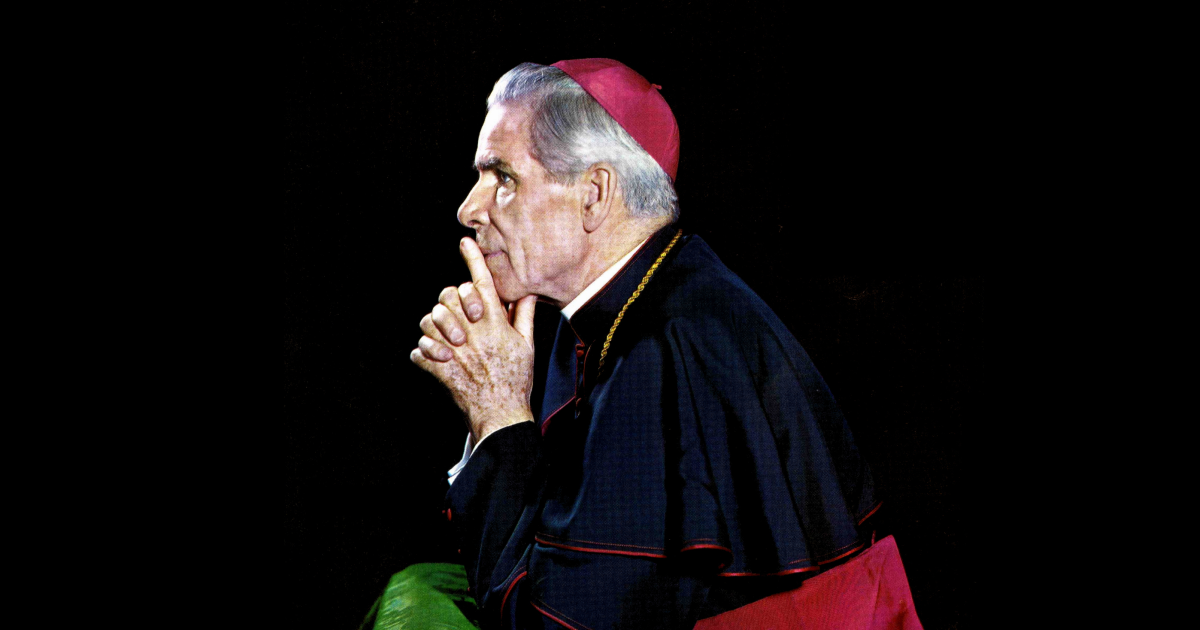



Today's beatification of Archbishop Fulton Sheen is above all a recognition of his holiness. Here was a man of deep spiritual faith, devotion to the Blessed Sacrament and an extraordinary zeal for the salvation of souls. Sheen carried out an unprecedented work of evangelisation, but aside from his spiritual success he also achieved a prominence and influence which marked a unique moment in American history.
While Sheen’s radio programme, The Catholic Hour, had been on the airwaves for decades, it wasn’t until the advent of his television show Life is Worth Living in 1952 that he became a household name across America. The DuMont television network was looking for something to fill what it expected to be a no-hoper slot every Tuesday evening competing with the comedian Milton Berle on NBC and the legendary Frank Sinatra on CBS.
There was little hope that a Catholic cleric in his distinctive soutane, armed only with a blackboard and a seemingly inexhaustible supply of chalk, could compete with such established and popular rivals while discussing morality, suffering, philosophy, communism and the meaning of life. Instead, America’s struggling fourth network found more and more regional affiliates seeking to carry the show.
Within a year, Bishop Sheen was attracting 10 million viewers each week, eventually rising to 30 million. Berle’s numbers began to suffer, but the Jewish comedian took it in his stride: if he was going to lose viewers, Berle quipped, it may as well be to the One whom Bishop Sheen was speaking for. Accepting the Emmy award for Most Outstanding Television Personality in 1953, Sheen thanked his four writers: Matthew, Mark, Luke and John.
Catholicism in 1950s America was a Church on the move. Veterans assisted by the GI Bill poured into colleges and universities. Catholic institutions expanded, vocations flourished and big Catholic families whose parents and grandparents had been labourers, policemen and factory workers entered the middle classes. What made Sheen’s achievement all the more remarkable was that he was not speaking merely to an expanding and increasingly confident Catholic subculture, but to America as a whole.
Old Protestant America’s hostility towards those suspicious Catholics had been weakened by the shared experience of wartime mobilisation. Americans of Irish, Italian, Polish and German descent had served in the same regiments; now they worked in the same offices and started to move out to the same suburbs as the White Anglo-Saxon Protestants.
Hollywood played its part as well: this was the era of Going My Way, The Bells of St Mary’s, The Song of Bernadette and The Keys of the Kingdom. For the first time, priests, nuns, saints and sinners began to occupy a prominent place in the American imagination. As the old joke had it, the golden age of Hollywood consisted of Jews making Catholic films to be watched by Protestants. Catholicism was escaping from the ethnic parish and claiming a place in a still overwhelmingly Protestant culture.
None of this is to imagine that the era was an idyll: racial discrimination, though increasingly challenged, was still entrenched, and the outward strength of expanding Catholic institutions also concealed some inner weaknesses. But an age need not be perfect for us to recognise that there was great good and even promise to it.
Sheen stood at the apex of that promise. Born in Illinois – Middle America – he was neither the product of an immigrant ghetto nor an assimilationist anxious to hide the peculiarities of his Catholic faith. He confidently strode onto his television studio in full episcopal dress and spoke of sin, judgement, heaven, hell, the Blessed Virgin and the Cross. Instead of watering down the Faith, Sheen was adept at finding new ways to express eternal truths to millions of fellow Americans. In this bishop’s hands, the message was made more digestible – but remained fully Catholic.
Sheen was more than capable of criticising America when it went wrong: he condemned racism and described the deliberate targeting of civilians during the recent war as “our national sin”. But he challenged his country from a position of love. Fulton Sheen believed in the greatness of America because he believed it could remain true to all that was best in its culture and become Catholic. Love of country did not require him to baptise every aspect of American life but gave him the standing to warn his fellow countrymen when they were going astray.
The election of John F Kennedy as president in 1960 may have seemed the culmination of Catholicism’s ascent in American society, but it also marked the beginning of its failure. Kennedy had insisted to Protestant ministers that he would keep his faith and his politics separate – an insistence on divorcing principle from policy that is as sociopathic as it is impossible. The contrast between Sheen and Kennedy is striking: one entered American homes on the airwaves bearing Catholic truth as a precious gift; the other assured America from the White House that it was anodyne and would be kept within carefully prescribed boundaries.
Without ever repudiating Sheen, a generation of Catholics rose admiring the model of Kennedy. Catholic politicians and prelates became increasingly comfortable with the trappings of American power and prestige, and increasingly reluctant to insist upon the totality of the Catholic vision for a just and flourishing society. In the decades after Kennedy’s election, access was mistaken for influence, and Catholics entered the American mainstream only to find it was carrying them rapidly away from the truths Sheen was preaching. Its prominence largely built upon a legacy of Catholic working-class votes, the Democratic Party now makes public repudiation of Catholic teaching almost a precondition of advancement.
Fulton Sheen’s beatification honours a great priest and communicator, but it also reminds America of a road not taken. For an extraordinary moment, Catholics possessed the numbers, institutions, confidence and fluency to enter the American mainstream without surrendering to it. Archbishop Sheen showed us a plausible future in which the United States would be fully Catholic and fully American – grateful for the blessings that freedom and prosperity had wrought, but also willing to call it to conversion. Just at the moment America was ready to listen, Catholics began to lose confidence in what we had to say. That work is now left to current and future generations – aided by the guidance, example and intercession of Blessed Fulton Sheen.