



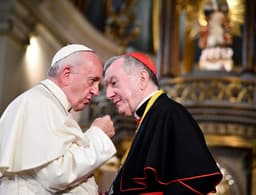
I’ve been on this beat for a good few years, and have seen a lot of things. It’s tough to get under my skin. Maybe it was because of all that, rather than despite it, that the announcement late last month of the Vatican’s rough halving of the amends proposed for Bishop Michael J Bransfield – emeritus of Wheeling-Charleston, encompassing the entire state of West Virginia – was so galling. The Congregation for Bishops slashed Bishop Bransfield’s tab from $792,000 to $441,000 – which Bransfield paid, suggesting he is not exactly resourceless – insisted he get a $2,250 per month pension rather than $736 monthly, and put Wheeling-Charleston back on the hook for Bransfield’s health insurance (which, let’s face it, the diocese really ought to pay, along with every diocesan employee’s – it never should have been on the table). In hindsight, however, I begin to think that it was not so much the run-of-the-mill Roman curial clericalism on display in the whole triste épisode, so much as it was the failure of Bishop Bransfield’s successor, Bishop Mark E Brennan, to stand up for his people. I mean, the guy just passed the buck. “I am grateful to Pope Francis and the Congregation for Bishops for accepting in large part the outline of the amends plan I presented to Bishop Bransfield in November 2019,” he said. Translation: Thank you, Sir. May I have another? “That plan,” ie his original plan of amends, he went on to say, “combined an insistence on restorative justice with a gesture of mercy, which is how God deals with all of us.” That assertion is … debatable. In any case, the assertion was carefully couched, in a way that raises the question: how about the plan the Congregation for Bishops actually imposed? Bishop Brennan never explicitly answers his implicit question, either. “I hope that the people of the Diocese of Wheeling-Charleston will see in the decision of the Congregation for Bishops a fair and reasonable resolution of this unseemly matter,” Bishop Brennan said. Translation: I didn’t do this, so please don’t come to my house with torches and pitchforks. That’s fine. Blameless, one hopes in charity, though not praiseworthy, but the faithful – in primis the sorely tried People of God in West Virginia – deserved a big win. “We will follow the path of truth wherever it may lead,” Pope Francis told sexual abuse victims in Philadelphia, on 27 September 2015. The apparent reticence of the Church under Pope Francis’s leadership to use its own investigative tools to discover the truth in Buffalo, Cincinnati, and other trouble spots makes the meaning of that promise hard to construct, if it’s not to be abandoned as empty. “[A] different treatment for Bishops who have committed or covered up abuse,” the Vatican declared in a 6 October 2018 statement announcing the review of the McCarrick files, “in fact represents a form of clericalism that is no longer acceptable.” While we’re at it, where is the McCarrick report?
6:28 PM
In Wheeling-Charleston, making amends just got a lot easier
Christopher R. Altieri


3 min read



Already a subscriber? Sign in
5freearticles every month
Continue reading with a free account. No card needed.
- Five free articles every thirty days, on any device you sign in on
- The Catholic Herald newsletter, every morning
- Subscribe whenever you like for everything: every article and the magazine
Related articles
 Analysis
Catholics were in America long before 1801
From Spanish Jesuit missionaries in Virginia to Maryland’s Catholic settlers, the history of Catholicism in America stretches back to the colonial era
Christine Rousselle Analysis
The extreme violence behind the international trade in drugs
Simon Caldwell Analysis
Assessing Pope Francis's most controversial decisions
Elise Ann Allen/ Crux Analysis
As Francis marks 12th anniversary of his election in hospital, we should recall his words during first days as Pope
Charles Collins/Crux Analysis
Trump's critics should consider parallels with another German leader
Charles Collins/Crux
subscribe to the catholic herald today
Our best content is exclusively available to our subscribers. Subscribe today and gain instant access to expert analysis, in-depth articles, and thought-provoking insights—anytime, anywhere. Don’t miss out on the conversations that matter most.
Subscribe



