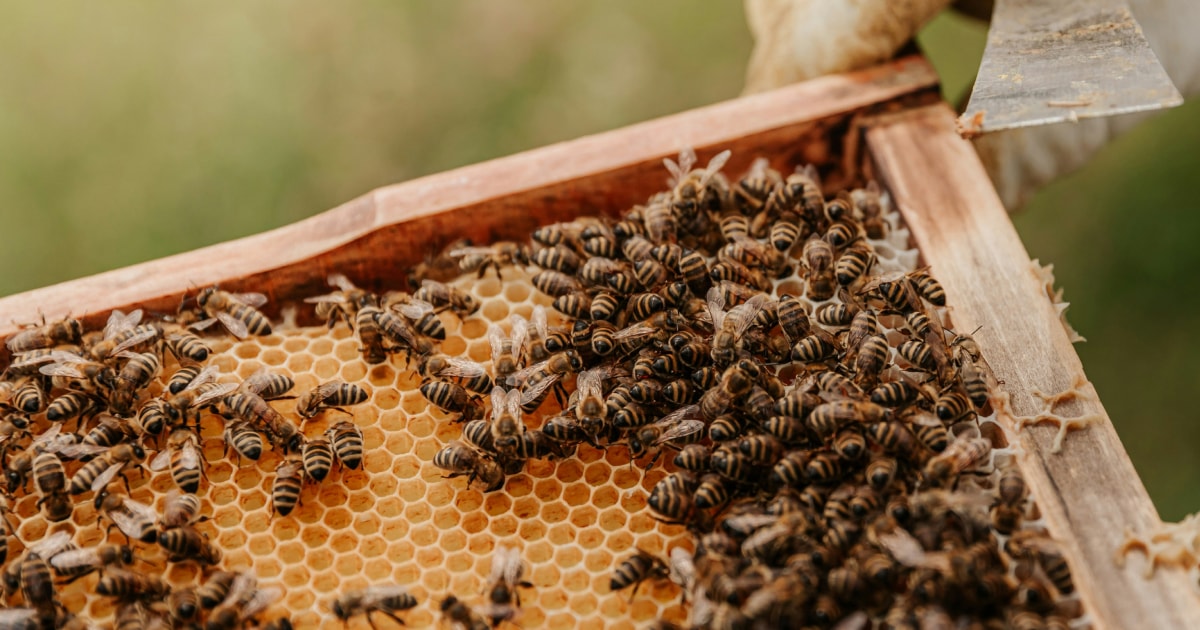

A few years ago, during the first Irish lockdown, I took up beekeeping at our family home in Moyne Park. What began as an attempt to remove a swarm of bees from an outbuilding became a modest experiment in self-sufficiency and has since become one of the great joys of my life in rural Galway.
I was drawn to it partly because the patron saint of bees and beekeepers is the Irish 5th/6th-century saint, St Gobnait, and partly because of a poem I learned at school: WB Yeats’s “The Lake Isle of Innisfree”. Its vision of simplicity and peace left a lasting impression on me, along with a generally positive disposition towards our friends the bees.
There is something profoundly Catholic about the hive: an ordered community, ceaseless labour for the common good and a quiet testimony to the Creator’s wisdom. In an age when so many seem intent on razing the natural order, I have found unexpected grace in raising bees.
Moyne Park sits among the farmland and gentle hills of East County Galway, a part of Ireland “beyond the Pale” where my family has roots beyond memory. Over many years I have planted orchards and native trees with my now grown-up children, allowed scrub to flourish and rewetted patches of land to encourage wildfowl and other creatures. The bees fit naturally into that effort.
In spring, the apple, pear and plum orchard I first planted with my youngest daughter, Clementine, bursts into blossom and the hives come alive. Watching the workers dart from flower to flower, one cannot help but marvel at the divine economy at work. Those same bees produce the honey that graces our table and help deliver the apples that fill our stores in autumn.
The honey itself has become a staple of our household. A proper Galway fry – eggs and mushrooms, lashings of tea, toast thick with butter and generous spoonfuls of Moyne Park honey – tastes all the sweeter for knowing its origin. There is a satisfaction in harvesting one’s own produce that modern life too often denies us.
Yet beekeeping is no mere hobby. It demands patience, humility and attentiveness. The bees teach these virtues daily. As an amateur beekeeper, I have learned the hard way about the threats to the hive. Wasps, for instance, descend in late summer and rob the stores with ruthless efficiency. One fits entrance reducers, deploys simple traps and maintains vigilance. Even in the natural order, harmony must sometimes be defended.
The same principle applies to the wider countryside. I have spent three decades building a wildlife habitat here, home to barn owls, birds of prey, snipe, woodcock, wild ducks, swans and other waterfowl. I even tried to coax the corncrake back to these parts. We never sought grants or schemes; it was done out of love for the land and a sense of duty to the generations that will follow.
Now, as I look at plans for vast solar plants and wind farms marching across the West of Ireland, I see the same principle under assault. These industrial schemes, justified in the name of “net zero”, threaten the very creatures we have worked to protect. The bees, like the swans and the corncrakes, remind us that genuine care for creation cannot be measured only in megawatts or subsidies.
There is, too, a liturgical dimension to all this that speaks directly to the Catholic heart, especially as we celebrate Pentecost and enter summer. At Candlemas we bless the candles that will light our altars and homes. The ancient rite recalls the work of the bee, whose wax gives us the pure light of the Paschal candle itself. In the Exsultet sung at the Easter Vigil, the Church praises the bee that “brought forth the substance of this precious lamp”.
That same candle burns brightly through the Easter season until Pentecost, when we celebrate the descent of the Holy Spirit in tongues of fire upon the Apostles. The bees’ humble labour sustains the very symbol of divine light that prepares us for the outpouring of the Holy Ghost.
To keep bees is to participate, in a small but real way, in that ancient economy of light and sacrifice. The hive becomes a living sermon on providence, industry and the ordered beauty of God’s world.
At Moyne Park the hives continue their quiet work. The apple, plum and pear trees stand heavy with promise, the honey jars line the pantry shelves and the land feels more alive for their presence. In raising bees I have found not only a practical skill but a deeper sense of communion with the natural and supernatural order.
I commend beekeeping to any reader who feels the pull of the land or the desire to reconnect with older rhythms of life. One need not own vast acres. A hive or two in a suburban garden or on a parish plot will do. The rewards are immediate: honey for the family, pollination for the neighbourhood and a daily reminder that we are not masters of creation but its grateful stewards.