


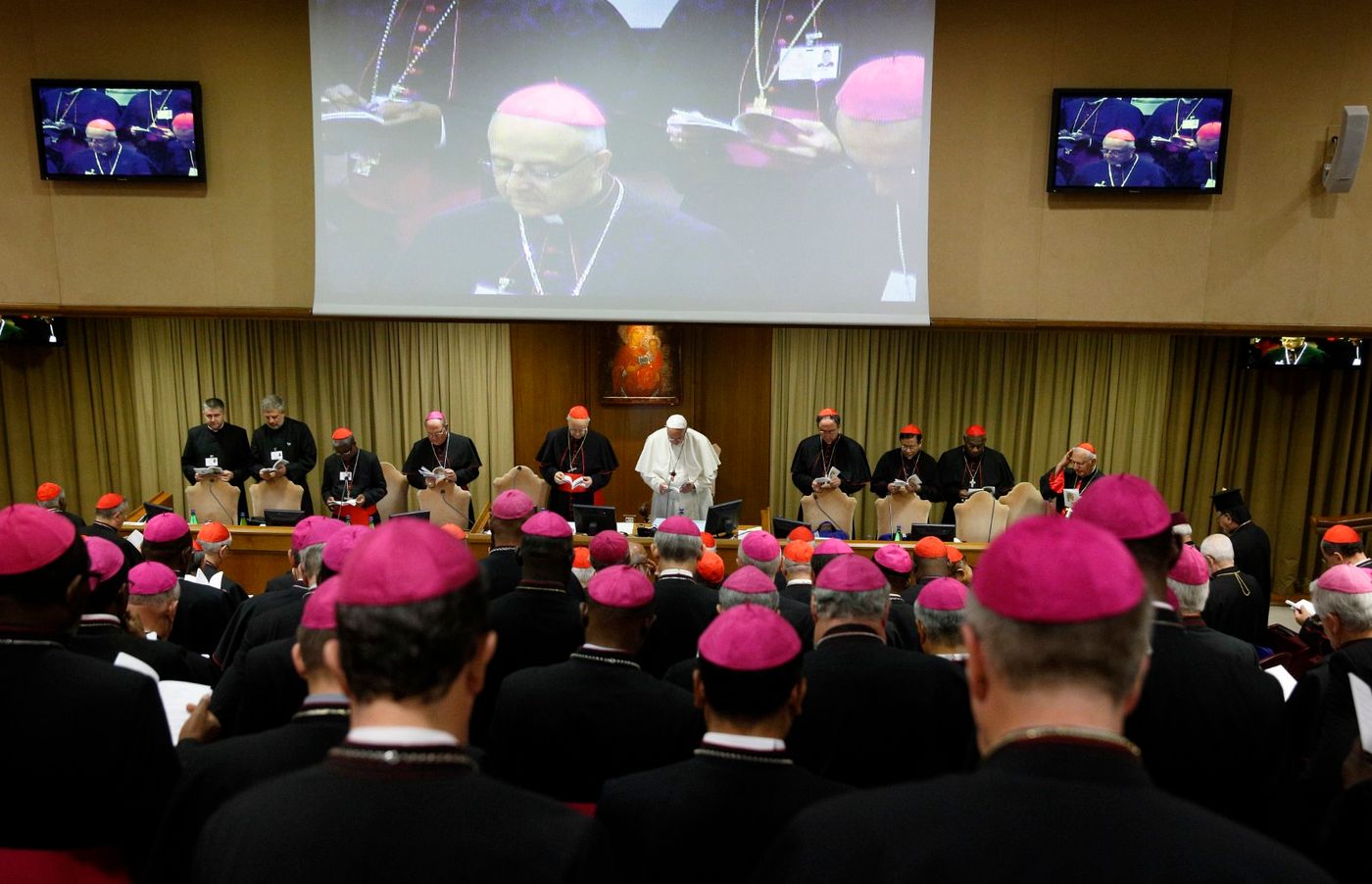
THE IMPORTANCE OF VOTING EARLY AND OFTEN (AS THEY SAY IN CHICAGO) Although some ambiguities remain to be clarified as this issue of LETTERS FROM THE SYNOD gets put to bed, it now seems as if Synod-2018’s draft final document will be voted on paragraph-by-paragraph, after which the amended really-final-document will be subject to another vote, with a two-thirds threshold for approval. This begins to resolve one of the question marks that was hovering over the Synod’s end-game, causing considerable concern late last week and over the weekend: Would the Synod fathers be able to make their judgments known by multiple votes, as in the past? The anxiety on this point reflected some recent history. Veterans of these exercises will remember that, prior to Synod-2015, it was also unclear whether the traditional way for the bishops to manifest their judgments – votes on the Synod’s draft final report, paragraph by paragraph – would be utilized. The issue was resolved in favor of paragraph-by-paragraph votes (each paragraph requiring a two-thirds majority for inclusion in the final report), thanks to an appeal to Pope Francis by thirteen senior cardinals whose request for votes the Pope honored. Now, however, the Synod is governed by a new apostolic constitution, Episcopalis Communio , which was issued last month. While attempting to give the Synod more magisterial gravitas, Episcopalis Communio also muddied the procedural waters. And that murkiness was, at first blush, not resolved by examining Synod-2018’s procedural “Instructions” (available only in Italian, be it noted). The apostolic constitution makes no provisions for voting, or none that anyone can discern. Rather, Episcopalis Communio decrees that the Synod General Secretary, in this case Cardinal Lorenzo Baldisseri, is to try to get “moral unanimity insofar as this is possible” on a draft final report, which is first constructed by a commission elected by the Synod fathers (one member is chosen from each continental group, and the commission is then filled out by papal appointments). Synod-2018’s schedule seemed to provide for proposing amendments to the draft final report (which the Synod fathers are given very little time to examine); but even now there remains no absolute clarity on whether these proposed amendments are to be voted on, or whether they, too, will be subject to Cardinal Baldisseri’s sense of “moral unanimity” or consensus. The apostolic constitution also provides that the final report should receive the “approval of the members” before being presented to the Pope (whose acceptance then turns the report into an exercise of the ordinary papal magisterium, according to Episcopalis Communio). Again, no voting procedures or thresholds for measuring approval were specified by the constitution; but Article 60 of Synod-2018’s “Regulations” (not to be confused with the aforementioned “Instructions”) states that “The final document is approved by a secret ballot. The majority has to be two-thirds of the Synod fathers who are present at the vote.” This now seems to have been confirmed at a Monday press conference. It’s all rather muddled, and unnecessarily so. It would be very helpful indeed if all such procedural issues were clarified, once and for all, before Synod-2018 enters its final week on October 22. It is crucial that there be a clean, transparent, agreed-upon, and well-understood mechanism by which the Synod fathers can register their judgments issue by issue, thereby making those judgments known to each other, to the world Church, and to the Pope. But even with Monday’s announcement of paragraph-by-paragraph votes on the draft final report, there remains considerable ambiguity on what the consensus of “moral unanimity” means, although, as noted, the “Regulations” specify a two-thirds majority vote on the really-final-report; but does two-thirds equate to “moral unanimity?” And who decides that? This muddle might be thought typically Italianate, the product of a culture that has many virtues but in which transparency, efficiency, and the use of the indicative are not prized. Still, across the spectrum of theological opinion at Synod-2018 there has been a concern forming: a concern that those in charge of the Synod of Bishops may have designed a process to deliver the result they want – and that this is in response to (or, if you prefer, this is payback for) both Synod-2014 and Synod-2015 failing to deliver the “consensus” the Synod managers wanted, namely, a consensus on changing the Church’s sacramental disciplines regarding marriage and worthiness to receive holy communion. In fact, the consensus that was achieved in 2014 and 2015 was against such a change. Before they arrived in Rome, more than a few Synod fathers wondered whether, in an attempt to forestall another synodal rebuff of a preferred outcome, the Synod general secretariat tried to stack the deck before Synod-2018 by its deleteriousness in releasing both the Synod’s working document and the official list of its members, which tended to preclude both close study of the working document and organizing by Synod members. There remain concerns – and those concerned are not just the bishops caricatured as “conservatives” – about whether Episcopalis Communio doesn’t only institutionalize control of the pre-synodal process and the Synod’s own work in the Synod’s (largely unaccountable and frequently unresponsive) general secretariat; that has been the case for some time. One hopes that Monday’s announcement resolves further concerns that the end-game procedures would skew the process by which the bishops at Synod-2018 – who, after all, are “the Synod” – will make judgments, and make those judgments known. Synods are consultative, not deliberative. A Synod is not a legislature. But surely a pope interested in consultation with his brother-bishops should himself want a reliable mechanism by which to understand just what his consultors are thinking. Absent such a mechanism, consultation can appear to be a façade: window-dressing for decisions made elsewhere and previously. That appearance must be rigorously avoided if the Synod is to have the enhanced place in the life of the world Church for which Pope Francis called in his important address to Synod-2015 on synodality. If Synod-2018 is to be an authentic expression of the “episcopal communion” suggested by the title of the new apostolic constitution, it has to have procedures that make unmistakably clear the points at which consensus has been achieved and the points at which consensus is lacking. In a body the size of the Synod, that can only be done by voting. That was why it was important that some clarity began to be brought into Synod-2018’s end-game on Monday. The only actors in this drama who can ensure that there is no further ambiguity going forward about the end-game process – shaping and amending the final report – are the Synod fathers, who should make clear to the Synod’s managers, including Cardinal Baldisseri and his deputy, Bishop Fabio Fabene, that they want their episcopal dignity and authority recognized.
5:00 AM
Letters from the Synod-2018: October 16
Reports and Commentary, from Rome and Elsewhere, on the XV Ordinary General Assembly of the Synod of Bishops
Xavier Rynne II

13 min read



Already a subscriber? Sign in
5freearticles every month
Continue reading with a free account. No card needed.
- Five free articles every thirty days, on any device you sign in on
- The Catholic Herald newsletter, every morning
- Subscribe whenever you like for everything: every article and the magazine



subscribe to the catholic herald today
Our best content is exclusively available to our subscribers. Subscribe today and gain instant access to expert analysis, in-depth articles, and thought-provoking insights—anytime, anywhere. Don’t miss out on the conversations that matter most.
Subscribe



