

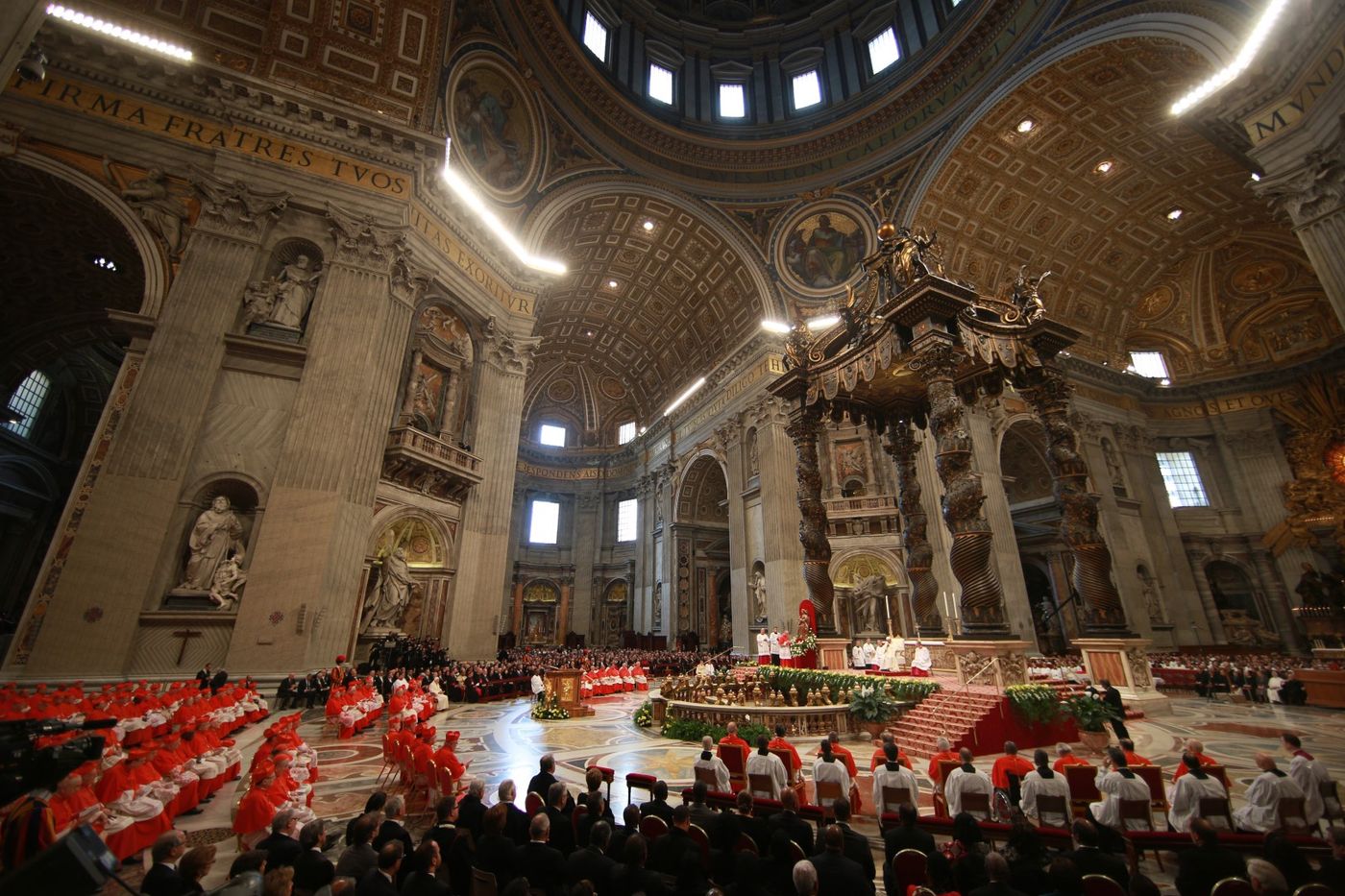
A SYNOD ON CHASTITY? After more than two and a half weeks of speech-making and conversation, Synod-2018 begins to grapple today with the product that will help define it. On Tuesday morning, the Synod fathers will be presented with a draft final report, which they will then have a free afternoon to read, reflect upon, and discuss privately. The days following will be spent in refining the draft final report, which will then be voted on Saturday, paragraph by paragraph, a two-thirds majority being required to adopt each paragraph. And while all this is going on, there will be more synodal end-game activity: on Friday, the Synod fathers will elect fifteen members of the Synod’s permanent council and they’ll also offer suggestions for a theme for the next ordinary general assembly of the Synod, which will presumably be held in 2021. There is considerable interest in Synod-2021 being devoted to the topic of women in the Church and in the world. And while that would indeed be a worthy subject, I’d like to suggest a different possibility: a Synod on chastity. The Catholic Church is suffering today from a crisis of chastity, the virtue that St. John Paul II defined as “the integrity of love.” The meltdown of chastity in the world under the pressures of the sexual revolution has now, unmistakably, corrupted the Church; that corruption has deeply damaged the Church’s evangelical mission by making Catholicism vulnerable to the lethal charge of hypocrisy. There is widespread and legitimate anger today over the failures of bishops, priests, and consecrated religious to live their vows of chastity with fidelity. But lay Catholics should also take a close look at our own failures to live the integrity of love, and to be witnesses in the world that sex is sacred, as Bishop David Konderla put it in these LETTERS. Chastity has, of course, been a tough one for humanity since that unfortunate afternoon in the Garden (after using that phrase, whose origin he thought obvious, Father Richard John Neuhaus was once asked by a New York Times reporter, “And what garden would that be, Father?). So the temptations of the flesh and the sins that follow from succumbing to those temptations are nothing new. And surely there have been other lascivious moments in history, as some of the “decorations” down the road in ruined Pompei (or a good history of Regency London) attest. This moment of ours is different, however, because of the ubiquity and celebration of un-chastity that surrounds us. Off-brand sex in its various forms, each of which is a counterfeit of genuine love, used to be private, even furtive. Now it has been industrialized and, in politics, weaponized. It saturates the Internet, the world of advertising, and popular entertainment. Just about every statistical indicator tells us that our culture’s descent into license is doing severe damage to individual lives and the social fabric of the West. Yet the defense of what was once considered indefensible, because it was humanly degrading, now threatens to unhinge virtually every western democracy. Pope St. Paul VI warned of the “smoke of Satan” entering the Church. And while there are many conjectures as to what precisely he meant, it’s hard for anyone with a biblical sensibility not to think that the Evil One, who got all this started back in that Garden, hasn’t had his hand in clerical sexual abuse and episcopal malfeasance, the damage they have done to victims and the demoralization they’ve caused throughout the world Church. That the Catholic Church has been vulnerable to some of the most destructive outcomes of the sexual revolution does not mean, as some at this Synod would have it, that the Church’s teaching is wrong and must be changed. It does mean that the biblical and moral truths the Church bears about the integrity of love have been poorly taught, inadequately received, and weakly defended. And that weakness is most destructive when it characterizes those charged with protecting the flock against wolves, some of whom have now been shown to be false shepherds, both personally corrupt and cogs in a network of corruption. And all that suggests to me the importance of a Synod on Chastity. Such a Synod would help demonstrate to the world, and to a lot of angry people in the Church, that Catholicism is serious about reforming what is corrupt and broken in its life by going to the root of that corruption: a failure to live the truth about love. Such a Synod could focus attention on the many important pastoral initiatives (including Theology of the Body-inspired catechetics, young adult ministries, and marriage preparation programs) that have helped armor the people of the Church, beginning with Catholic children, against the assaults they inevitably encounter in an unchaste culture that celebrates its unchastity. Such a Synod could lift up before the world a nobler vision of human possibility than the false anthropology of self-assertion that underwrites the aggressiveness of the sexual revolution: it could offer the world, through the prism of the Cross, the possibility of self-gift, including the gift of self in chaste love, married or celibate. Pope St. John XXIII opened the Second Vatican Council by summoning the Church to be a more winsome, effective, evangelical presence in the modern world. Pope St. Paul VI, in Evangelii Nuntiandi, tried to put an end to post-conciliar drift and confusion by refocusing Catholics’ attention on John XXIII’s summons. Pope St. John Paul II called for a “New Evangelization” in which every Catholic understood himself or herself to be a missionary who went into “mission territory” every day. Pope Francis spoke, in the early days of his pontificate, of a “Church permanently in mission.” The living parts of the Catholic Church today are those that have embraced that evangelical imperative. But even in the living parts of the world Church, the failures of bishops and priests to promote, defend, and live the integrity of love has become a major obstacle to announcing the Good News, as has the insouciance of too many lay Catholics about Catholic sexual ethics. A Synod that challenged everyone in the Church, in every state of Christian life, to understand that chastity is the virtue that allows us to live with the undivided heart we all seek, might go a long way to accelerating the reform the Church badly needs if it is to be salt and light in an increasingly jaded world determined to defend the practices that have left it jaded. The Catholic Church is regularly charged with being obsessed about sex. The truth of the matter is that it’s post-modern culture that’s sex-obsessed. What the Catholic Church is obsessed with is love: the love that, as Dante put it at the end of the world’s greatest poem, “moves the Sun and the other stars;” the love that took flesh in the womb of Mary of Nazareth; the crucified love that demonstrated the divine will to redeem; the resurrected love that brought the humanity of the Risen Christ into the life of the Most Holy Trinity. It is hard, these days, for many to see that Catholicism’s true passion is for love. A Synod on chastity – a global Catholic reflection on the integrity of love, and on how living love in integrity makes for happiness and beatitude – might help those whom we are called to evangelize to see more clearly what we’re really all about.
5:00 AM
Letters from the Synod-2018: October 23
Reports and Commentary, from Rome and Elsewhere, on the XV Ordinary General Assembly of the Synod of Bishops
Xavier Rynne II

24 min read



Already a subscriber? Sign in
5freearticles every month
Continue reading with a free account. No card needed.
- Five free articles every thirty days, on any device you sign in on
- The Catholic Herald newsletter, every morning
- Subscribe whenever you like for everything: every article and the magazine


subscribe to the catholic herald today
Our best content is exclusively available to our subscribers. Subscribe today and gain instant access to expert analysis, in-depth articles, and thought-provoking insights—anytime, anywhere. Don’t miss out on the conversations that matter most.
Subscribe



