


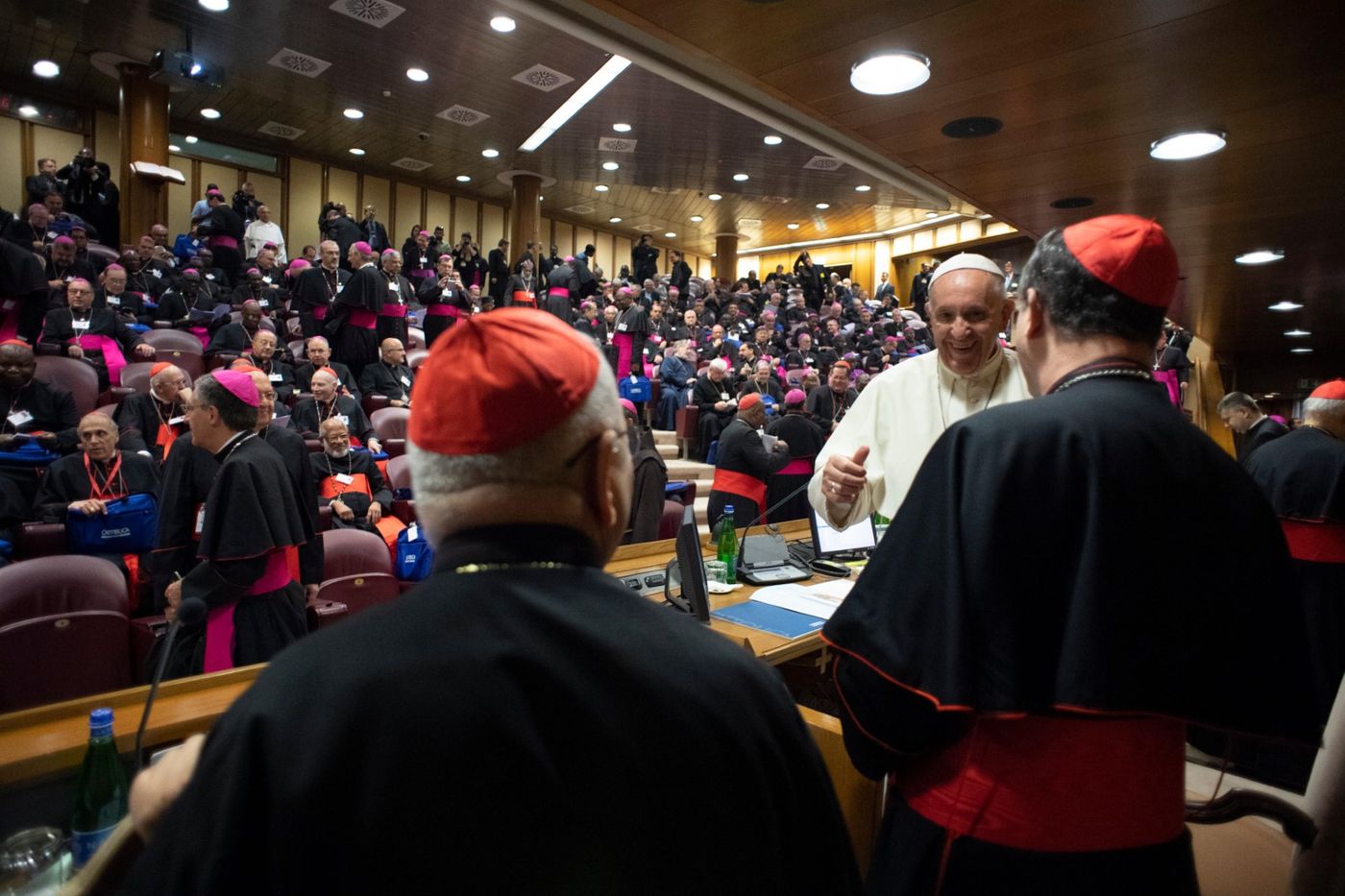
SOPHIE SCHOLL, JOHN HENRY NEWMAN, AND THE SYNOD It would be interesting to know how many of this year’s Synod fathers, staff, and auditors have ever heard of Sophie and Hans Scholl and the anti-Nazi resistance organization they formed, the White Rose. The White Rose has not become a global moral reference point, like America’s civil rights movement in its classic period or Poland’s Solidarity movement. But as Paul Shrimpton points out in his fine new book, Conscience Before Conformity (Gracewing), Sophie Scholl in particular has become something of an icon in 21st-century Germany. Not only have two feature-length movies been made about her life; almost two hundred schools bear the name of this young women who was condemned by notorious Nazi “People’s Court” judge, Roland Freisler, and guillotined for distributing leaflets calling cowed Germans to recover their moral senses during the Second World War. In German Lutheranism, Sophie (who wanted to enter into full communion with the Catholic Church before her death) is an unofficial martyr, and a TV series, Greatest Germans, proclaimed her the greatest German woman ever. I suspect that Miss Scholl, from her present position in the Communion of Saints, may find both those accolades a bit embarrassing. Why? Because Sophie Scholl was both extraordinary and quite ordinary. That’s why her life-story is a fitting one for those at Synod-2018 to ponder as the Synod enters its first full week of work. As author Shrimpton explains, Sophie, her brother Hans, their friend Christof Probst, and the other Munich students who formed the White Rose were, in many respects, normal youngsters for their time and place. In their early adolescence, both Hans and Sophie participated for a time in Nazi youth organizations, the militaristic Hitler Youth and the League of German Girls. Neither of the Scholls was exceptionally pious growing up and Hans had a somewhat adventurous romantic life as a young man. Their father was anti-Nazi and their mother was a student of the Bible who took social issues seriously; but there was little in their middle-class family background to suggest that Robert and Magdalena Scholl were raising two children who would become icons of the power of conscience in its resistance to evil. Sophie and Hans Scholl’s original attraction to National Socialism and its claim to be restoring German greatness crashed and burned because of Nazi vulgarity and brutality – Hans, for example, was repulsed by the gargantuan crowd manipulations staged by Leni Riefenstahl at annual Party rallies in Nuremberg (a city chosen because it sought to link the Austrian-born Hitler to a millennium of German history). But it was only later, at the University of Munich, that Sophie and Hans Scholl encountered the ideas and ideals that led them into resistance. Some of that discovery was philosophical and literary: Plato and Pascal, Kierkegaard and Bernanos were all influential in forming the minds and souls of the young people of the White Rose. But so were the theologians, including Augustine (paragon of conscientious self-examination), Thomas Aquinas (who taught them about the meaning of justice and the moral duty of resisting tyranny), and above all, John Henry Newman. I’d learned a bit about the White Rose over the years, and I’d watched one of the films about Sophie Scholl, but it wasn’t until I read Conscience Before Conformity that I understood what a profound effect Newman had had on these youngsters. Some of them read Newman’s books: the Grammar of Assent, the Essay on the Development of Christian Doctrine, The Idea of a University. It was Newman’s collected sermons, however, that had a decisive impact, for they opened up what Sophie Scholl described to her friend Susanne Hirzel as a “wonderful world.” And in that world of homiletic wonders, the crucial text for the White Rose was Newman’s sermon, “The Testimony of Conscience.” There, Sophie and her friends learned that (as one of them put it), “…we know by whom we were created, and that we stand in a relationship of moral obligation to our Creator. Conscience gives us the capacity to distinguish between Good and Evil.” This conviction was at the root of the White Rose’s resistance to Nazism and its demands. For Sophie Scholl and the White Rose, as for Newman, conscience shaped one’s exercise of freedom because a rightly-formed conscience informed a proper understanding of freedom: freedom as a virtue, the moral habit of choosing the good; freedom not to do whatever we like, but to do what we ought. As Paul Shrimpton puts it, Sophie developed, from reading and discussing Newman, a “rich ‘theology of conscience’” in which true freedom was grasped as “the freedom to do what is good, true, and beautiful, to act according to the dictates of a conscience informed by the laws of God imprinted on the heart…” All of which would find resonance, decades later, in the theological work of another German, Joseph Ratzinger, himself a keen student of John Henry Newman, who would write that “this way of conscience is everything other than a way of self-sufficient subjectivity; it is a way of obedience to objective truth” – the truths that God the Creator built into the world and into us. Sophie Scholl also read Jacques Maritain and came to love Maritain’s aphorism, “Il faut avoir l’esprit dûr et le cœur tendre .” Both the tenderness and the toughness were nurtured in her by Newman’s sermon on conscience. Newman taught Sophie and the other young adults of the White Rose that they had an obligation to oppose evil publicly, no matter who listened or followed their lead. Newman’s understanding of conscience as obedience to the voice of God resonating in the depths of our humanity made Sophie Scholl into someone immune to panic, even immune to fear, such that a 21-year-old could face down an evil maniac like Roland Feisler who held life-and-death power over her, and then lay her head into the guillotine with a serenity the executioner said he had never witnessed before. As at Synod-2015, there will be a lot of talk about conscience at Synod-2018, in this case about young adults and conscience. Everyone involved here in the Synod’s deliberations, inside the Synod Hall and “Off Broadway” (so to speak), would do well to reflect on the story of Sophie Scholl, the White Rose, and the effect that John Henry Newman’s teaching about conscience can have on young lives looking to challenge, and even convert, culture, politics, and society.
5:00 AM
Letters from the Synod-2018: October 8 - Commentary
Reports and Commentary, from Rome and Elsewhere, on the XV Ordinary General Assembly of the Synod of Bishops
Xavier Rynne II

21 min read



Already a subscriber? Sign in
5freearticles every month
Continue reading with a free account. No card needed.
- Five free articles every thirty days, on any device you sign in on
- The Catholic Herald newsletter, every morning
- Subscribe whenever you like for everything: every article and the magazine

subscribe to the catholic herald today
Our best content is exclusively available to our subscribers. Subscribe today and gain instant access to expert analysis, in-depth articles, and thought-provoking insights—anytime, anywhere. Don’t miss out on the conversations that matter most.
Subscribe



