


The Second World War film is one of the most precious, educative and enjoyable of cinematic genres. Ever since the Germans threw in the towel we have produced an amazing number and variety of films about the Allied nations’ struggle against Nazism. Sometimes these are straight-up tales of derring-do like Where Eagles Dare (1968); other times slightly revisionist takes like Enigma (2001); and rarely complete anti-historical rewritings like U-571 (2000).
The golden age was clearly in the 1960s and 1970s when there was a sufficient supply of excellent and serious actors, many of whom had fought in the war itself, others slightly younger but raised in the shadow of it.
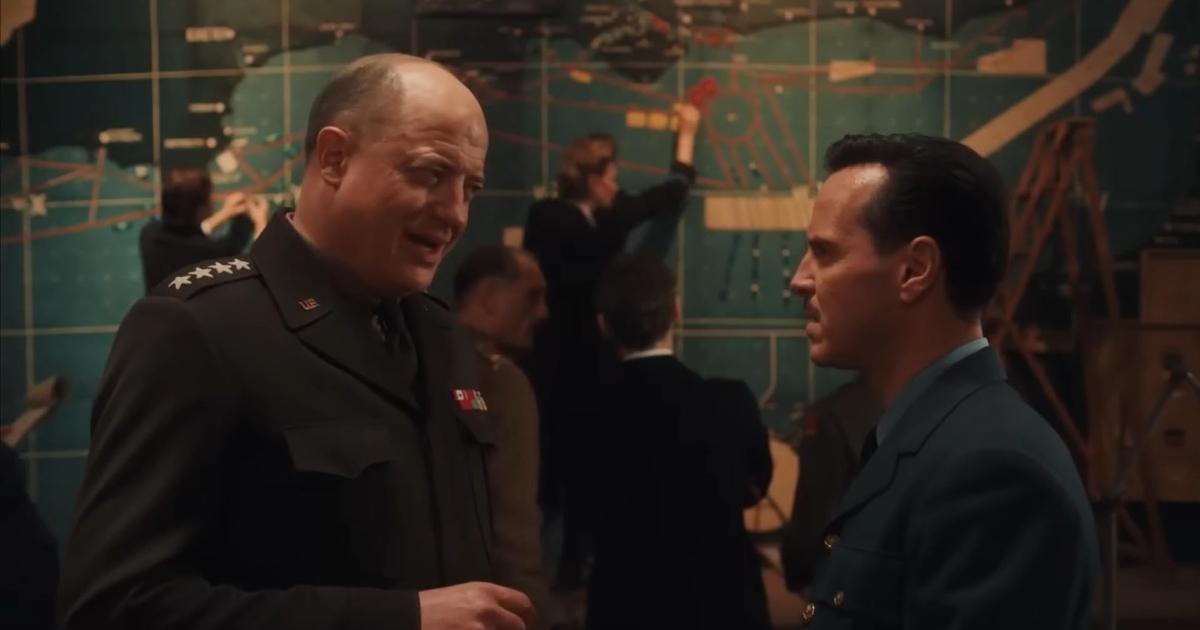
Now we have Pressure, currently in cinemas, bringing us an untold story of the influence meteorology had on the Normandy landings. The infinitely praised Andrew Scott (previously of Sherlock, Fleabag and Spectre) plays Group Captain James Stagg, chief meteorological officer to Operation Overlord, commanded by Brendan Fraser (The Mummy, The Quiet American) as General Dwight D Eisenhower.
It would be charitable to assume that these two are doing their best. Stagg, by all accounts, was a rather dour and serious Scotsman, but Scott seems totally incapable of putting himself into the mentality of a dutiful, boring, intelligent and plodding personality like the Group Captain. Everything is all internalised repression made so obvious to the cinemagoer as to undermine the entire effort.
Andrew Scott appears nothing like a man of the Second World War, but a very bad imitation of one carried out by someone who is terribly trapped in the prison of the present day. There is another useful term for this phenomenon: bad acting. Fraser is less bad, though he equally lacks any gravitas in the role of supreme Allied commander.
Needless to say, fidelity to the historical record is thrown right out the window in the hopes of upping the historical drama instead. The film depicts Group Captain Stagg as recommending a delay of two weeks when in fact he advised a delay of one day. The important role of the Norwegian meteorologist Sverre Petterssen is omitted (as it was from the 2014 stage play upon which the film is based).
At least the film accurately depicts the information warning about the storm and telling of its clearing as coming from the west of Ireland. The Met Office of neutral Éire shared its weather data in full with the Allies but not the Nazis – a fact often overlooked by Hibernophobes convinced de Valera was a foaming crypto-Nazi.
Pressure presents Stagg as a loner, a loser, a tortured genius working on his own in an isolated Valhalla above the hard-working staff of the meteorological team. In reality, he was really just a primus inter pares who had to coordinate three different teams of forecasters, amalgamate their findings and deduce a recommendation from them.
Stagg was responsible for heeding the two groups who accurately predicted that weather was deteriorating against an American team under Col Irving Krick (played by Chris Messina) insisting everything was going to be hunky-dory. There is a certain unpleasant element of oh-those-confident-but-clueless-Americans about this film – aren’t they lucky they had good, cleverer chaps like Group Captain Stagg to be the responsible adults in the room?
It would be hard to imagine the actual Group Captain of history would find this film anything other than a deplorable over-dramatisation, including only the most basic skeleton of historic events in its depiction.
This entire effort falls flat, and one can’t help but think the producers have misspent their £22 million budget.