Now that the day-light dies away, By all Thy grace and love, Thee, Maker of the world, we pray To watch our bed above.
Let dreams depart and phantoms fly, The offspring of the night, Keep us, like shrines, beneath Thine eye, Pure in our foe’s despite.
This grace on Thy redeemed confer, Father, Co-equal Son, And Holy Ghost, the Comforter, Eternal Three in One.
After his conversion, Newman’s poetry explored more explicitly Catholic themes, and some of the poems that became hymns are in the sentimental vein of 19th-century popular piety. A beautiful hymn on the Holy Souls, written in 1857, explores some of the ideas found also in The Dream of Gerontius:Oh, by their patience of delay, Their hope amid their pain, Their sacred zeal to burn away Disfigurement and stain;
Oh, by their fire of love, not less In keenness than the flame, Oh, by their very helplessness, Oh, by Thy own great Name,
Good Jesu, help! Sweet Jesu, aid The souls to Thee most dear, In prison, for the debt unpaid Of sins committed here.
Gerontius is also recalled by Guardian Angel (1853), which tenderly addresses “My oldest friend, mine from the hour / When first I drew my breath; / My faithful friend, that shall be mine, / Unfailing, till my death.” Newman’s devotion to his guardian angel, expressed here, was one of childlike trust and confidence, and this hymn (appropriately shortened from its 11 verses) is one that could certainly be used in Catholic schools. His invocation of St Michael, however, expressed in a poem of 1862 which appears in the Westminster Hymnal as late as 1964, is very different:And thou, at last, When time itself must die, Shalt sound that dread and piercing blast, To wake the dead, and rend the vaulted sky, And summon all to meet the omniscient Judge on high.
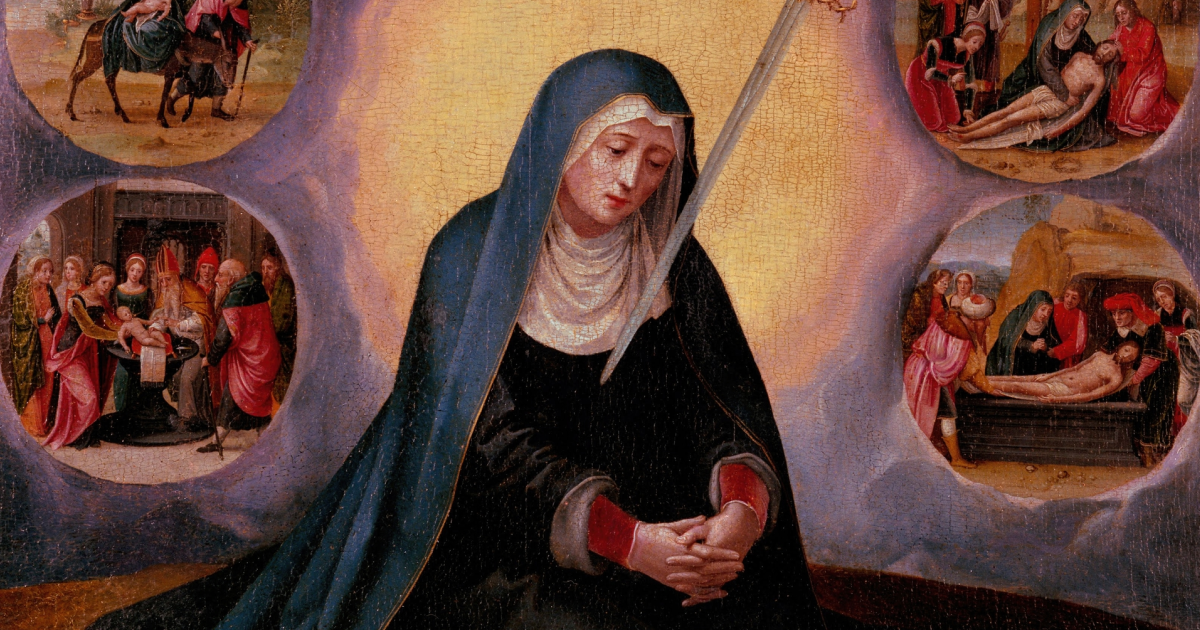
Newman’s Marian devotion was profound, and naturally found expression in poetry. A curiously Chestertonian ballad “The Pilgrim Queen” (1849) became a hymn in the 1870 volume Hymns and Songs for Catholic Children, which describes Mary sitting on the ground “desolate” over the loss of England, but ends in hope with the memorable verses:I look’d on that Lady, and out from her eyes Came the deep glowing blue of Italy’s skies; And she raised up her head and she smiled, as a Queen On the day of her crowning, so bland and serene.
“A moment,” she said, “and the dead shall revive; The giants are falling, The Saints are alive; I am coming to rescue my home and my reign, And Peter and Philip are close in my train.”
“The Month of Mary” (1850) is a similarly stirring hymn for the ‘Queen of May’, which shows Newman’s embrace of popular Marian devotion after his conversion, and is found in hymnaries of Marian sodalities in the late century. It may have been sung by these when processing through the streets of towns and cities such as Boston or Birmingham, and perhaps it may yet be again with Newman’s canonisation. But if none of these hymns find the same favour in parishes as the more popular Praise to the Holiest or Lead, Kindly Light when their author is raised to the altars, I hope people will find renewed interest in the volumes from which they are drawn. Newman’s poetry is full of rich devotional material, and profound reflections on the spiritual life. His “other” hymns have the potential to enrich our personal prayer lives if not necessarily our parishes’. Dr Matthew J C Ward is director of music at Mayfield School, director of Stonegate Choir and regional director (South East) of the Schola Gregoriana of Cambridge