
The season of Lent is upon us yet again, and it has made me reflective. Many of the habits and devotions we were most proud of have fallen into neglect. Again, it is time to tuck away our sweets and dust off our prayer books: the spiritual equivalent of a spring cleaning. It is time we put ourselves back in order, but not in just any order. The Christian is in the habit of putting last things first. From its beginning, Lent orients us towards our end, our death, for to dust you shall return. We are ordering our hearts, preparing our wills for a fight: a fight to the death, our own.
To understand how Lent prepares us for death, we should begin by talking about docility. An essential quality in our preparation for death is this calmness of spirit, a docile heart. It is worth adding that this calm is not indolent. No, the Christian must be docile and remain decisive. In fact, he must be decisively docile. It is not laziness that causes the monk to sit still at his office, but an intense act of will. Docility is not a passive quality; it is not inaction. Docility is the quality of the soldier at the ready. The soldier must be able to follow his general’s orders at any moment, and so he has a duty to be still. The soldier must be docile in his heart, so that he can be decisive in his assault. Thus, stillness becomes not an escape from battle, but the very discipline that makes free action possible.
Likewise, the Christian must be docile in his prayer so that he can be decisive in his sacrifice. He must quiet his heart to hear his Lord and train his heart to follow His orders. However, the Christian is not only decisive in worldly affairs, nor is the world his primary focus. His chief concern is the marshalling of himself against himself, or, if we are to speak more precisely, his higher reason against his unreasonable desires. If he ever hopes to be trustworthy in external affairs, he must become distrustful of his own judgment. This distrust is not despair, but humility: a recognition that grace must lead where instinct would mislead. He must be merciless in crushing the mutinous desires that arise within his own heart if he hopes to become truly faithful. He must know that before he can be an ally of men, or even a servant of God, he must be an enemy of himself.
As Christians, we know that the best leaders are those who doubt their own strength. If there were any quality that could disqualify a leader in the eyes of the Christian, it must be self-confidence. The Christian knows to avoid such proud boasting because none is sufficient but Christ – and His voice is still and small. This is why we turn in prayer to quiet our hearts, to hear Him who is sure to lead us best. Lent is the time to again become docile, and a time to be decisive.
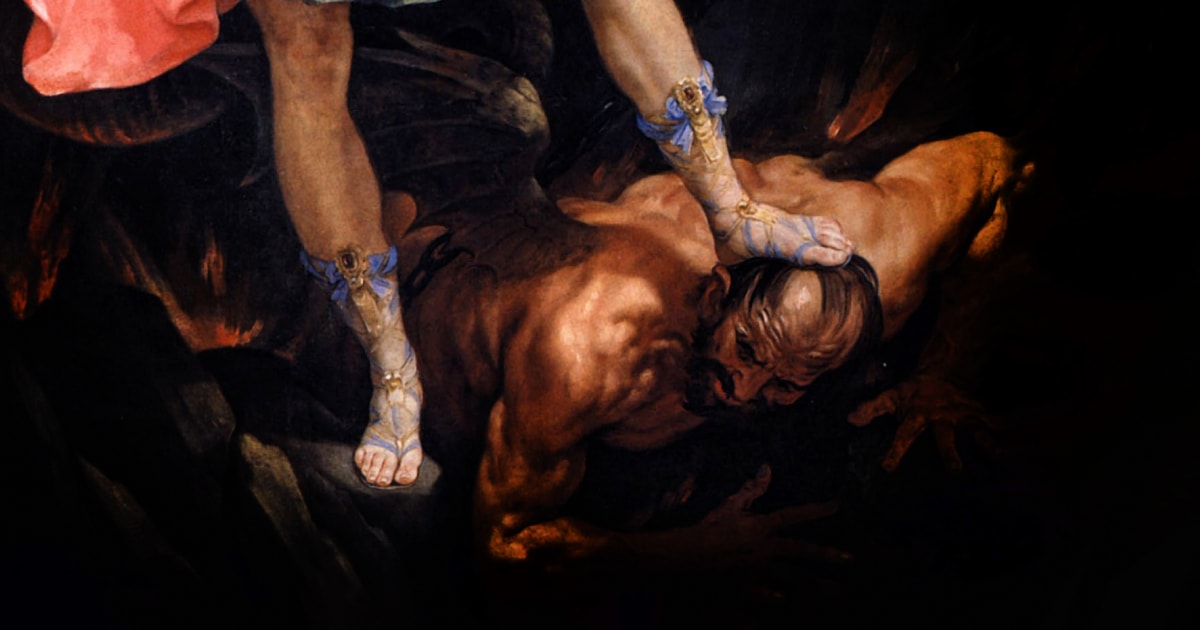
Lent is the season of spiritual combat. Christ leads the way. He models this by His own forty-day fast prior to beginning His public ministry. Following His Baptism in the Jordan, He entered the wilderness of Judea, which tradition says is the abode of devils. Christ, our captain, not only takes up arms, prayer, fasting, but He leads the offensive into enemy territory. Indeed, the gates of Hades shall not prevail against it. In this season, the Christian is awakened to his purpose and reminded of his fate. He follows his Lord into the wilderness, so that he might meet him in Golgotha, and ultimately in Paradise.
Victory is won by the Christian who follows his Lord in death, and so he speaks of “mortifications”. By each act of self-denial, missed meals, time in meditation, alms given, he embraces his cross as though handling the hilt of his blade. He does not forget that before he can make a gift of himself, he must possess himself. A man cannot wield his blade before he can control his arm. Before he can lay down his life, he must first take it up. Such small deaths, freely chosen, school the soul for the greater surrender that love will one day require.
Lent is nothing short of an Arthurian quest. Obtaining the Divine Mystery gives way to human mastery so that in Christ we overcome our greatest obstacle, our own sinful weakness and knavish self-love. By our holy arsenal, prayer, fasting, and almsgivings, we can become docile enough for God to pass through us, but decisive enough to slay giants. The Israelites under Joshua were led by God into an earthly inheritance by making great war with the seven Canaanite peoples. Let us be led by God in a holy war against the promised land of our own souls and make no peace nor give censure to the seven deadly sins that inhabit our souls. Yet even this warfare is ordered to peace and docility: the quiet reign of grace within a rightly governed heart.
So we are marshalled by our King. Let us join the fight. For love of God and for the sake of this world, may we make war on ourselves – to the death, and for glory.