
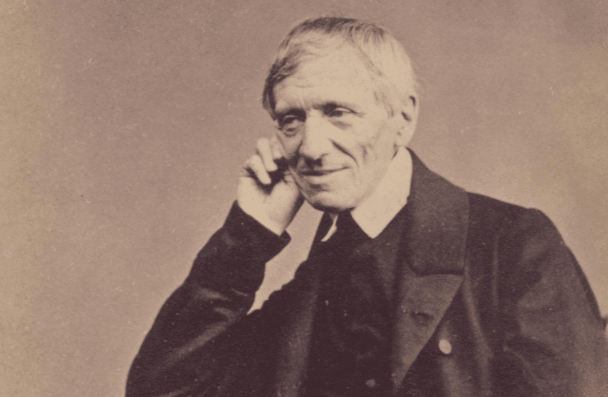
What were Shakespeare’s greatest play and Leonardo’s greatest painting? The very questioning is contentious and sparks verbal wars, most violently among pedants. We then tread fields of landmines when looking for Newman’s greatest achievement, exclusive of the fundamental and definitive achievement of heroic sanctity. But just as Alexander Pope cautioned that fools rush in where angels fear to tread, I would play the fool in saying that Newman especially graced general culture with his psychological analysis of the role of personality in the economy of faith. Newman was not given to abstract thought, and the closest he came to it was his Grammar of Assent, but even that dense treatise studied how human personality thinks and ascertains the integrity of what is thought. His examples are human examples, and his evidence is from experience rather than speculation. In this, he was a precursor and prophet of modern attempts at what is called personalism. On nearly every page of Karol Wojtyła’s The Acting Person is the shade of Newman. The great Newman never preached to congregations. He preached to individuals and whenever he prepared to preach to unfamiliar assemblies, he asked who would be there and where they would be seated. He would not be, as Gladstone was according to Queen Victoria, someone who addressed individuals as though they were a public meeting. So when the “cloud” of suspicion about his stability of doctrine was “lifted” by Leo XIII making him a cardinal, he chose as his motto “Cor ad cor loquitur”, a variant of a line of that intimate companion of personalities who spoke heart to heart, St Francis de Sales: “Cor cordi loquitur.” In the Discourses to Mixed Congregations, Newman said: “The prophets have ordinarily not only gifts but graces, they are not only inspired to know and to teach God’s will, but inwardly converted to obey it. For surely those can only preach the truth who duly feel it personally; those only transmit it fully from God to man, who have in the transmission made it their own.” His natural affinity was for the “preference of the Personal to the Abstract”, as he described it in the transporting line of his Apologia, which is one of literature’s most emotive accounts of the journey of a soul: “It is faith and love which give to probability a force which it had not in itself … Thus the argument from probability, in the matter of religion, became an argument from personality, which in fact is one form of the argument from authority.”
2:30 PM
Newman's greatest achievement: putting the personal over the abstract
what were shakespeare’s greatest play and leonardo’s greatest painting? the very questioning is contentious and sparks verbal wars, most vio...
Fr George Rutler

3 min read



Already a subscriber? Sign in
5freearticles every month
Continue reading with a free account. No card needed.
- Five free articles every thirty days, on any device you sign in on
- The Catholic Herald newsletter, every morning
- Subscribe whenever you like for everything: every article and the magazine

subscribe to the catholic herald today
Our best content is exclusively available to our subscribers. Subscribe today and gain instant access to expert analysis, in-depth articles, and thought-provoking insights—anytime, anywhere. Don’t miss out on the conversations that matter most.
Subscribe



