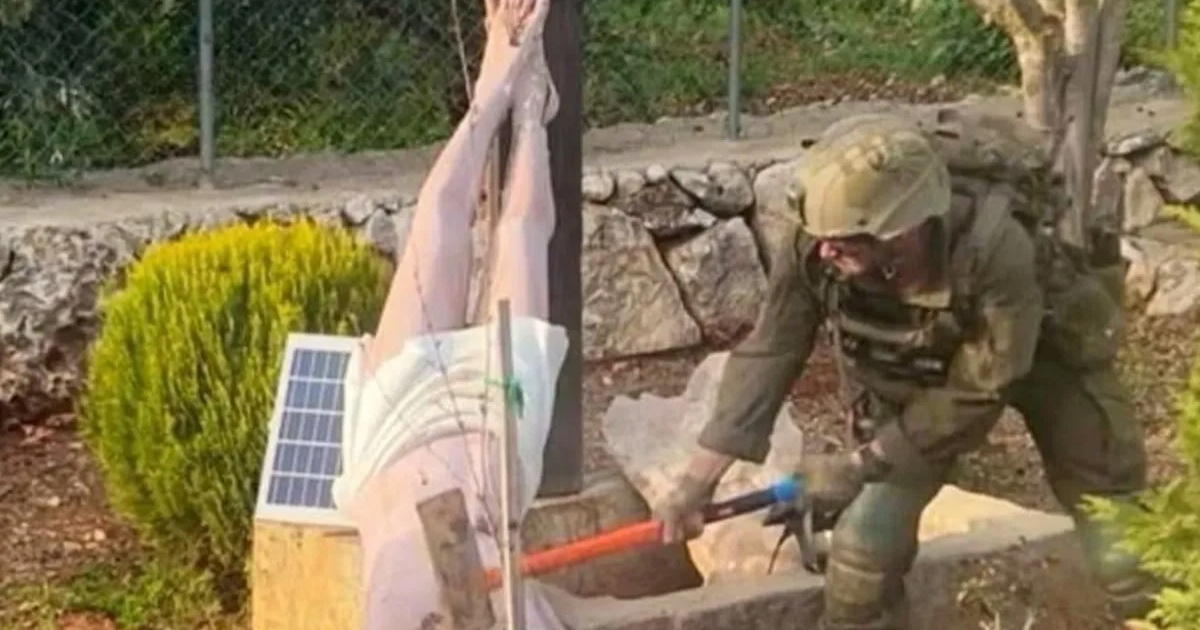


An Israeli soldier was photographed striking the head of a fallen statue of the crucified Christ with a sledgehammer in the Maronite Christian village of Debel in southern Lebanon, an act of desecration that has provoked profound outrage among Christians worldwide and drawn apology and condemnation from Israeli leaders at the highest levels.
The image, which circulated rapidly on social media over the weekend and was verified as authentic by the Israel Defense Forces on Monday, April 20, 2026, shows the soldier using the blunt side of an axe or sledgehammer against the sculpture on a crucifix outside a family home on the edge of Debel, one of the few Christian communities where residents remained during Israel’s military operations against Hezbollah.
The IDF stated that it views the incident with great severity, declaring the soldier’s conduct “wholly inconsistent with the values expected of its troops”, and has opened a criminal investigation by the Northern Command, promising: “Appropriate measures will be taken against those involved in accordance with the findings,” including anyone who photographed or recorded the scene.
Prime Minister Benjamin Netanyahu issued an expression of remorse following the incident. “Yesterday, like the overwhelming majority of Israelis, I was stunned and saddened to learn that an IDF soldier damaged a Catholic religious icon in southern Lebanon. I condemn the act in the strongest terms,” he wrote on X.
“Military authorities are conducting a criminal probe of the matter and will take appropriately harsh disciplinary action against the offender,” he added, noting that Israel, as a Jewish state, “cherishes values based on tolerance and mutual respect among followers of all religions”.
Foreign Minister Gideon Sa’ar described the behaviour as “grave and disgraceful” and “ugly”, offering a direct apology. “We apologise for this incident and to every Christian whose feelings were hurt,” he posted on X, expressing confidence that “the necessary strict measures will be taken against whoever carried out this ugly act”.
Cardinal Pierbattista Pizzaballa, Latin Patriarch of Jerusalem and head of the Assembly of Catholic Ordinaries of the Holy Land, however, issued strong condemnation and concern. He signed a statement expressing the Assembly’s “profound indignation and unreserved condemnation of the desecration of a representation of Jesus Crucified”. The statement declared: “This act constitutes a grave affront to the Christian faith and adds to other reported incidents of desecration of Christian symbols by IDF soldiers in southern Lebanon. It further reveals a disturbing failure in moral and human formation, wherein even the most elementary reverence for the sacred and for the dignity of others has been gravely compromised.” The Assembly called for “immediate and decisive disciplinary action, a credible process of accountability, and clear assurances that such conduct will neither be tolerated nor repeated”.
A local priest in Debel, Fr Fadi Flaifel, told reporters that one of the Israeli soldiers “broke the cross and did this horrible thing, this desecration of our holy symbols”. Fr Flaifel pointed out that the act of vandalism was not a one-off and that similar incidents had taken place before.
Israeli officials have stressed that the episode runs counter to the State of Israel’s longstanding commitment to protecting holy sites and upholding religious freedom for the three Abrahamic faiths, and the military has indicated it is working with the local Christian community to restore the statue.
The attack, however, comes amid growing anti-Christian sentiment among the Israeli public. As BBC News reports, a 2025 report by the Rossing Center, a Jerusalem-based think tank, describes a “recent surge in overt animosity towards Christianity”, putting this down to “a continued deepening of polarisation and ultra-nationalist political trends”.
In late March, the decision by Israeli authorities on Palm Sunday to deny Cardinal Pizzaballa entry to the Church of the Holy Sepulchre for a private Mass sparked outcry. Israeli police cited safety concerns due to the ongoing Iran war; however, this was widely criticised, including by Mike Huckabee, the US Ambassador to Israel.
Huckabee called that episode an “unfortunate overreach already having major repercussions around the world”. With Israeli restrictions allowing religious gatherings of up to 50 people at the time, he said the decision to deny the Church leaders entry was “difficult to understand or justify”.
Polls suggest there has been a significant drop in support for Israel among US citizens over the last four years. Findings published by the Pew Research Center revealed that 60 per cent of Americans now have an unfavourable view of Israel, up from 53 per cent last year.
The statue incident has unfolded against the backdrop of Israel’s ground operations in southern Lebanon. Israeli authorities have apologised and condemned the act. Questions remain about the precise circumstances, any further involvement, and whether this forms part of a broader pattern of reported disrespect towards Christian heritage in the conflict zone.