




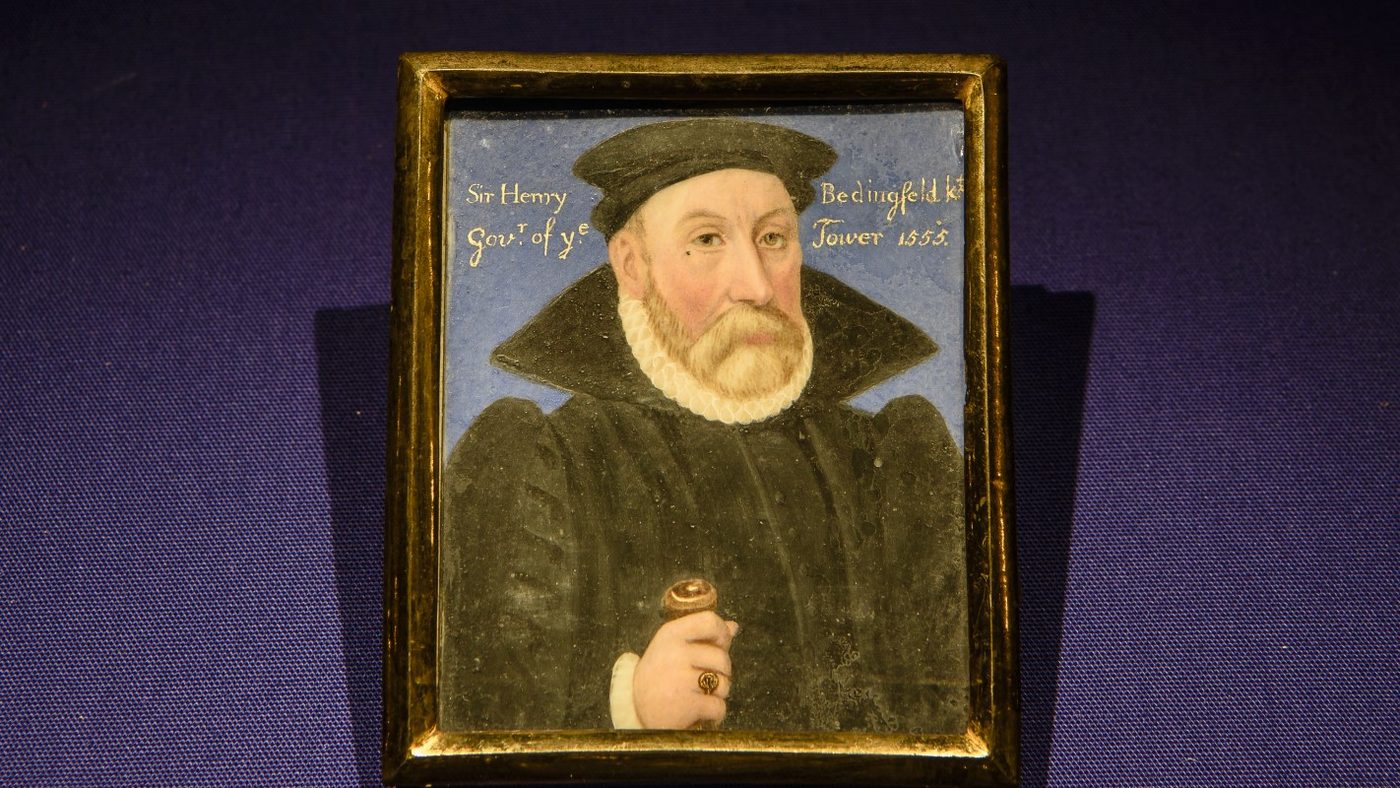
The survival of the thousands of artefacts recently recovered from the attic of Oxburgh Hall is remarkable, but the survival of the house itself is no less impressive. Home of the Bedingfeld family for over 500 years, Oxburgh has lived through religious persecution, Civil War, financial turmoil and near demolition. Sir Edmund Bedingfeld inherited the Oxburgh estate in 1476 through his marriage to Margaret, daughter and heiress of Sir Robert Tuddenham. Sir Edmund was granted a licence by Edward IV to build a fortified residence, which he completed in 1482 with expensive red brick, reflecting the rising status of the Bedingfelds. The family were Yorkists and fervent Royalists, who became powerful figures in the late 15th century. Sir Edmund was made a Knight of the Bath at Richard III’s coronation and later, in 1487, he assisted Henry VII in his final victorious battle of the War of the Roses. The third of Sir Edmund’s sons to inherit the property, also called Edmund, served in France under Henry VIII who knighted him in 1523 at Montdidier. But the Bedingfelds’ loyalty to the Tudor court was soon forgotten when the next inheritor of the property, the devout Catholic Sir Henry Bedingfeld, refused to support Elizabeth I’s Act of Uniformity in 1559, which outlawed the Catholic faith. In the following years, the Bedingfelds faced severe pressure and suspicion. The family began sheltering clergy, constructing a priest-hole as a closet which was accessible via a lavatory. Lady Mary Paston-Bedingfeld told the Catholic Herald that it is “thought the priest-hole was built by Nicholas Owen but proof would have been too dangerous to keep … It was a time when there were many spies reporting on such activities, so there was considerable danger.” During this time, the value of the estate diminished significantly due to the heavy fines being levied on recusants. Then, in the 17th century, another Sir Henry Bedingfeld found himself imprisoned for a time after fighting in the Battle of Marston Moor during the Civil War. Known as a Catholic Royalist in an area that was strongly Puritan and Parliamentarian, Sir Henry saw the majority of his estates confiscated, with Oxburgh raided and partially burned. It was the low point of the Bedingfelds’ fortunes. Life became easier at the Restoration of the monarchy, when they were raised to the baronetage by Charles II. Over the next century, the family continued to recover despite the subsequent reimposition of penalties on Catholics. And in 1761, when Mary Browne, daughter of Viscount Montague of Cowdray, married into the family, she brought with her the extraordinary needlework of Mary Queen of Scots, completed while Mary Stuart was incarcerated by Queen Elizabeth I. Having kept alive the flame of faith through the centuries, the family emerged from the shadows in the Catholic emancipation. Sir Henry Richard Paston-Bedingfeld commissioned John Chessell Buckler and Augustus Pugin in the 1830s to do significant restoration work on the Hall. Soon a chapel was added, as was a stable block, and the gardens were rebuilt. It was around this time that the family acquired what Lady Mary Paston-Bedingfeld calls the “greatest treasure” of the house: a 1530 hand carved altar piece from Antwerp. The following century, however, things again took a turn for the worse, with rising taxes and unpaid rents forcing the Bedingfelds to eventually sell up; the Hall was auctioned off in lots in 1950. A year later the property faced demolition but was saved by Lady Sybil Paston-Bedingfeld, who managed with her daughter Frances Playford and niece Violet Hartcup, to raise up enough money to buy back Oxburgh Hall, before offering it as a gift to the National Trust in 1952. The thousands of manuscripts and textiles recently recovered in the attic of Oxburgh Hall will be added to the historic collection of paintings, tapestries, and sacred items that Oxburgh Hall is already proud to own. Currently undergoing a £6 million re-roofing project, the hall hopes one day to display the new finds alongside the existing collection, shedding new light on the remarkable history of the house – and the faith of the Bedingfelds.
6:29 PM
Oxburgh Hall: The ups and downs of a recusant Catholic family
The survival of the thousands of artefacts recently recovered from the attic of Oxburgh Hall is remarkable
Thomas Caddick

4 min read



Already a subscriber? Sign in
5freearticles every month
Continue reading with a free account. No card needed.
- Five free articles every thirty days, on any device you sign in on
- The Catholic Herald newsletter, every morning
- Subscribe whenever you like for everything: every article and the magazine
Related articles
 Analysis
Catholics were in America long before 1801
From Spanish Jesuit missionaries in Virginia to Maryland’s Catholic settlers, the history of Catholicism in America stretches back to the colonial era
Christine Rousselle Analysis
The extreme violence behind the international trade in drugs
Simon Caldwell Analysis
Assessing Pope Francis's most controversial decisions
Elise Ann Allen/ Crux Analysis
As Francis marks 12th anniversary of his election in hospital, we should recall his words during first days as Pope
Charles Collins/Crux Analysis
Trump's critics should consider parallels with another German leader
Charles Collins/Crux
subscribe to the catholic herald today
Our best content is exclusively available to our subscribers. Subscribe today and gain instant access to expert analysis, in-depth articles, and thought-provoking insights—anytime, anywhere. Don’t miss out on the conversations that matter most.
Subscribe



