

The bishops of Poland have reaffirmed their opposition to changes to religious education within the school curriculum as the ministry of education has ruled out reversing its implementation. The Church has warned that the reduction in religious education would marginalise the Faith in schools.
Bishop Wojciech Osial of Łowicz called the decision to halve the religious education from two hours per week to one “unfair”. Bishop Osial, who is chairman of the Catholic Education Commission of the Polish Bishops’ Conference, said: “We do not accept the marginalisation of religion classes.”

The bishop told Vatican News: “Today, especially when we see a crisis of values among young people, such a solution would benefit both believers and non-believers.”
Bishop Marek Mendyk of Świdnica , former chairman of the Catholic Education Commission of the Polish Bishops’ Conference, described the changes as an “attempt, at all costs – including through deceptive means and violations of the law – to remove religion from schools”.
The bishops of Poland released a statement on August 24 ahead of the beginning of the school year, noting their concern that, as well as the reduction in hours, religious lessons were to be placed before or after compulsory classes. They also warned that the possibility of combining classes and changes to grading would marginalise the subject in schools.
The bishops appealed for the “immediate restoration of the proper place for these activities”, as well as dialogue between the ministry and representatives of religious communities.
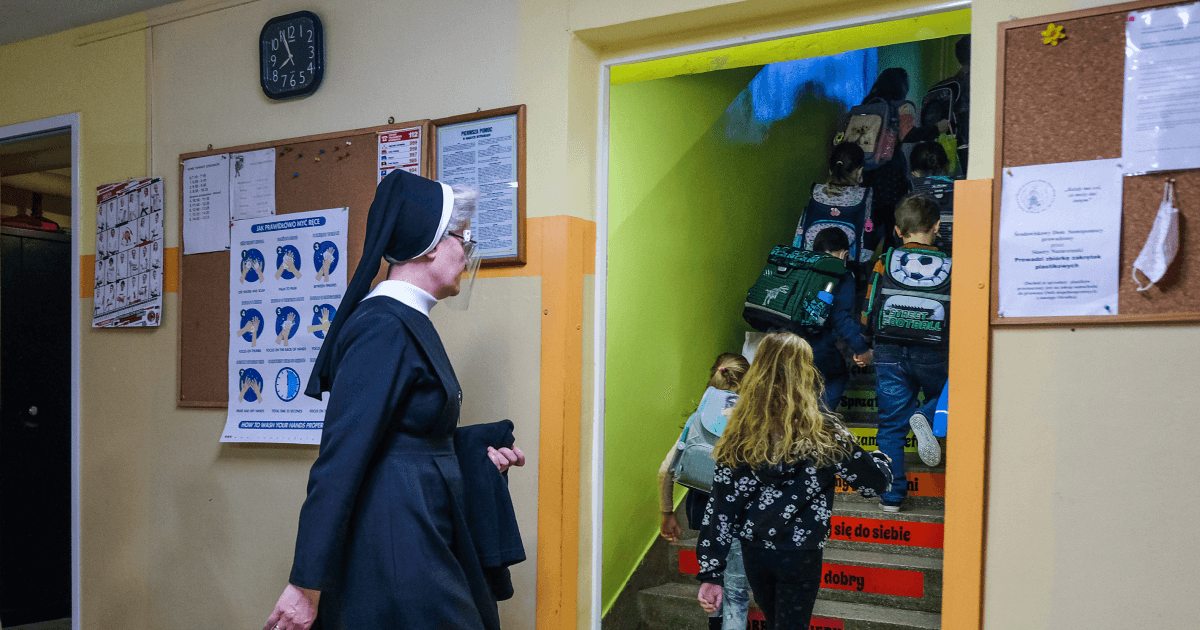
The Polish education ministry said that it had no plans to amend the changes, which came into effect on September 1. Religious education, which in the Polish education system focuses heavily on Church teaching, has been offered in Polish public schools since its reintroduction following the fall of communism.
Arkadiusz Kuznacki, a father of two from Wschowa in western Poland, told Vatican News that he has observed religious education being increasingly marginalised in school timetables. Last year, his daughter’s religion class was scheduled late in the school day, meaning that she had to wait a further hour before the lessons began. Kuznacki said the timetable was “being arranged in such a way that children will not attend religion classes”.
Aneta Rayzacher-Majewska, a religion teacher of 23 years, emphasised the importance of religious education in providing an environment for pupils to ask challenging questions, develop their own understanding of God and the Church, and learn about Europe’s Christian heritage.
Noting that the rescheduling particularly affects students who commute to school, she said that “sometimes, in practice, it forces them to withdraw from religion classes”. She argued that it could also put parents in a difficult situation by making it much less convenient to choose for their children to study religion.