


February 11, 2026

Pope Francis greets Auschwitz survivor at General Audience

Staff Reporter
More
Related
Min read
share
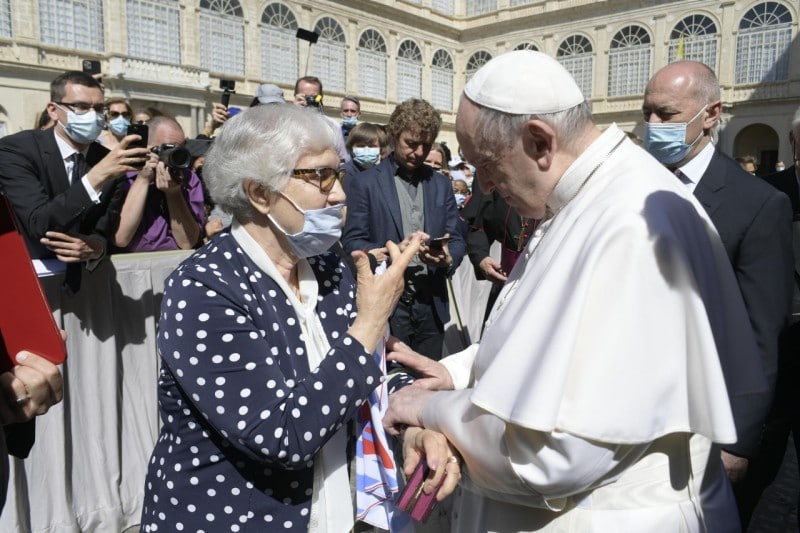
Pope Francis greets Auschwitz-Birkenau survivor Lidia Maksymowicz at the weekly General Audience on 26 May 2021 (Image © Vatican Media)
 

-- Rome -- Lidia Maksymowicz was only two years-old when she was deported to the infamous Nazi death camp of Auschwitz-Birkenau. For three years she was subjected to medical experiments at the hands of Josef Mengele. “All the children knew who Mengele was and were terrified of him,” she says telling her story in the decades following the end of the war.

On Wednesday morning, Maksymowicz was able to greet Pope Francis at the Vatican during the General Audience. During their brief encounter, the Holy Father kissed the number tattooed into her arm.


“With the Holy Father, we understood each other with our eyes,” she told Vatican News after the encounter. “We didn’t have to say anything to each other. There was no need for words.”

Maksymowicz recounted her experience at the death camp earlier this year during a “Festival of Memory” organized by the “Terra del Fuoco Trentino” association in northern Italy, which offered the opportunity for people to listen to witnesses to the tragedy of the Holocaust and virtually visit the concentration camp and extermination centre of Auschwitz-Birkenau.

The program is intended “to live memory as a true experience, remembering that in the world, even today, there are realities that repeat these atrocities,” according to Mirko Bisesti, one of the organisers of the event.

“I consider it a mission to tell this story,” she said. “I owe it to those who didn’t make it and died” in the camps.

Upon her arrival at Auschwitz, Maksymowicz was immediately identified as a subject for various experiments, including injections with infectious diseases to test for cures. “I lived there many, many months and I didn’t understand why I was there,” she said. “I was afraid of people in uniforms and people in white coats.”

She recounted how, as Mengele’s assistants chose the children for each day’s experiments, “I would choose to make myself small and hide under the furthest shelf” that served as the children’s beds. “But it didn’t always work.”

After the Russian Army liberated the camp in January 1945, Maksymowicz was placed with a Polish family because her mother, who had also been sent to Auschwitz, was feared dead. “Psychologically I was destroyed, but those people who looked after me were very important,” Lidia said. “In 1947, I finally stopped being a number, and those adoptive parents also gave me a surname.”

Her mother, however, had survived the war and been relocated to Hamburg, in Germany.

Maksymowicz was featured in a television report. “After many, many searches, they found a woman who had the same number as me she said. She was one of the first child survivors of Auschwitz to find her mother. “My mother explained a lot of things to me” after they were reunited, Lidia said. “She had been looking for me for years but the Iron Curtain prevented information from passing from West to East.” Then 70 years old, her mother died shortly after their reunion.

Following her meeting with Pope Francis, Maksymowicz launched an appeal to young people through Vatican News and Vatican Radio: “In your young hands is the future of the world. Listen to my words, go and visit Auschwitz and Birkenau and see to it that this atrocity never returns."

"That history," she said, "must never be repeated.”

Pope Francis greets Auschwitz-Birkenau survivor Lidia Maksymowicz at the weekly General Audience on 26 May 2021 (Image © Vatican Media)
 

-- Rome -- Lidia Maksymowicz was only two years-old when she was deported to the infamous Nazi death camp of Auschwitz-Birkenau. For three years she was subjected to medical experiments at the hands of Josef Mengele. “All the children knew who Mengele was and were terrified of him,” she says telling her story in the decades following the end of the war.

On Wednesday morning, Maksymowicz was able to greet Pope Francis at the Vatican during the General Audience. During their brief encounter, the Holy Father kissed the number tattooed into her arm.

“With the Holy Father, we understood each other with our eyes,” she told Vatican News after the encounter. “We didn’t have to say anything to each other. There was no need for words.”

Maksymowicz recounted her experience at the death camp earlier this year during a “Festival of Memory” organized by the “Terra del Fuoco Trentino” association in northern Italy, which offered the opportunity for people to listen to witnesses to the tragedy of the Holocaust and virtually visit the concentration camp and extermination centre of Auschwitz-Birkenau.

The program is intended “to live memory as a true experience, remembering that in the world, even today, there are realities that repeat these atrocities,” according to Mirko Bisesti, one of the organisers of the event.

“I consider it a mission to tell this story,” she said. “I owe it to those who didn’t make it and died” in the camps.

Upon her arrival at Auschwitz, Maksymowicz was immediately identified as a subject for various experiments, including injections with infectious diseases to test for cures. “I lived there many, many months and I didn’t understand why I was there,” she said. “I was afraid of people in uniforms and people in white coats.”

She recounted how, as Mengele’s assistants chose the children for each day’s experiments, “I would choose to make myself small and hide under the furthest shelf” that served as the children’s beds. “But it didn’t always work.”

After the Russian Army liberated the camp in January 1945, Maksymowicz was placed with a Polish family because her mother, who had also been sent to Auschwitz, was feared dead. “Psychologically I was destroyed, but those people who looked after me were very important,” Lidia said. “In 1947, I finally stopped being a number, and those adoptive parents also gave me a surname.”

Her mother, however, had survived the war and been relocated to Hamburg, in Germany.

Maksymowicz was featured in a television report. “After many, many searches, they found a woman who had the same number as me she said. She was one of the first child survivors of Auschwitz to find her mother. “My mother explained a lot of things to me” after they were reunited, Lidia said. “She had been looking for me for years but the Iron Curtain prevented information from passing from West to East.” Then 70 years old, her mother died shortly after their reunion.

Following her meeting with Pope Francis, Maksymowicz launched an appeal to young people through Vatican News and Vatican Radio: “In your young hands is the future of the world. Listen to my words, go and visit Auschwitz and Birkenau and see to it that this atrocity never returns."

"That history," she said, "must never be repeated.”

subscribe to
the catholic herald

Continue reading your article with a subscription.
Read 5 articles with our free plan.
Subscribe

subscribe to the catholic herald today

Our best content is exclusively available to our subscribers. Subscribe today and gain instant access to expert analysis, in-depth articles, and thought-provoking insights—anytime, anywhere. Don’t miss out on the conversations that matter most.
Subscribe