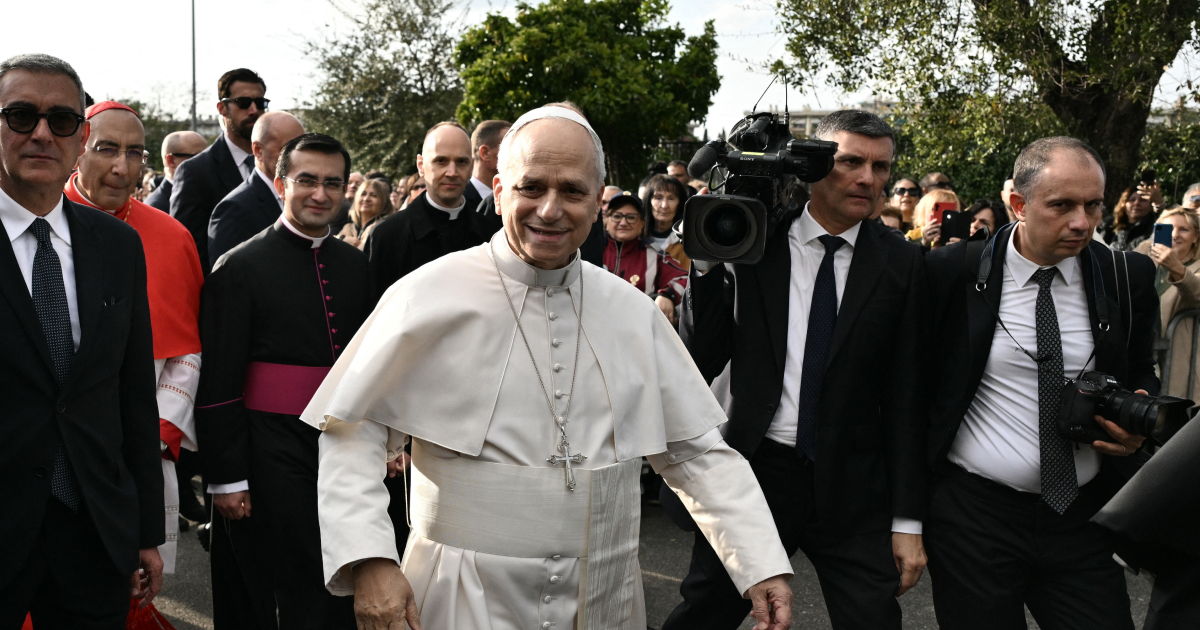


Pope Leo XIV has met privately with two prominent sociologists whose research has focused on communities devoted to the Tridentine Mass.
The Holy See Press Office confirmed that the Pope received Professors Stephen Bullivant and Stephen Cranney in a private audience on March 5, though no official details were released about the content of the meeting. Both academics have become well known in recent years for their sociological research into communities devoted to the Tridentine Mass.
Bullivant, a British scholar of religion who himself attends the Latin Mass, and Cranney, an American sociologist, have been working on a major study of Catholics who frequent the traditional liturgy in the United States. Their forthcoming book, Trads: Latin Mass Catholics in the United States, is scheduled for publication in November 2026 and is expected to be one of the most comprehensive sociological examinations of the movement to date.
In preparation for the book, the two researchers published a survey in 2024 examining the beliefs and attitudes of Catholics who attend the Traditional Latin Mass. Their findings attracted considerable attention because they appeared to contradict a widely held perception that traditionalist communities are defined primarily by rejection of the Second Vatican Council or disloyalty to the papacy.
The research sought to examine empirically the claim that the Traditional Latin Mass milieu functions as a centre of opposition to the Church’s post-conciliar teaching. That assumption had been highlighted by Pope Francis in his 2021 apostolic letter Traditionis Custodes, which imposed new restrictions on the celebration of the Tridentine Mass and argued that the liturgical reform of the Second Vatican Council should be recognised as the unique expression of the Roman Rite.
Bullivant and Cranney’s survey, however, suggested a more complicated picture. When respondents were asked whether they accepted the teachings of the Second Vatican Council, nearly half said they “agreed” or “strongly agreed” with the statement. Eleven per cent said they “disagreed” or “strongly disagreed”, while a sizeable minority said they neither agreed nor disagreed or expressed only partial agreement.
The study also examined doctrinal belief among Catholics who attend the traditional liturgy. According to the researchers, only two per cent of respondents said they believed the Eucharistic bread and wine should be understood as merely symbolic rather than the true Body and Blood of Christ.
The survey further revealed strong consensus among participants on questions relating to moral teaching. Eighty-five per cent of respondents said they believed abortion should be illegal in all circumstances, while 13 per cent said it should be illegal in most cases. Fewer than two per cent said abortion should be legal in most or all circumstances.
Political attitudes were also explored as part of the research. Among the 446 respondents who attended the Traditional Latin Mass at least once per year, 77 per cent said they leaned towards the Republican Party. The authors noted that this finding appeared to confirm a perception that traditionalist Catholics in the United States often hold politically conservative views, though they cautioned that political affiliation was not the central focus of the study.
Another part of the survey examined attitudes towards papal authority. Although the researchers did not include a specific question on sedevacantism, the belief that the papal office is vacant because recent popes are considered illegitimate, the results suggested that rejection of papal authority was rare among respondents. Ninety-five per cent said they agreed or strongly agreed with the statement: “I believe the Pope is the Vicar of Jesus Christ.”
The researchers also reported that while many respondents expressed feelings of frustration or hurt over restrictions imposed on the traditional liturgy, most nevertheless recognised the authority of the Pope and regarded denial of the papacy as spiritually dangerous.
The meeting between Pope Leo XIV and the two academics has drawn attention because the Pontiff has not yet announced any decision regarding the future of the restrictions introduced by Pope Francis. Since his election, the American-born Pope has largely maintained the existing disciplinary framework governing the older liturgy while consulting widely with figures across the Church.
It has been reported that he has held a number of audiences with individuals known for their support of the Traditional Latin Mass. Over the past year these have included Bishop Athanasius Schneider, Cardinal Raymond Burke and Cardinal Robert Sarah, all of whom have spoken publicly in favour of greater freedom for the celebration of the Tridentine rite.
The Pope’s meeting with Bullivant and Cranney is therefore likely to be interpreted as part of a wider effort to understand more clearly the character of the communities attached to the older rite.