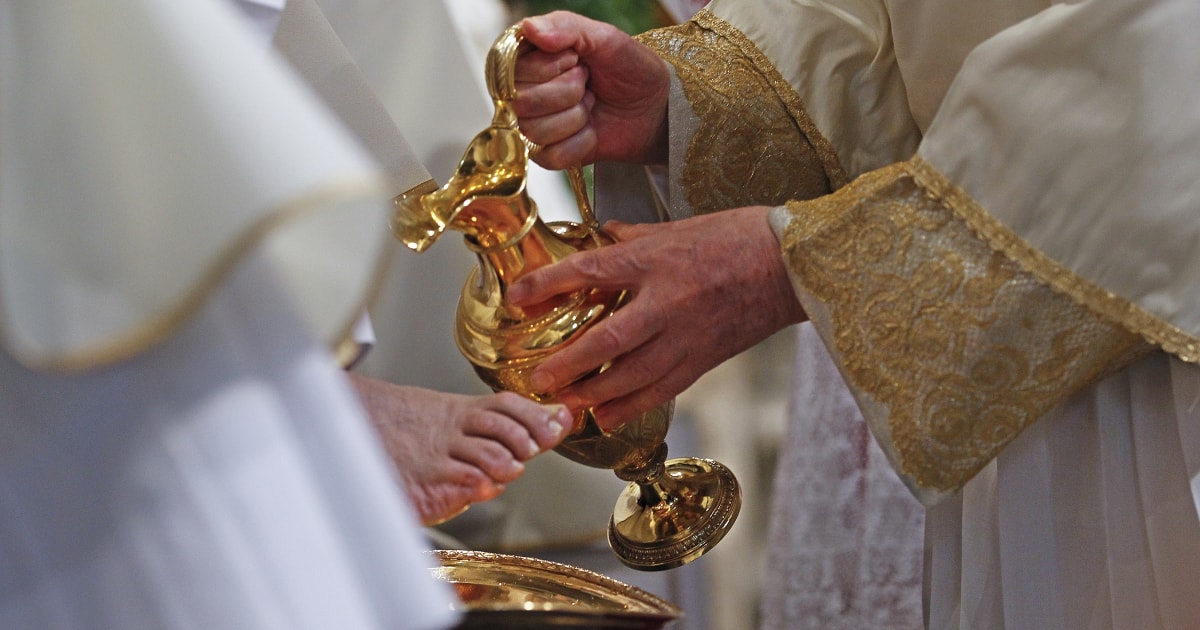

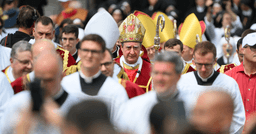
Pope Leo XIV will celebrate the Mass of the Lord’s Supper on Holy Thursday in the Basilica of St John Lateran, where he will wash the feet of 12 Roman priests in a return to a more customary papal practice at the start of the Sacred Triduum.
The Vicariate of Rome confirmed the arrangements in a statement issued on April 1, identifying the clergy who will take part in the Mandatum during the “In Coena Domini” liturgy, which is due to begin at 5.30pm. Eleven of the priests were ordained last year by the Pope himself, while the twelfth, Don Renzo Chiesa, serves as spiritual director of the Pontifical Roman Major Seminary.
The full list released by the Vicariate reads: “Don Andrea Alessi, Don Gabriele Di Menno Di Bucchianico, Don Renzo Chiesa, Don Francesco Melone, Don Clody Merfalen, Don Federico Pelosio, Don Marco Petrolo, Don Pietro Hieu Nguyen Huai, Don Matteo Renzi, Don Giuseppe Terranova, Don Simone Troilo, Don Enrico Maria Trusiani. These are the 12 priests to whom Pope Leo XIV will wash the feet tomorrow, Holy Thursday, during the Mass in Coena Domini.”
It added: “Eleven of them are the priests who were ordained last year by Pope Leo XIV; Don Renzo Chiesa, on the other hand, is the spiritual director of the Pontifical Major Roman Seminary. At the end of the liturgy, the Pope will carry the Most Blessed Sacrament to the place of reposition, near the Chapel of Saint Francis.”
The decision marks a contrast with the approach adopted by Pope Francis, who during his pontificate frequently celebrated the Holy Thursday liturgy outside the Lateran Basilica and extended participation in the rite to prisoners, migrants and women, including non-Catholics.
His first such Mass in 2013 took place at the Casal del Marmo juvenile detention centre, and in subsequent years he presided at various detention facilities, including Rebibbia Prison and the District House of Velletri. As recently as 2024, Pope Francis celebrated the liturgy in the women’s section of Rebibbia, washing the feet of 12 female inmates.
By contrast, Pope Leo’s decision to perform the rite with priests of his own diocese, and specifically with those he ordained, places emphasis on the traditional link between the bishop and his presbyterate. The Holy Thursday liturgy, which commemorates the Last Supper and Christ’s washing of the Apostles’ feet, has long been associated with the institution of the priesthood.
The use of the Lateran Basilica, the cathedral church of the Bishop of Rome, also restores a setting that had not been the regular venue for the Mandatum in recent years. In his capacity as diocesan bishop, the Pope traditionally presides over the Holy Thursday liturgy there, marking the beginning of the Paschal Triduum in his own cathedral.
The last occasion on which a pope washed the feet of priests at the Lateran was on April 5, 2012, when Pope Benedict XVI performed the rite with 12 priests of the Diocese of Rome. That celebration followed the longstanding custom of restricting the Mandatum to male clergy or laymen, reflecting the Gospel account of Christ washing the feet of the 12 Apostles.
In recent decades, however, the practice has developed in different directions, particularly under Pope Francis, whose emphasis on outreach to those on the margins led him to broaden participation in the rite and to take the liturgy beyond the confines of the Vatican and Rome’s principal basilicas.
The historical development of the Maundy Thursday foot-washing rite follows a decree issued at the request of Pope Francis. It traces its origins to the seventh century, when a bishop would wash the feet of clerics in his household, and notes that by the 12th century the Roman Pontifical had placed the rite after Vespers, with the feet of 12 subdeacons being washed in Rome from the 13th century. The Roman Missal of 1570 retained the washing of clerics’ feet without fixing the number, while the Ceremonial of Bishops of 1600 prescribed the washing and kissing of the feet of 13 poor men after they had been fed, a custom that later gave way again to the washing of clerics’ feet, albeit with local variations.
Under Pope Pius XII in 1955, the rite was placed within the evening Mass and permitted the washing of the feet of 12 men as “an imitative sign”, a formulation carried forward, though modified, in the Roman Missal of 1970, which removed the fixed number and retained the rubric referring to Viri.