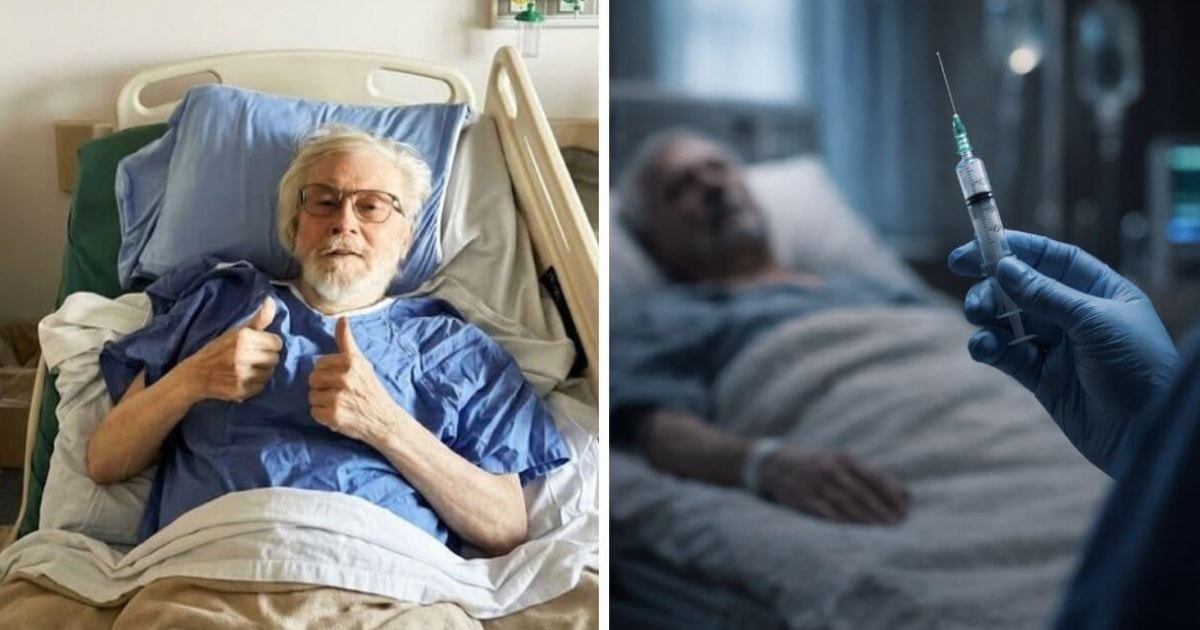


A Canadian priest has twice been offered an assisted death while recovering from a hip fracture, despite being known to be opposed to euthanasia.
According to reports, the 79-year-old priest, Father Larry Holland from Vancouver, British Columbia, Canada, said he was not dying then or now, but that medical professionals raised the prospect of ending his life by euthanasia on more than one occasion.
“I think I was very shocked. It is such a sensitive subject”, he said, describing his reaction when a doctor raised the topic of euthanasia and assisted suicide with him.
The medical professionals’ mention of this topic left him “kind of silent” for a moment. “There are some things you just don’t talk about to some people”, said Holland.
After the Catholic priest explained to the doctor that he was morally opposed to euthanasia, the doctor said “he just wanted to make sure that, if a [terminal] diagnosis came up or not … I knew of the different services I had access to”.
Despite making his views clear, just a few weeks later, the priest was offered euthanasia a second time. The offer came from a nurse whom Holland believed to be uncomfortable raising the topic with him.
A spokesman for Vancouver Coastal Health, which operates the hospital in which Holland was cared for, said “staff may consider bringing up MAID [medical assistance in dying] based on their clinical judgment, provided they possess the necessary knowledge and skills to do so”.
The archdiocese’s pro-life chaplain, Father Larry Lynn, said “This must surely be among the most appalling examples of Canada’s coercive and insensitive euthanasia regime”.
Lynn said it was disturbing when a medical professional raises euthanasia with any patient, but it is particularly bad when the patient is explicitly known to be morally opposed to the practice.
Amanda Achtman, founder of the anti-euthanasia project Dying to Meet You, and ethics director of Canadian Physicians for Life, said that medical professionals initiating euthanasia discussions in a medical setting is a form of coercion that attacks patients’ deepest convictions when they are vulnerable. She described it as a form of “torment” for someone who has deeply held beliefs and “an attack on their identity”.
In March 2026, guidance produced by the Canadian Association of MAID Assessors and Providers titled ‘Bringing Up Medical Assistance in Dying (MAiD) As a Clinical Care Option’, recommended that “great caution” be taken by euthanasia providers in deciding not to raise it with patients who meet the legal criteria. The document warns that medical professionals can make “incorrect assumptions about a patient’s beliefs or preferences – for example, assuming a patient might object because they belong to a faith community, even though some individuals of strong faith have chosen MAiD”.
Spokesperson for Right To Life UK, Catherine Robinson, said “Offering euthanasia to a vulnerable person like Holland, who was known to be opposed to the practice, is an appalling abuse of the relationship between patient and doctor. It is highly coercive, and Achtman is right to say this is an attack on his identity as a priest”.
“Fortunately, the assisted suicide Bill in England and Wales has failed, otherwise we could expect similar occurrences here”.