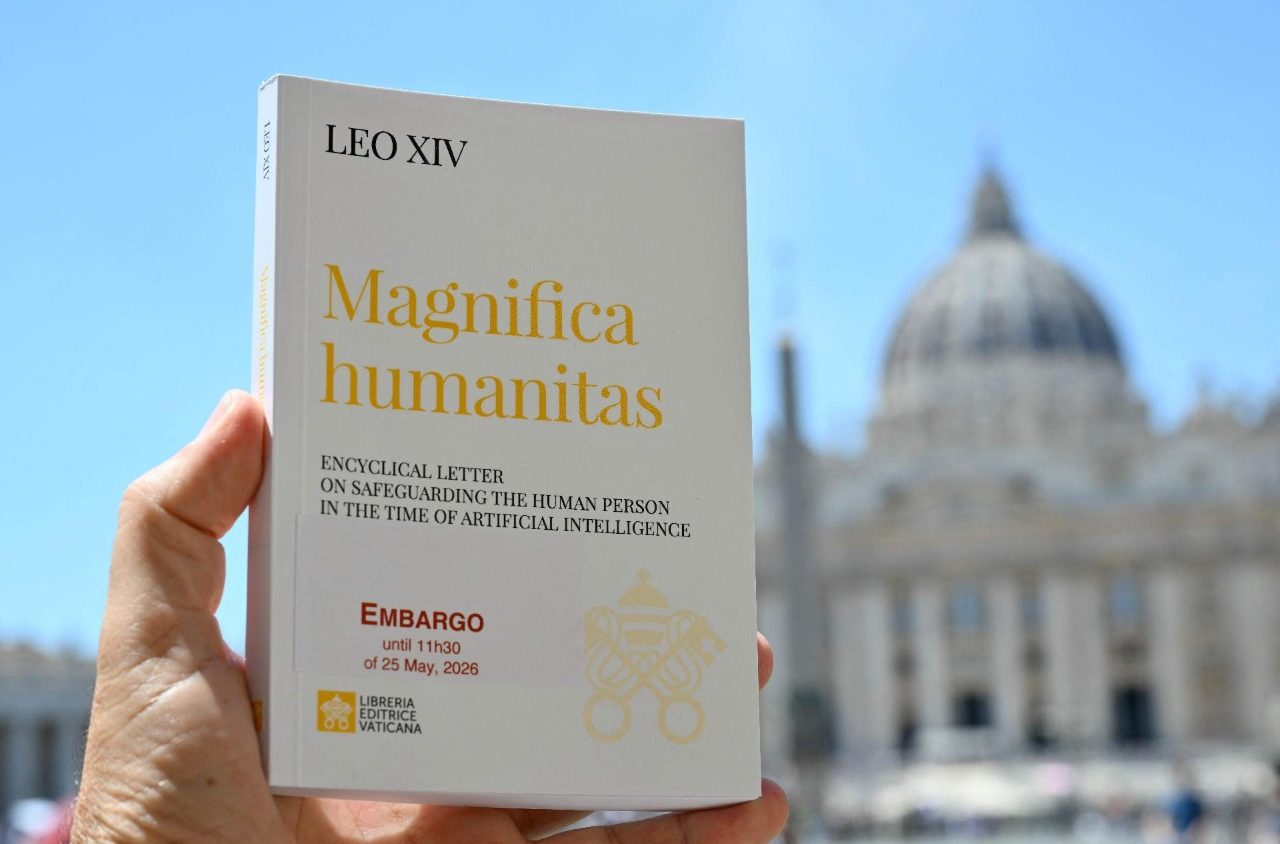
The reactions to Pope Leo XIV’s Magnifica Humanitas have been plentiful, ranging across a spectrum of interpretations of the document. Some encountered a cautious and specific moral reflection upon emerging technologies; others, a sweeping critique of technocracy and concentrated power. The New York Times faulted the encyclical for being “disappointingly mild”, implying that Leo XIV stopped short of offering genuinely radical institutional or economic prescriptions. The business magazine Forbes, by contrast, interpreted Magnifica Humanitas in almost apocalyptic terms, warning of “moral, social collapse” and foregrounding the Pope’s “Tower of Babel warning without human control”. Contrasts such as these reveal that the encyclical has a power to unsettle assumptions across ideological and intellectual boundaries simultaneously – that itself is usually a sign of something profoundly Catholic.
Press coverage has perhaps inevitably reflected the preoccupations of the institutions producing it. The Guardian framed the encyclical sympathetically as “a humanity first message” which “the secular world can get behind”. Its emphasis fell upon democratic accountability and human flourishing rather than specifically theological concerns. Le Monde, meanwhile, interpreted the document through a recognisably continental communitarian lens. Leo XIV, it argued, “does not simply proclaim that another world is possible – he calls on us to build that other world.” The Pope was presented not as a reactionary opponent of modernity, but as someone insisting that technological development remain subordinate to moral and political judgement.
Other reactions placed the document more explicitly within the tradition of Catholic social thought. The Conversation connected Magnifica Humanitas directly to the industrial anxieties that produced Rerum Novarum. TechCrunch, in a perceptive secular reading, argued that while “AI is the hook, the problems Leo focuses on are older and more pervasive.” In other words, the encyclical is really about labour, alienation, dependency, power and the moral consequences of organising society around efficiency instead of a humane understanding of mankind.
The strongest and most substantial reaction piece was probably the essay published in The New Digest by René Tapia of the University of Barcelona and Asanga Welikala of Edinburgh University. Unlike many of the quicker journalistic responses, it recognised that the encyclical’s central concern is not speculative fears about machine consciousness, but political economy and the structure of authority within technological civilisation itself. Its sharpest line is also its simplest: “AI changes the structure of power.”
That observation cuts through much of the confusion surrounding contemporary AI debate. The question posed by Leo XIV is not whether machines will become “intelligent” in some abstract sense, but who governs the systems increasingly mediating communication, labour, memory, administration, creativity – even war. Tapia and Welikala identify the encyclical as fundamentally concerned with dependency and sovereignty: whether human beings remain participants within social and political life or become passive objects managed by institutions and systems too opaque to understand, scrutinise or challenge.
Their essay is valuable precisely because it resists the tendency – common among techno-optimists and catastrophists alike – to treat AI as somehow detached from older questions of political power. Leo XIV is not writing science fiction: he is writing social doctrine. The replacement of human judgement by technological optimisation, the concentration of informational power within vast private institutions, the erosion of intermediary human relationships and the creation of technologically redundant populations are not merely technical developments. They are political and moral transformations. The New Digest understands that clearly, and in doing so probably comes closest to identifying the encyclical’s true centre of gravity.
Other commentators approached the encyclical from still different angles. The New York Times business section’s “DealBook” analysis focused heavily upon the emerging relationship between the Vatican and Silicon Valley, treating Leo XIV less as a purely religious figure than as a potentially significant actor within global debates about regulation and governance. Fortune similarly framed the encyclical as an attempt to inject concepts such as dignity, solidarity and restraint into a conversation otherwise dominated by the narrow focuses of venture capital, engineering culture and geopolitical competition.
In UnHerd, Sohrab Ahmari interpreted the encyclical as a defence of what he called “unfashionable universalism”. Leo XIV rejects both the flattening universalism of technocracy and the tribal fragmentation increasingly characteristic of democratic politics. Against both tendencies, he proposes a genuinely universal account of human dignity grounded neither in productivity, identity nor consumption, but in the intrinsic moral worth of every human being.
OSV News highlighted the insistence that “no technology can replace a child of God.” Archbishop Eamon Martin of Armagh stressed the need to defend the vulnerable from systems reducing persons to utility or data. The European Union’s foreign affairs department drew attention to the encyclical’s defence of “authentic culture and art”, which “can never be replaced or reproduced by artificial intelligence”.
The reaction on X/Twitter was more chaotic and more amusing. The American blogger and journalist Matt Yglesias reacted with visible irritation to what he described as Pope Leo’s “superstitious mind/body dualism”, to which Audrey Horne responded with deadpan obviousness: “This is like criticising the Pope for being Catholic.” Still, Yglesias continued that Pope Leo “is also raising a lot of good points about some of the risks at play”.
There was something comic in watching technologically minded commentators discover with renewed astonishment that the Bishop of Rome does not in fact subscribe to a fully materialist account of human consciousness. The entire encyclical rests upon precisely the proposition Yglesias found objectionable: that human beings are not interchangeable information-processing units whose value can be measured purely in terms of functional output or any other material concern.
Susannah Black Roberts probably came closest to capturing the encyclical’s moral instinct in a single memorable formulation. She noted on X/Twitter that just as Rerum Novarum had eventually been flattened into “unregulated capitalism and worker exploitation bad”, so Magnifica Humanitas would likely be remembered as “Silicon Valley technocracy and AI bad”.
Like Leo XIII before him, Leo XIV is writing about much more than just a particular economic or technological arrangement: he is writing about the sort of human beings modern systems encourage us to become. Human capacities – intellectual, moral, physical and spiritual – are strengthened by use and weakened by dependence. One of the inherent dangers of AI is a slow surrender of human faculties through disuse. A civilisation in which people no longer write, remember, decide or create for themselves will not just possess different tools; it will eventually produce different kinds of persons.
Susannah encouraged readers to hone the skills that AI seeks to make easy and therefore dulls: “You shouldn’t do things that will predictably make you less virtuous… Don’t use AI to write… Do your own stunts, in life. And train for them.”
“Do the things that will train you to do your own stunts,” Black Roberts continued. “Do them a lot. Every day. Make your kids do them.”
Another perceptive observation on X/Twitter came from Justin Murphy, who remarked that “there is simply no other religion/church where original longform writing by the institutional leader is taken so seriously – by Christians and atheists alike, the smart and the dim, in theory and in practice.” The papacy remains one of the very few institutions still capable of intervening in civilisational questions at a genuinely universal level.
Traditionally, modern encyclicals were addressed “to the bishops, priests, and deacons, men and women religious, the lay faithful, and all people of good will”. Pope Francis dropped this in his second encyclical Laudato si’, believed to be the first written principally by him, as the previous Lumen fidei was largely drafted under Benedict XVI. Pope Leo has not yet chosen to restore this formula, but the universal category of “all people of good will” seems to have been inferred regardless. That a lengthy social encyclical on artificial intelligence could provoke argument simultaneously among bishops, diplomats, venture capitalists, newspaper editorialists, Catholic intellectuals, secular technocrats and ironic Twitter personalities is itself a revealing fact about the present condition of the West.
The comic dimension of the online reaction was never entirely absent. Doug Balloon, on his X/Twitter account “New York Times Pitchbot”, produced a parody headline perfectly calibrated to America’s coastal liberal media mindset: “I converted to Catholicism last week. Here’s why the Pope’s woke encyclical is a disgrace.” Successful satire works because it requires no exaggeration.
Taken together, these reactions are revealing not simply because they illuminate the encyclical, but because they illuminate the anxieties of the societies reading it. Consciously or otherwise, each take extracted from Magnifica Humanitas the aspect of the technological revolution it already feared most: loss of control, collapse of community, concentration of power, erosion of labour, synthetic culture, weakened democracy, spiritual emptiness and managerial domination.
In a time of widespread uncertainty across countries and social sectors, this is probably why the encyclical has resonated so widely beyond explicitly religious audiences. Leo XIV has understood something many political and technological elites still struggle to grasp: artificial intelligence is not merely another innovation to be regulated or commercialised. It is a development that touches directly upon the distinctively human faculties – reason, language, creativity, judgement and relationship – around which civilisation itself has been organised.
The argument is theological in the broadest possible sense: not a dispute about technology, but about what man is for; not just about innovation, but about authority, dignity, freedom and the common good. That is why reactions to Magnifica Humanitas have been so varied, so contradictory and so revealing of the receivers’ mindsets. The encyclical compelled its readers to disclose what they believe the AI revolution is actually about.