

I’m much looking forward to seeing the already greatly acclaimed film The Odyssey, directed by Christopher Nolan. The critics are raving about it. In Britain, the Telegraph declared it the “film of the year”, and Metro claims the film will “change cinema forever”. For The Times, it is “a masterpiece in every way”, and the Irish Times considers it “a spectacular feat of cinematic storytelling”. And by all accounts it is a very faithful rendering of Homer’s poem, despite initial fears that it was going to be a woke reworking of the original epic.
That said, Emily Wilson – the academic whose translation of the original was apparently used by Nolan – has slated the film for its infidelity to the original. Elon Musk has even mooted the possibility of a new film version of the Homeric poem that would be rigorously faithful to the original story – Homeric Greek and all.
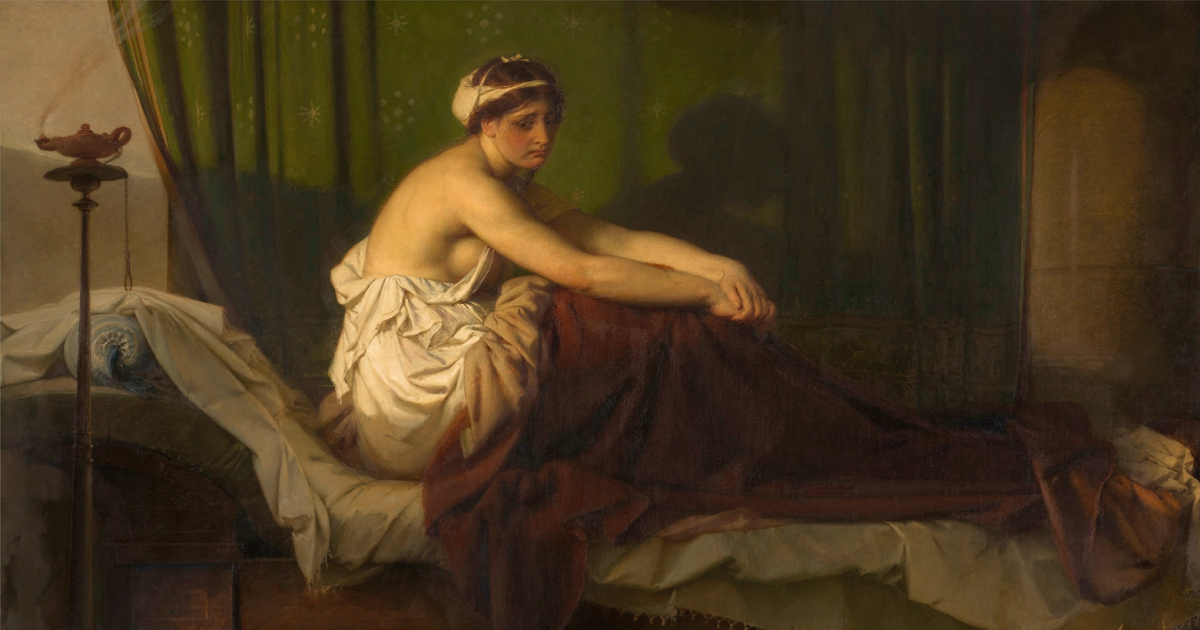
It doesn’t seem very likely that this Greek remake is about to happen any time soon, but if it does, there is one very important detail of the original story that didn’t make Nolan’s cut, and Elon – if you are reading this – I’d suggest you include it: the bridal bed around which the newlywed Odysseus and Penelope built their house.
In Homer’s epic, when Ulysses returns to his homeland island of Ithaca, he is completely unrecognisable, more because of a disguise produced by the goddess Athena than because of his 10-year absence. It is this bed alone that allows Penelope finally to recognise as her husband the stranger who has just slain her 108 infuriating suitors.
By way of a clever test, Penelope – fully aware that the bed and its immovability are “their sign” – instructs their maid, in his presence, to move that bed outside the bedchamber for their guest to sleep on. Ulysses flares up angrily on hearing this suggestion and reveals something only he and his wife know:
“An old trunk of olive grew like a pillar on the building plot, and I laid out our bedroom round that tree, lined up the stone walls, built the walls and roof, gave it a doorway and smooth-fitting doors. Then I lopped off the silvery leaves and branches, hewed and shaped that stump from the roots up into a bedpost, drilled it, let it serve as model for the rest. I planed them all, inlaid them all with silver, gold and ivory, and stretched a bed between – a pliant web of oxhide thongs dyed crimson. There’s our sign!”
How important this detail is! That bed literally has roots deep in the soil. It is immovable. As Ulysses says in his anger: “No mortal in his best days could budge it with a crowbar.” It is the fixed centre of a tale of dizzying motion on the seas, with preternatural storms and whirlpools, shipwrecks on distant shores and even a descent into the underworld.
This bed is really the beating heart of the story. It lies at the centre of their shared home, which lies at the heart of the island of Ithaca – the home towards which all of Ulysses’s wanderings are directed. For a story whose theme is nostos – homecoming – this bed is everything.
Few reviewers make much of the omission of the “bed test”, but one – in the Guardian – does so on feminist grounds, lamenting the omission of the bed test because it “demonstrates how Penelope matches her husband for guile”. It is true that this test is proof that Penelope is a match for her famously wily husband – it was he, for example, who came up with the Trojan Horse ruse.
But to reduce the test to a feminist masterstroke is to miss its point entirely. The bed test shows so clearly that the epic is really about homecoming, not just to a kingdom, or even a house, but to a bedroom and a bed – the bed where the couple consummated their love and conceived their son Telemachus before Ulysses was compelled to leave for Troy and war.
Ulysses has persevered through 10 years of incredible suffering, on a journey that has taken him to hell – or at least Hades – and back, and has even led him to reject a beautiful goddess’s offer of immortality, if only he would set up home with her on her little love island. In this bed, literally rooted in the soil of their homeland island of Ithaca, is encapsulated the inspiration for this incredible odyssey: a wife, a child, a home.