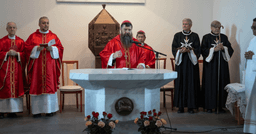
In a quiet corner of the Flemish countryside, just outside Bruges, sits a Benedictine abbey dedicated to St Andrew. Like places in this part of Europe, it bears the marks of centuries of upheaval. Earlier foundations were destroyed by reformation and revolution before monastic life returned in the 19th century. Yet even this history is perhaps not as fascinating as the story of one of the men buried in its cemetery: the former Chinese prime minister Lou Tseng-tsiang (Lu Zhengxiang).
At first glance there seems little reason why a Chinese statesman should lie buried among Flemish monks. The road that led Lou to this Belgian woodland passed through the final decades of the Qing Empire, the birth of the Chinese Republic, the peace negotiations at Versailles and some of the most dramatic political and religious transformations of the modern age.
Lou was born in Shanghai in 1871. China at the time was confronting a world that seemed to be changing faster than it could keep pace. European powers had forced open Chinese ports through a series of military and diplomatic humiliations. Missionaries and merchants were becoming increasingly visible, and reform-minded officials were searching for explanations for the country’s relative weakness. How had a civilisation that had long regarded itself as the centre of the world fallen behind a disunited gaggle of comparatively small states on the western fringe of Eurasia?
Lou’s own family belonged to this world of East-West encounter. His father worked as a translator for the Qing government and ensured that his son received an education that included foreign languages and exposure to Western ideas. The young Lou was raised a Protestant Christian, a fact that reflected the growing presence of foreign missions in Shanghai and well beyond.
His talents soon carried him into the diplomatic service. One of the most important influences upon him was Xu Jingcheng, a senior Qing official and diplomat who served as China’s ambassador in several European capitals – and converted to Catholicism in the meantime. Xu belonged to a generation of Chinese statesmen who had observed the West at close quarters. They understood the importance of military power and industrial development, but they were also interested in deeper questions. According to Xu, “Europe’s strength is found not in her armaments, nor in her knowledge: it is found in her religion.” Xu advised Lou to observe the Christian faith and “when you have grasped its heart and its strength, take them and give them to China”.
During his years abroad, Lou met and married Berthe Bovy, the daughter of a Belgian family (and not to be confused with the actress of the same name). Their marriage was to prove one of the most important relationships of his life. Berthe was a faithful Catholic and, over time, her faith drew Lou towards the Church. His conversion was gradual rather than dramatic. In 1911, the year that saw the collapse of the Qing dynasty and the end of more than two millennia of imperial rule, Lou was received into full communion with the Catholic Church.
In a tumultuous time for China and the world, Lou’s public career continued to advance. He served as foreign minister and, for a brief period, even prime minister of the young Chinese Republic. Amid the factionalism and instability that characterised much of Chinese politics during these years, Lou maintained a reputation for integrity and competence. It was in 1919, however, that he secured his place in the national memory.
The First World War had ended and representatives of the victorious powers gathered in Paris to determine the shape of the post-war settlement. China joined them in the hope that the principles of national self-determination proclaimed by the Allies would be applied to Chinese interests as well. Humiliatingly, instead of returning Germany’s concessions in Shandong to China, the conference powers decided to transfer them to Japan.
The decision provoked outrage in China and Lou, at the head of the Chinese delegation, refused to sign the Treaty of Versailles. China had little leverage and few powerful friends, but by withholding his signature, Lou demonstrated that there remained some principles that could not be bartered away for diplomatic convenience. It earned him admiration at home and abroad. It also marked, in some respects, the high point of his public career.
A different chapter of his life began with tragedy. Berthe died in 1926 after more than three decades of marriage. Her death affected Lou profoundly. Widowed and increasingly drawn towards religious life, he gradually withdrew from public affairs. In 1927 he entered the Benedictine Abbey of St Andrew near Bruges as a postulant. The questions that had occupied him throughout his life – questions about civilisation, morality, faith and the foundations of society – had not disappeared. They had merely taken a different form.
Taking the name Dom Pierre-Célestin, he embraced the life of the cloister and was ordained a priest in 1935. During these years he also wrote and lectured, reflecting on the relationship between Chinese culture and Christianity. He rejected the notion that the two were inherently opposed. Like many Chinese Catholic intellectuals before him, he believed that Christianity was not the possession of any one civilisation but a universal faith capable of taking root in many cultures.
The culmination of his religious life came in 1946 when Pope Pius XII appointed him titular abbot of St Peter’s Abbey in Ghent. It was a remarkable honour for a man who had begun life as the son of a Protestant family in Shanghai. Yet the recognition came at a melancholy moment. China was once again descending into civil war. The possibility of returning to his homeland grew increasingly remote.
Lou died in Belgium in 1949, the same year Mao Zedong proclaimed the People’s Republic of China. He never saw the country whose interests he had defended at Versailles enter its new era. His life remains difficult to categorise: diplomat, patriot, convert, husband, monk, priest. He did not regard Christianity as foreign to China, nor China as somehow inaccessible to Christianity. He saw no contradiction between loyalty to his country and the flourishing of his faith. Alongside the Congregationalist Sun Yat-sen and the Methodist Chiang Kai-shek, he is perhaps the third most important Christian in the history of modern China – and the only one of these three who was raised a Christian from birth.
At a time when China’s totalitarian rulers are once more attempting to suppress Christianity as a foreign interloper, Lou’s life shows that the faith has long since ceased to be merely foreign. A Chinese patriot, diplomat and statesman found in it not a rejection of his civilisation but its fulfilment.