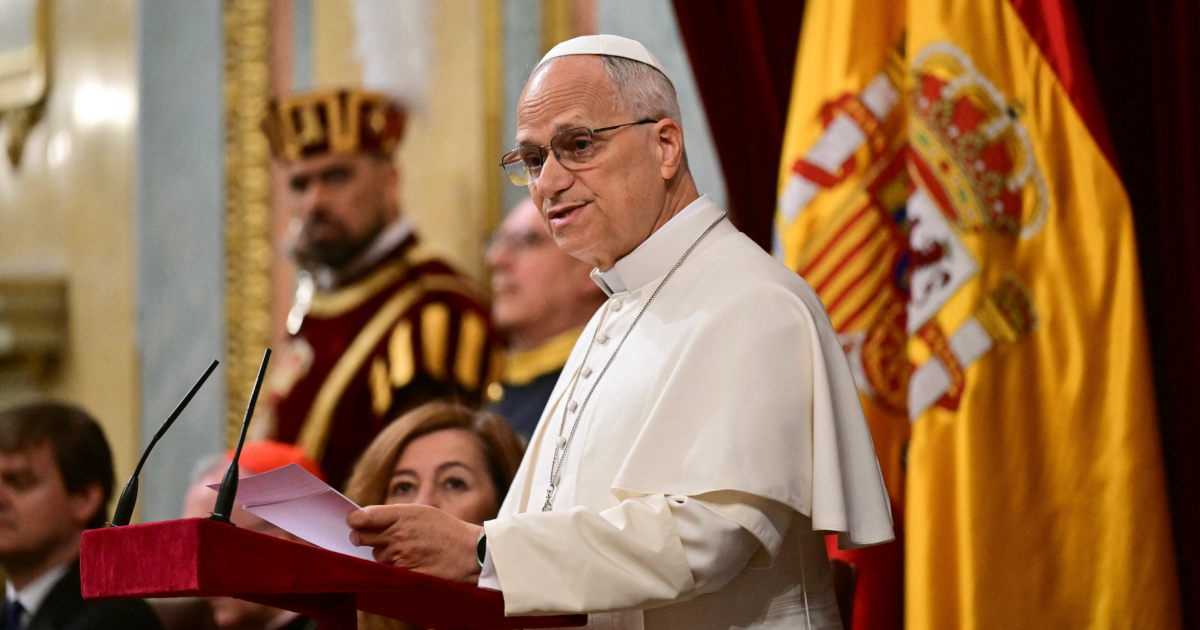


In the first address by a Pope to Spain’s Cortes Generales, the Spanish parliament, delivered on June 8, Pope Leo XIV offered a robust defence of the inviolability of human life from the moment of conception, the absolute seal of the confessional, and an integral vision of Spain’s identity deeply rooted in its Catholic history and culture. The speech ended with a prolonged seven-minute standing ovation and chants of “¡Viva el Papa!” from lawmakers across much of the chamber, yet has prompted selective praise, discomfort and criticism from sections of the political Left.
In a speech rich in references to Spain’s Catholic heritage, the Holy Father praised the nation’s “particularly rich heritage” in which “faith and reason, art and law, tradition and thought have come together in a fruitful manner”. He evoked the University of Salamanca and the School of Salamanca’s moral legacy, the pages of Don Quixote, the writings of Unamuno and the spiritual witness of St Teresa of Ávila. He concluded by invoking “the apostolic footprint of St James and by the maternal presence of Our Lady of the Pillar”.
The Pope’s defence of the inviolability of human life was unambiguous. He told parliamentarians: “Every human life must be recognised and safeguarded from conception to its natural end, in every circumstance of its existence. When this certainty is obscured, the most vulnerable are the first victims, and the law loses its deepest meaning: to serve and protect every person.” He added that “the moral greatness of a nation is manifested, above all, in its capacity to accompany, protect and love those lives that are most fragile”.
He also explicitly defended the sacramental seal of confession as an essential element of religious freedom: “To protect it legally, as is done in a similar way in some professions, means preserving a sacred space of inner freedom, where the believer can open his or her soul to God without fear of external pressures.”
On migration, the Pope offered a carefully balanced intervention that recognised both the duty of welcome and the right to remain in one’s homeland. He described the situation as a “tragic drama” and warned that “many people remain prey to traffickers and smugglers who take advantage of their desperation”. He called for strengthened prevention, rescue and assistance, but insisted on a “twofold demand for social justice”: “to offer safe and legal pathways, a respectful welcome and real opportunities for integration; and, at the same time, to promote the right to remain in one’s own land, working to ensure that no one has to leave their home due to a lack of peace, security or decent living conditions.” He added that borders “can become spaces for the responsible protection of human dignity”.
The Socialist-led government responded with selective praise. Minister Félix Bolaños described the speech as “valiente” – brave – and aligned with the government’s positions on peace and multilateralism. PSOE parliamentary spokesman Patxi López acknowledged that the party did not share “100 per cent” of the Pope’s words, particularly on abortion and euthanasia, but praised the “moral and political component” and emphasis on coexistence. “We are a secular organisation,” he noted, underlining the distance on life issues.
Further left, discomfort was more pronounced. Ione Belarra, secretary general of Podemos, who boycotted the session along with the BNG’s Néstor Rego, said that the Pope’s address to parliament “should never have taken place”. She compared it to an ayatollah speaking in the chamber and said the event had turned “the temple of democracy into a church”. Belarra argued that the visit was an “opportunity lost” to address historical Church matters such as abuse cases and “stolen babies”.
Sumar representatives welcomed passages on migration, polarisation and the common good but expressed reservations on life issues and the lack of specific references to Gaza. ERC’s Gabriel Rufián noted the irony of PP and Vox applauding the Pope while voting against measures he appeared to support on migration and the common good, yet acknowledged that the speech was “correct” on several points. EH Bildu’s Mertxe Aizpurua focused positively on the migration sections.
The pattern was consistent: broad approval for social and migratory themes, tempered by silence or disagreement on the Pope’s clear defence of life from conception and the seal of confession. Traditional Catholics have noted with concern that parts of the Left appear eager to claim the Pope when his words align with progressive priorities on migrants or peace, but quick to criticise, boycott or remain silent when he upholds unchanging moral teachings.
The address, delivered in the presence of King Felipe VI, senior judges and a near-full chamber, has been widely described in Spanish media as historic.
The Pope’s integration of Spain’s Catholic patrimony – from its cathedrals and universities to its literature and legal tradition – offered an integral vision of the nation that many faithful welcomed as a corrective to secular attempts to erase or marginalise the Church’s historical role.
As the Pope’s apostolic visit to Spain continues, the parliamentary speech is likely to remain a reference point for ongoing debates about the place of Christian moral reasoning in contemporary European democracy.